• HOME
  • NEWS
  • EXPLORE
    • CAREER
      • Companies
      • Jobs
    • EVENTS
    • iGEM
      • News
      • Team
    • PHOTOS
    • VIDEO
    • WIKI
  • BLOG
  • COMMUNITY
    • FACEBOOK
    • INSTAGRAM
    • TWITTER
Thursday, May 21, 2026
BIOENGINEER.ORG
No Result
View All Result
  • Login
  • HOME
  • NEWS
  • EXPLORE
    • CAREER
      • Companies
      • Jobs
        • Lecturer
        • PhD Studentship
        • Postdoc
        • Research Assistant
    • EVENTS
    • iGEM
      • News
      • Team
    • PHOTOS
    • VIDEO
    • WIKI
  • BLOG
  • COMMUNITY
    • FACEBOOK
    • INSTAGRAM
    • TWITTER
  • HOME
  • NEWS
  • EXPLORE
    • CAREER
      • Companies
      • Jobs
        • Lecturer
        • PhD Studentship
        • Postdoc
        • Research Assistant
    • EVENTS
    • iGEM
      • News
      • Team
    • PHOTOS
    • VIDEO
    • WIKI
  • BLOG
  • COMMUNITY
    • FACEBOOK
    • INSTAGRAM
    • TWITTER
No Result
View All Result
Bioengineer.org
No Result
View All Result
Home NEWS Science News Biology

‘Thermometer’ protein regulates blooming

Bioengineer by Bioengineer
March 23, 2020
in Biology
Reading Time: 2 mins read
0
IMAGE
Share on FacebookShare on TwitterShare on LinkedinShare on RedditShare on Telegram

IMAGE

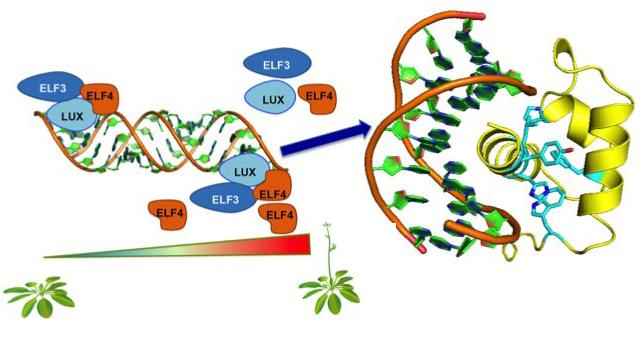
Credit: © Silva et al. / PNAS


As average temperatures rise every year, it is no longer rare to see plants flower as early as February. Behind this phenomenon is a complex of proteins whose activity is controlled by temperature changes, as has just been demonstrated by researchers from the Cell and Plant Physiology Laboratory (CNRS / CEA / INRAE / Université Grenoble Alpes) and their partners.* Composed of three proteins (LUX, ELF3, and ELF4), the Evening Complex regulates the expression of genes involved in plant growth and flowering, as a function of exterior temperatures. The research team has shown, in vitro, that while all three proteins are needed for the complex to function correctly, ELF3 is the only one whose activity directly depends on temperature. When the temperature increases, ELF3 prevents the complex from binding to DNA and repressing plant growth genes. Consequently, growth proceeds. A study of the structure of LUX nonetheless demonstrated that certain mutations could alter plant sensitivity to temperature. These findings are published in PNAS (12 March 2020).

###

*- Scientists from the following institutions participated in this study: the European Synchrotron Radiation Facility (Grenoble); Sungkyunkwan University (South Korea); the Centro Nacional de Biotecnología, Consejo Superior de Investigaciones Científicas (Spain); the National Institute of Science Education and Research (India); and the Institut für Gemüse- und Zierpflanzenbau (Germany).

Media Contact
Francois Maginiot
[email protected]

Original Source

http://www.cnrs.fr/en/thermometer-protein-regulates-blooming

Related Journal Article

http://dx.doi.org/10.1073/pnas.1920972117

Tags: BiologyCell BiologyGeneticsMolecular BiologyPlant Sciences
Share12Tweet8Share2ShareShareShare2

Related Posts

How Atlantic Herring Rewired Their Reproductive Strategy to Thrive in Changing Oceans — Biology

How Atlantic Herring Rewired Their Reproductive Strategy to Thrive in Changing Oceans

May 20, 2026
Study Finds Young Fraser River Chinook Salmon Swimming in Chemical Mixture — Biology

Study Finds Young Fraser River Chinook Salmon Swimming in Chemical Mixture

May 20, 2026

Thousands of UK Beekeepers Contribute Honey to Advance Environmental Science

May 20, 2026

New Fossil Finds in Northwest Canada Transform Understanding of Early Animal Evolution

May 20, 2026
Please login to join discussion

POPULAR NEWS

  • blank

    New Study Reveals Plants Can Detect the Sound of Rain

    733 shares
    Share 292 Tweet 183
  • ESMO 2025: mRNA COVID Vaccines Enhance Efficacy of Cancer Immunotherapy

    301 shares
    Share 120 Tweet 75
  • Research Indicates Potential Connection Between Prenatal Medication Exposure and Elevated Autism Risk

    846 shares
    Share 338 Tweet 212
  • Breastmilk Balances E. coli and Beneficial Bacteria in Infant Gut Microbiomes

    58 shares
    Share 23 Tweet 15

About

We bring you the latest biotechnology news from best research centers and universities around the world. Check our website.

Follow us

Recent News

Primate Frontal Cortex Encodes Action Symbols

Mitochondrial l-2-Hydroxyglutarate Signals Cellular Metabolism

Tent5a-Mediated Insulin mRNA Polyadenylation Controls Beta Cells

Subscribe to Blog via Email

Enter your email address to subscribe to this blog and receive notifications of new posts by email.

Join 82 other subscribers
  • Contact Us

Bioengineer.org © Copyright 2023 All Rights Reserved.

Welcome Back!

Login to your account below

Forgotten Password?

Retrieve your password

Please enter your username or email address to reset your password.

Log In
No Result
View All Result
  • Homepages
    • Home Page 1
    • Home Page 2
  • News
  • National
  • Business
  • Health
  • Lifestyle
  • Science

Bioengineer.org © Copyright 2023 All Rights Reserved.