Nuclear power plants were engineered to do one thing exceptionally well: generate electricity at a steady rate, around the clock. That design philosophy made sense for decades, but it is increasingly at odds with a grid that now shares space with solar and wind resources whose output rises and falls with the weather and the time of day. Researchers at the University of Central Florida’s Center for Advanced Turbomachinery and Energy Research (CATER) argue that thermal energy storage, or TES, could be the key to reconciling the two.
In a study published in the Journal of Energy Resources Technology, Part A: Sustainable and Renewable Energy, the CATER team paired thermodynamic modeling with an economic analysis of how nuclear plants could operate in a shifting energy market. The paper, titled “Molten Salt Reactor Dispatch Optimization via Thermal Energy Storage: Coupled Thermodynamic Modeling and Rolling-Horizon Economic Analysis,” examines how a molten salt reactor equipped with TES could be dispatched more flexibly than conventional nuclear plants allow. The research team included doctoral research assistants Augusto Delavald Marques and Abhilash Prasad, postdoctoral scholar Shinjan Ghosh, associate professor Erik Fernandez, alumnus Marcel Otto, and CATER director Jayanta Kapat.
The core problem the researchers set out to address is a mismatch between reactor design and grid demand. “Nuclear power needs to be flexible while nuclear reactors operate at a steady pace because grid demand varies throughout the day,” Marques says. “This is a challenge for power plants because they must adjust quickly to meet grid demand.”
Traditional nuclear plants are not built to cycle rapidly on and off. When demand drops, operators face an unattractive choice: deliberately ramp down output, which can place mechanical stress on equipment, or keep producing electricity that the grid does not currently need. Both options carry costs, and both become more frequent as weather-dependent renewables claim a larger share of generation.
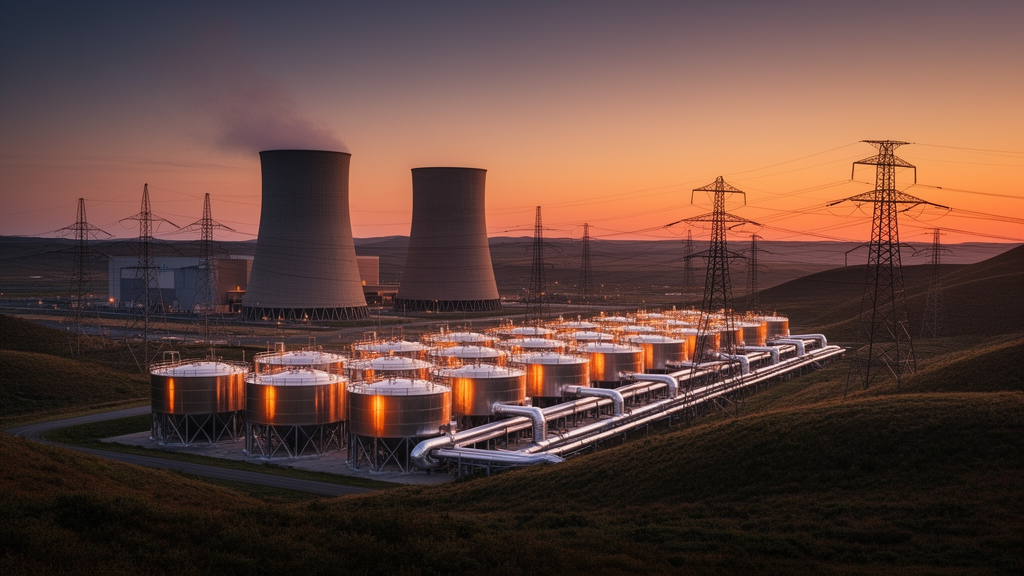
TES offers a third path. Instead of forcing the reactor itself to follow demand, a storage system can absorb excess heat produced by the reactor and regulate how much of that heat is delivered to the power conversion side of the plant. When electricity demand is low, heat accumulates in storage; when demand climbs, the stored thermal energy can be drawn down to run the plant’s generation equipment.
The reactor keeps operating at the steady pace it was designed for, while the plant’s electrical output flexes to match the grid. The flexibility has a financial dimension as well. Electricity prices fluctuate through the day as supply and demand shift, and the researchers’ rolling-horizon economic analysis was designed to capture how dispatch decisions play out under those changing conditions.
“By storing the energy when demand and prices are low and using it when demand and prices increase, it can increase the value of the electricity produced,” Ghosh says. In effect, TES lets a nuclear plant sell its output when it is worth the most rather than when the reactor happens to produce it. The study’s focus on molten salt reactors reflects where the researchers see the opportunity.
“As renewable power generation grows, the need for flexibility in nuclear plants has become more important,” Marques says. “The deployment of next-generation nuclear reactors in the US over the next few years, such as molten salt reactors, is an opportunity to incorporate TES and improve the integration of nuclear and renewable energy on the same grid.”
It is worth emphasizing what the study does and does not show. The findings come from coupled thermodynamic modeling and economic analysis, not from an operating plant, so the results represent model-based projections of how a TES-equipped molten salt reactor could be dispatched and how such dispatch might affect revenue. Real-world performance would depend on factors the models necessarily simplify.
For a country investing in both advanced reactors and large volumes of solar and wind, the CATER team’s analysis suggests that the heat leaving a reactor does not have to become electricity at the exact moment it is produced. Stored as thermal energy and released on schedule, it could give nuclear power the dispatch flexibility that modern grids increasingly demand, without asking reactors to do something they were never designed to do.
Subject of Research: Thermal energy storage integration for flexible dispatch of molten salt nuclear reactors
Article Title: CATER researchers explore use of thermal energy storage for nuclear power plants
Article References: CATER researchers explore use of thermal energy storage for nuclear power plants. Original publication (Bibliographic details unavailable.)
Image Credits: AI Generated
DOI: Not provided
Keywords: thermal energy storage, nuclear power, molten salt reactor, grid flexibility, renewable energy integration, dispatch optimization, thermodynamic modeling, economic analysis, University of Central Florida, CATER, researchers, explore
News Source: Faith Mcneil. (October 26, 2026). Thermal Energy Storage Could Let Nuclear Plants Flex With the Grid. Scienmag.