• HOME
  • NEWS
  • EXPLORE
    • CAREER
      • Companies
      • Jobs
    • EVENTS
    • iGEM
      • News
      • Team
    • PHOTOS
    • VIDEO
    • WIKI
  • BLOG
  • COMMUNITY
    • FACEBOOK
    • INSTAGRAM
    • TWITTER
Wednesday, February 25, 2026
BIOENGINEER.ORG
No Result
View All Result
  • Login
  • HOME
  • NEWS
  • EXPLORE
    • CAREER
      • Companies
      • Jobs
        • Lecturer
        • PhD Studentship
        • Postdoc
        • Research Assistant
    • EVENTS
    • iGEM
      • News
      • Team
    • PHOTOS
    • VIDEO
    • WIKI
  • BLOG
  • COMMUNITY
    • FACEBOOK
    • INSTAGRAM
    • TWITTER
  • HOME
  • NEWS
  • EXPLORE
    • CAREER
      • Companies
      • Jobs
        • Lecturer
        • PhD Studentship
        • Postdoc
        • Research Assistant
    • EVENTS
    • iGEM
      • News
      • Team
    • PHOTOS
    • VIDEO
    • WIKI
  • BLOG
  • COMMUNITY
    • FACEBOOK
    • INSTAGRAM
    • TWITTER
No Result
View All Result
Bioengineer.org
No Result
View All Result
Home NEWS Science News Chemistry

The world’s first integrated quantum communication network

Bioengineer by Bioengineer
January 6, 2021
in Chemistry
Reading Time: 2 mins read
0
IMAGE
Share on FacebookShare on TwitterShare on LinkedinShare on RedditShare on Telegram

IMAGE

Credit: university of science and technology of China

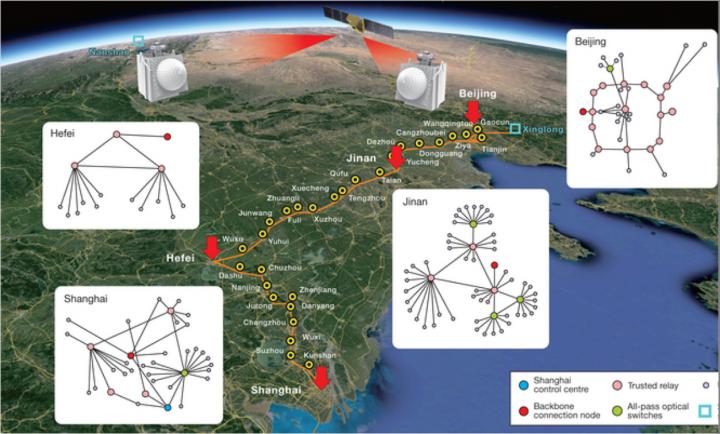
Chinese scientists have established the world’s first integrated quantum communication network, combining over 700 optical fibers on the ground with two ground-to-satellite links to achieve quantum key distribution over a total distance of 4,600 kilometers for users across the country. The team, led by Jianwei Pan, Yuao Chen, Chengzhi Peng from the University of Science and Technology of China in Hefei, reported in Nature their latest advances towards the global, practical application of such a network for future communications.

Unlike conventional encryption, quantum communication is considered unhackable and therefore the future of secure information transfer for banks, power grids and other sectors. The core of quantum communication is quantum key distribution (QKD), which uses the quantum states of particles–e.g. photons–to form a string of zeros and ones, while any eavesdropping between the sender and the receiver will change this string or key and be noticed immediately. So far, the most common QKD technology uses optical fibers for transmissions over several hundred kilometers, with high stability but considerable channel loss. Another major QKD technology uses the free space between satellites and ground stations for thousand-kilometer-level transmissions. In 2016, China launched the world’s first quantum communication satellite (QUESS, or Mozi/Micius) and achieved QKD with two ground stations which are 2,600 km apart. In 2017, an over 2,000-km-long optical fiber network was completed for QKD between Beijing and Shanghai.

Using trusted relays, the ground-based fiber network and the satellite-to-ground links were integrated to serve more than 150 industrial users across China, including state and local banks, municipal power grids, and e-government websites. “Our work shows that quantum communication technology is sufficiently mature for large-scale practical applications,” said Jianwei Pan, Professor of USTC. Similarly, a global quantum communication network can be established if national quantum networks from different countries are combined, and if universities, institutions and companies come together to standardize related protocols, hardware, etc., he added.

In the last couple of years, the team extensively tested and improved the performance of different parts of the integrated network. For instance, with an increased clock rate and more efficient QKD protocol, the satellite-to-ground QKD now has an average key generation rate of 47.8 kilobits per second, which is 40 times higher than the previous rate. The researchers have also pushed the record for ground-based QKD to beyond 500 km using a new technology called twin-field QKD (TF-QKD).

Next up, the team will further expand the network in China and with their international partners from Austria, Italy, Russia and Canada. They also aim to develop small-scale, cost-efficient QKD satellites and ground-based receivers, as well as medium and high earth orbit satellites to achieve all-time, ten-thousand-km-level QKD.

###

Their work was supported by the National Development and Reform Commission of China, the provincial/municipal government of Shandong, Anhui, and Shanghai, China Banking Regulatory Commission, the Chinese Academy of Sciences, the Ministry of Science and Technology of China, and the National Science Foundation of China.

Media Contact
[email protected]
[email protected]

Related Journal Article

http://dx.doi.org/10.1038/s41586-020-03093-8

Tags: Chemistry/Physics/Materials SciencesExperiments in SpaceIndustrial Engineering/ChemistryResearch/DevelopmentSatellite Missions/ShuttlesTechnology TransferTelecommunications
Share12Tweet8Share2ShareShareShare2

Related Posts

Innovative Technique Developed to Eliminate Toxic PFAS Chemicals from Water

Innovative Technique Developed to Eliminate Toxic PFAS Chemicals from Water

February 25, 2026
Using Machine Learning to Develop Affordable Biochar Solutions for Combating Phosphorus Pollution in Lakes

Using Machine Learning to Develop Affordable Biochar Solutions for Combating Phosphorus Pollution in Lakes

February 25, 2026

When Light “Thinks” Like the Brain: Unveiling the Link Between Photons and Artificial Memory

February 25, 2026

Illuminate discoveries, craft a crystal: breakthrough in scientific innovation

February 24, 2026
Please login to join discussion

POPULAR NEWS

  • Imagine a Social Media Feed That Challenges Your Views Instead of Reinforcing Them

    Imagine a Social Media Feed That Challenges Your Views Instead of Reinforcing Them

    962 shares
    Share 383 Tweet 240
  • New Record Great White Shark Discovery in Spain Prompts 160-Year Scientific Review

    60 shares
    Share 24 Tweet 15
  • Epigenetic Changes Play a Crucial Role in Accelerating the Spread of Pancreatic Cancer

    58 shares
    Share 23 Tweet 15
  • Water: The Ultimate Weakness of Bed Bugs

    53 shares
    Share 21 Tweet 13

About

We bring you the latest biotechnology news from best research centers and universities around the world. Check our website.

Follow us

Recent News

New Blood Test Predicts Lifespan, Study Reveals

Can Specific Circulating Small Non-Coding RNAs Influence Longevity?

Predicting Energy Use in Directed Deposition via Transfer Learning

Subscribe to Blog via Email

Enter your email address to subscribe to this blog and receive notifications of new posts by email.

Join 75 other subscribers
  • Contact Us

Bioengineer.org © Copyright 2023 All Rights Reserved.

Welcome Back!

Login to your account below

Forgotten Password?

Retrieve your password

Please enter your username or email address to reset your password.

Log In
No Result
View All Result
  • Homepages
    • Home Page 1
    • Home Page 2
  • News
  • National
  • Business
  • Health
  • Lifestyle
  • Science

Bioengineer.org © Copyright 2023 All Rights Reserved.