• HOME
  • NEWS
  • EXPLORE
    • CAREER
      • Companies
      • Jobs
    • EVENTS
    • iGEM
      • News
      • Team
    • PHOTOS
    • VIDEO
    • WIKI
  • BLOG
  • COMMUNITY
    • FACEBOOK
    • INSTAGRAM
    • TWITTER
Thursday, June 25, 2026
BIOENGINEER.ORG
No Result
View All Result
  • Login
  • HOME
  • NEWS
  • EXPLORE
    • CAREER
      • Companies
      • Jobs
        • Lecturer
        • PhD Studentship
        • Postdoc
        • Research Assistant
    • EVENTS
    • iGEM
      • News
      • Team
    • PHOTOS
    • VIDEO
    • WIKI
  • BLOG
  • COMMUNITY
    • FACEBOOK
    • INSTAGRAM
    • TWITTER
  • HOME
  • NEWS
  • EXPLORE
    • CAREER
      • Companies
      • Jobs
        • Lecturer
        • PhD Studentship
        • Postdoc
        • Research Assistant
    • EVENTS
    • iGEM
      • News
      • Team
    • PHOTOS
    • VIDEO
    • WIKI
  • BLOG
  • COMMUNITY
    • FACEBOOK
    • INSTAGRAM
    • TWITTER
No Result
View All Result
Bioengineer.org
No Result
View All Result
Home NEWS Science News Biology

The two faces of the Jekyll gene

Bioengineer by Bioengineer
June 26, 2019
in Biology
Reading Time: 2 mins read
0
IMAGE
Share on FacebookShare on TwitterShare on LinkedinShare on RedditShare on Telegram

Dual allelic state of Jekyll discovered
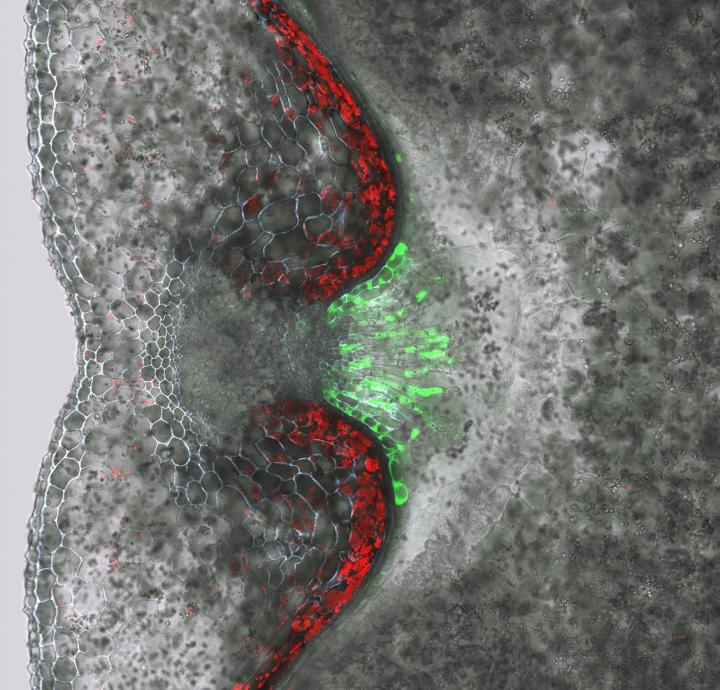
IMAGE

Credit: Stefan Ortleb & Twan Rutten

The corresponding genes are lineage-specific for the grass tribes Triticeae and Bromeae and functioned as drivers for the speciation process within the Poaceae.

The Jekyll gene was first described in 2006 by researchers from the IPK in Gatersleben. They found that while it was crucial for sexual reproduction and fertility in barley (Hordeum vulgare), it was also partially similar to the Cn4 toxin produced by scorpions and played a role in cell autolysis. Inspired by this seemingly two-faced nature of the gene, the researchers had named it after Dr. Jekyll, the main character with the split personalities Dr. Jekyll and Mr. Hyde and from the eponymous gothic novella. A follow-up study by the same group of IPK researchers, led by Dr. Ljudmilla Borisjuk, has now shown how stunningly apt their choice of name was.

Whilst working on Jekyll, Dr. V. Radchuk discovered that the gene exists as two different and much diverged allelic variants, Jek1 and Jek3. The Jek1/Jek3 sequences are located at the same chromosomal locus and are inherited in a monogenic Mendelian fashion, whilst Jek1 and Jek3 share identical signal peptides, conserved cysteine positions and direct repeats. Although the encoded protein sequences might just have over 50% similarity, the researchers found that Jek3 actually complements the function of Jek1 in Jek1-deficient plants. Further investigations showed that Jekyll likely emerged in the common ancestor of the tribes of the Triticeae, such as barley, and Bromeae, therefore functioning as a lineage specific gene and probable driver for the separation of the lineages within the Poaceae.

The dual allelic nature of Jekyll made the cover of The Plant Journal and was featured in the belonging Research Highlight. In the meanwhile, the authors have started looking into the newly arisen questions of the cause and benefits of this allelic diversity in barley.

###

Media Contact
PD Dr Ljudmilla Borisjuk
[email protected]

Original Source

https://www.ipk-gatersleben.de/fileadmin/content-ipk/content-ipk-institut/Presseinformationen/2019/190626_PM_2019_18_Jekyll_Neu.pdf

Related Journal Article

http://dx.doi.org/10.1111/tpj.14363

Tags: BiologyGenesGenetics
Share12Tweet8Share2ShareShareShare2

Related Posts

Natural Hallucinogens: Evolution’s Ecological Tools, Not Mere Chemical Byproducts

June 25, 2026

This Famous Butterfly Revealed: Three Distinct Species Hidden in One

June 25, 2026

Scientists Attack Soybean Cyst Nematode by Starving Its Food Source

June 25, 2026

Decoding the Secret Code of a Crucial Immune Sensor

June 24, 2026
Please login to join discussion

POPULAR NEWS

  • Saying Goodbye to PGY-6: Pediatric Fellowship Realities

    103 shares
    Share 41 Tweet 26
  • Multi-Hospital Study Reveals Long Covid Burden Is Twice as High as Current Estimates

    92 shares
    Share 36 Tweet 23
  • Detection of EDCs in Breast Milk and Infant Urine Up to Six Months Highlights Early Exposure Risks

    77 shares
    Share 31 Tweet 19
  • New Drug Candidate Developed at McMaster Shows Potential for Treating Brain Cancer

    58 shares
    Share 23 Tweet 15

About

We bring you the latest biotechnology news from best research centers and universities around the world. Check our website.

Follow us

Recent News

Tracking Lanthanide-Labeled Microplastics in Plants

POSTECH Researchers Slash Cost of Reconstituted Cell-Free Systems by 95%

AI and Physics Collaborate to Design Advanced Hydrogen Storage Materials

Subscribe to Blog via Email

Enter your email address to subscribe to this blog and receive notifications of new posts by email.

Join 82 other subscribers
  • Contact Us

Bioengineer.org © Copyright 2023 All Rights Reserved.

Welcome Back!

Login to your account below

Forgotten Password?

Retrieve your password

Please enter your username or email address to reset your password.

Log In
No Result
View All Result
  • Homepages
    • Home Page 1
    • Home Page 2
  • News
  • National
  • Business
  • Health
  • Lifestyle
  • Science

Bioengineer.org © Copyright 2023 All Rights Reserved.