Scientists have worked out how one unusual species of trilobite — an ancient, sea-dwelling relative of spiders and lobsters — was able to defend itself against predators and survive a bumpy ride as Earth’s oxygen levels fluctuated.
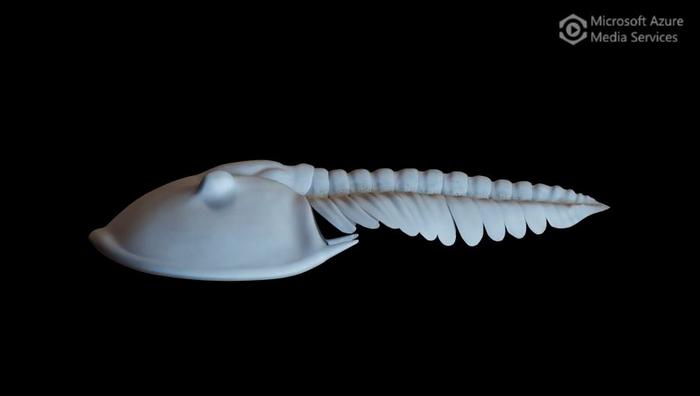
Credit: Nigel Hughes/UCR
Scientists have worked out how one unusual species of trilobite — an ancient, sea-dwelling relative of spiders and lobsters — was able to defend itself against predators and survive a bumpy ride as Earth’s oxygen levels fluctuated.
The seas were filled with trilobites for nearly 300 million years starting in the Cambrian Period, some 520 million years ago. During their time on Earth, which lasted much longer than the dinosaurs, they survived two major episodes of mass extinctions and dominated ocean floor ecosystems.
Their armored bodies are divided into three sections: a head, a thorax or middle section, and a rigid tail. There are more than 20,000 known trilobite species and, when mature, most of them have a very specific number of segments in their mid-sections. However, in Aulacopleura koninckii, scientists discovered something unusual.
Though each early growth stage showed little variation in size and shape, mature Aulacopleura developed anywhere between 18 and 22 mid-section segments.
“My collaborators and I thought this species was weird. We couldn’t understand why Aulacopleura bodies varied and others living at the same time had a constant number,” said Nigel Hughes, UC Riverside paleobiologist and corresponding author of a new study about this trilobite.
“Seeing trilobites with variable numbers of segments in the thorax is like seeing humans born with different numbers of vertebrae in their backs,” Hughes said.
The researchers had questions about this anomaly, how it affected the animals’ ability to protect itself, and why it might have developed in this way. These questions are answered in a new study published in the Proceedings of the Royal Society B: Biological Sciences.
Like modern pillbugs or “rollie pollies,” trilobites curled up into a ball shape to protect themselves from large squid-like creatures, fish, and other predators. When rolled up, they could tuck their tails neatly under their heads, so the soft tissues were protected by their hard exterior skeletons. In the case of Aulacopleura, 3D modelling showed that protection during rolling up was restricted to smaller, immature forms with less than 18 segments in the middle.
“As the number of segments increased, the body proportions did not allow them to tuck their posteriors neatly under their heads and still be completely shielded,” Hughes said. “So, why did this species keep adding segments anyway, and how could it survive the nasty predators?”
Based on their virtual reconstructions, it seems highly likely that when Aulacopleura with a large number of mid-segments felt threatened, they would roll up like their relatives and simply let their tails extend past their heads, minimizing the exposed gap.
“Other possible defense maneuvers would have left gaps on the sides that exposed critical organs — highly unlikely,” Hughes said.
As to the question of why this trilobite varied in the number of mid-section segments, the researchers turned to their earlier work. “What is underneath these segments? Legs that serve as gills!” Hughes said. “The more segments, the more surface area for respiration.”
Growing additional breathing apparati likely gave these animals the ability to tolerate dips in local seafloor oxygen levels that excluded other species, such as those that preyed on larger Aulacopleura. Parts of the sea floor becoming anoxic forced predators to retreat to sites where oxygen remained sufficient. But larger Aulacopleura, with their extra gills, could stay put, predator-free.
Learning how this species adapted to both biological and physical pressures gives researchers a better understanding of how survival strategies evolve. The way trilobites developed holds clues to how the common ancestor to major groups of modern arthropods, including insects and arachnids, first evolved.
“One of the reasons to study these animals is to study how development itself has evolved,” Hughes said. “It’s not so much that the meek will inherit the Earth, but the flexible.”
Journal
Proceedings of the Royal Society B Biological Sciences
DOI
10.1098/rspb.2023.0871
Method of Research
Computational simulation/modeling
Article Title
Developmental and functional controls on enrolment in an ancient, extinct arthropod
Article Publication Date
14-Jun-2023