Credit: University of Sussex
Checking the heartbeat of babies in the womb is set to become more accurate and less stressful for expectant mothers thanks to research by the University of Sussex.
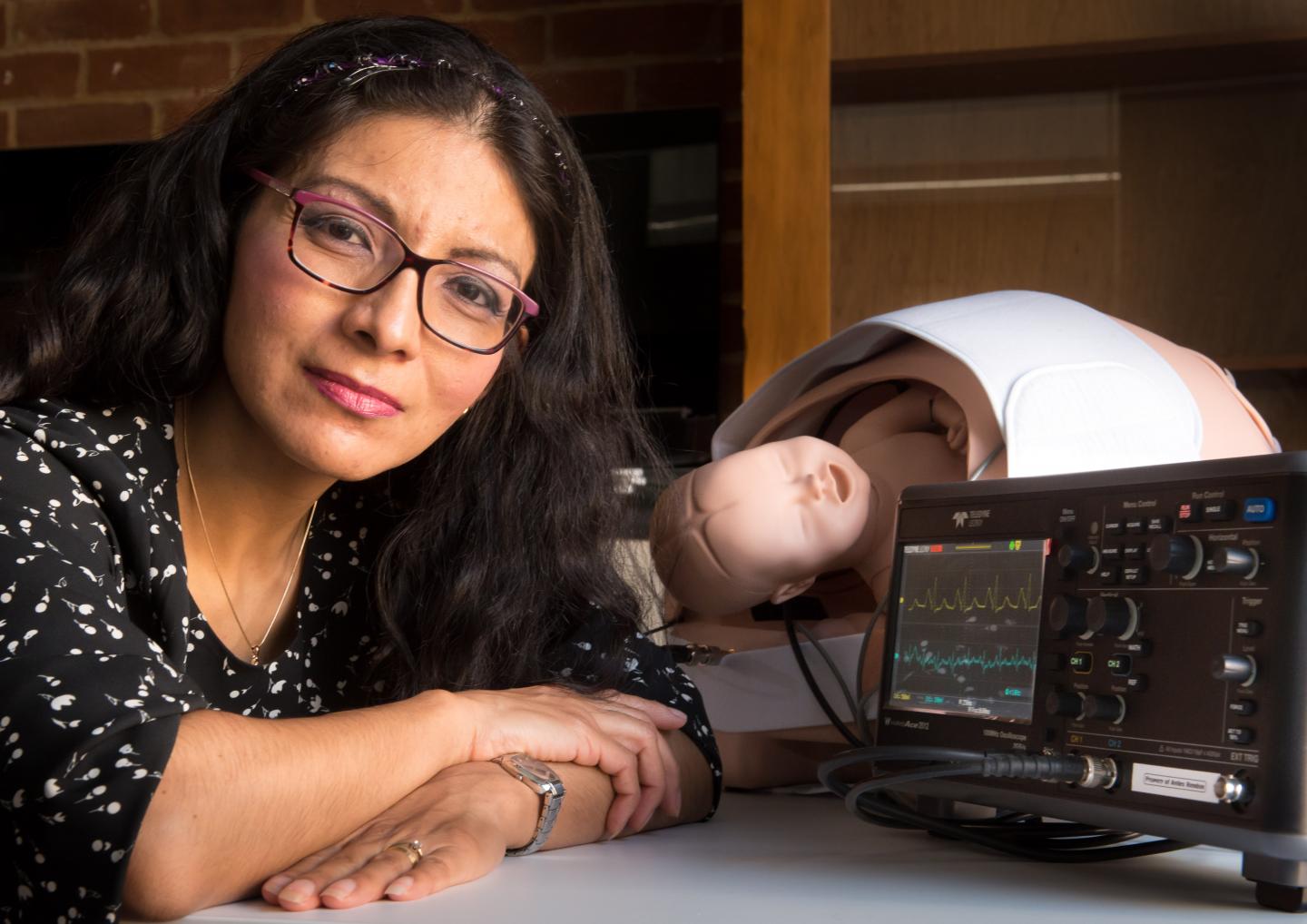
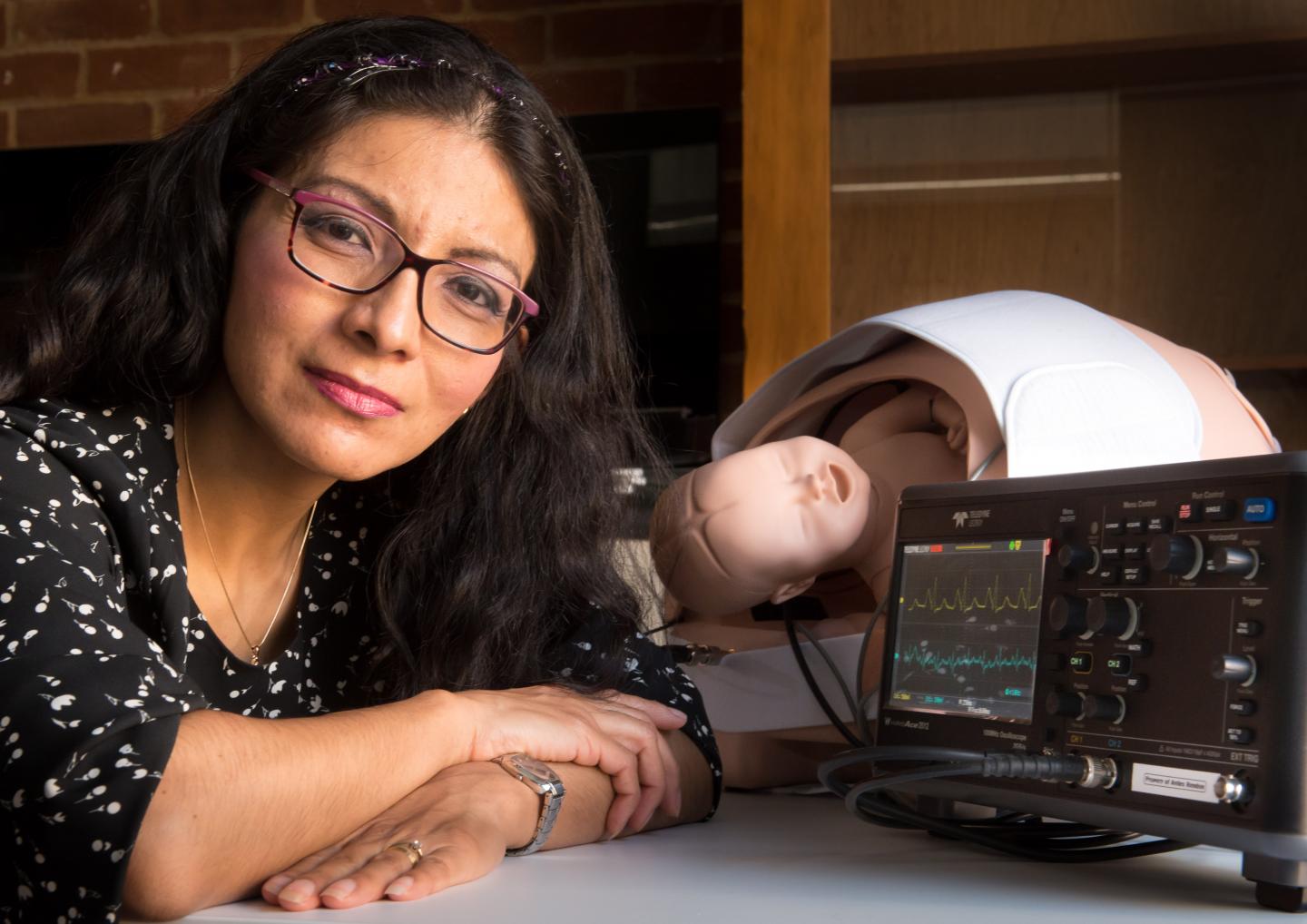
Dr Elizabeth Rendon-Morales has a developed a much more effective sensor to measure a baby's heartbeat without needing to visit a hospital.
It could help detect heart-related congenital disorders during pregnancy or highlight the need for medical interventions due to complications such as premature delivery or umbilical cord compression.
The new technology would also greatly benefit women experiencing high-risk pregnancy factors, such as high blood pressure, diabetes, preeclampsia and gestational high blood pressure, who require regular monitoring to ensure the wellbeing of their baby.
Dr Rendon-Morales, a Lecturer in Electrical and Electronic Engineering at the University of Sussex, said: "Currently expectant mothers with health concerns about their babies have to go through the stress of going to hospital to check on the heartbeat of their child. With this new technology, they will be able to do this from the comfort of their own home, which will be much better for the welfare of mother and baby."
The research is the first significant update in the technology used to measure babies' heart rates for 40 years and moves away from the existing use of silver chloride electrodes.
Instead, the University of Sussex has developed an electrometer-based amplifier prototype using Electric Potential Sensing (EPS) technology, which allows for in utero foetal electrocardiogram monitoring by just placing the device on top of the skin of the pregnant mother's abdomen in a non-invasive way.
Although there are some home-based foetal electrocardiograms available commercially, they are considered not suitable for daily or medical usage because of concerns around their accuracy and portability.
Dr Rodrigo Aviles-Espinosa, a research fellow at the University of Sussex and co-author of the study said: "This technology is a step forward for home-based medical devices, benefiting not only health service providers though resource optimization, but also expectant mothers who are experiencing a very exciting, but sometimes stressful, moment in their lives.
"This technology will give peace of mind in providing answers very quickly and ultimately ensuring the baby's wellbeing."
The technology developed at the University of Sussex is capable of recording information required to calculate foetal heart rate values and variability with high accuracy.
This can be used to clinically assess congenital cardiac diseases such as arrhythmia and to monitor processes associated with body auto regulation such as blood pressure and heart vascular tone.
The electrocardiogram can isolate the baby's heartbeat from the mother's with pinpoint accuracy, providing a simple reading without the need for any additional processing.
Devices currently in use require complex signal-conditioning algorithms to separate the maternal and foetal cardiac waveforms.
The new detector also removes the need for a special gel to be applied to the skin. This is necessary when using silver chloride electrodes, in order to establish a reading, but the process can produce inaccurate readings.
Dr Rendon-Morales said: "Although the ultrasound procedure is described as being non-invasive, having gel rubbed on your skin and then an electrode pressed against your womb is invasive and can be an uncomfortable experience for mothers. With this new heart monitor, expectant mothers can get reassurance that their baby is doing fine within a few seconds, removing the unnecessary stress and worry that waiting for a hospital scan currently involves."
The new baby monitor has grown out of previous work Dr Rendon-Morales had published in 2015 in which she used highly sensitive sensors to map the electrical activity of the developing heart in the embryos of zebrafish, which are 2,500 times smaller than human hearts.
The potential of the technology to be adapted for human mothers and babies was recognised by Dr Heike Rabe, a consultant neonatologist at Brighton and Sussex Medical School.
Dr Rabe said: "At the moment it is sometimes difficult to distinguish between the heartbeat of the mother and that of the baby with the current ultrasound technique. Often there is signal loss as well. With the new technique we hope to recognize much earlier if a baby should be delivered quickly if their heart rate drops and does not recover."
###
Media Contact
Neil Vowles
[email protected]
01-273-873-712
@sussexunipress
http://www.sussex.ac.uk
Related Journal Article
http://dx.doi.org/10.1063/1.5042358