Credit: Monash University
Evolution by Darwinian natural selection is immensely powerful – both in nature and within laboratories. Using 'laboratory evolution', we can take an enzyme which combines random mutations and functional selection, and improve its function by more than 1000 times. You can see evidence of science taking advantage of evolution across the field, from synthesised medications used to prevent the reoccurrence of heart attacks (beta blockers) to the development of tumor-targeting antibody therapeutics.
However, nothing evolves unless it already exists. When life started more than three billion years ago, what was the spark that created something from randomness?
Researchers from the Monash Biomedicine Discovery Institute (BDI), have identified what they have termed 'Structural Capacitance Elements' in mutated proteins that are associated with many different types of human diseases, in particular a range of cancers.
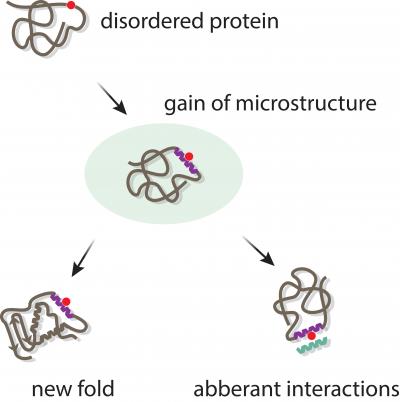
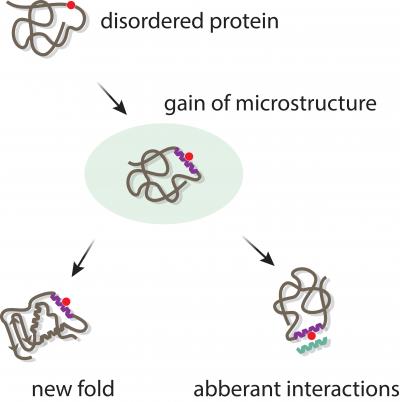
Structural Capacitance Elements are localised regions of disorder within proteins, which retain the potential to coalesce into 'micro-structures' following the introduction of a mutation. They act as nucleating seeds, or 'feedstock' for evolution to proceed, providing the basis of an accelerated mechanism of Darwinian evolution by natural selection, supplementing the slow and incremental process of classic Darwinian evolution.
This discovery has recently been published in the Journal of Molecular Biology. Lead researcher on this paper, Associate Professor Ashley Buckle, explained the significance of this discovery.
"Up until now, the prevailing belief amongst structural biologists has been that mutations that are implicated in disease act by disrupting protein structures – typically referred to as the 'loss-of-structure-function' paradigm. However it has recently been uncovered that more than 40 per cent of proteins have no well-defined structure at all," Associate Professor Buckle said.
"This prompted us to ask a very different question, and to turn the prevailing belief on its head," he said.
The research team analysed many of these disease-associated mutations and found that these 'Structural Capacitance Elements' may allow mutations to trigger a 'gain-of-function' by inducing structure where none existed before.
"We realised that our work may have diverse implications. Not only does it shed light on the evolution of protein structures, it may provide insights into the engineering of highly evolvable proteins, and the identification and selective targeting of human disease epitopes," he said.
"Understanding if and how a mutation may change the protein shape will be pivotal in targeting that protein for use in therapeutics that recognise the mutated region."
###
Read the full paper in the Journal of Molecular Biology titled Structural Capacitance in Protein Evolution and Human Diseases.
Dr Chen Li (now an NHMRC CJ Martin Fellow working at the ETH in Zurich) performed the work as part of his PhD in the Buckle lab, in collaboration with Dr Adrian Woolfson (Nouscom AG, Basel).
About the Monash Biomedicine Discovery Institute
Committed to making the discoveries that will relieve the future burden of disease, the newly established Monash Biomedicine Discovery Institute (BDI) at Monash University brings together more than 120 internationally-renowned research teams. Our researchers are supported by world-class technology and infrastructure, and partner with industry, clinicians and researchers internationally to enhance lives through discovery.
Media enquiries
Grace Williams
Senior Communications Advisor
Monash Biomedicine Discovery Institute
+61399059597
[email protected]
Media Contact
Grace Williams
[email protected]
61-399-059-597
@MonashUni
http://www.monash.edu.au
Related Journal Article
http://dx.doi.org/10.1016/j.jmb.2018.06.051