• HOME
  • NEWS
  • EXPLORE
    • CAREER
      • Companies
      • Jobs
    • EVENTS
    • iGEM
      • News
      • Team
    • PHOTOS
    • VIDEO
    • WIKI
  • BLOG
  • COMMUNITY
    • FACEBOOK
    • INSTAGRAM
    • TWITTER
Monday, May 18, 2026
BIOENGINEER.ORG
No Result
View All Result
  • Login
  • HOME
  • NEWS
  • EXPLORE
    • CAREER
      • Companies
      • Jobs
        • Lecturer
        • PhD Studentship
        • Postdoc
        • Research Assistant
    • EVENTS
    • iGEM
      • News
      • Team
    • PHOTOS
    • VIDEO
    • WIKI
  • BLOG
  • COMMUNITY
    • FACEBOOK
    • INSTAGRAM
    • TWITTER
  • HOME
  • NEWS
  • EXPLORE
    • CAREER
      • Companies
      • Jobs
        • Lecturer
        • PhD Studentship
        • Postdoc
        • Research Assistant
    • EVENTS
    • iGEM
      • News
      • Team
    • PHOTOS
    • VIDEO
    • WIKI
  • BLOG
  • COMMUNITY
    • FACEBOOK
    • INSTAGRAM
    • TWITTER
No Result
View All Result
Bioengineer.org
No Result
View All Result
Home NEWS Science News Biology

The search for the origin of mast cells

Bioengineer by Bioengineer
June 4, 2018
in Biology
Reading Time: 1 min read
0
Share on FacebookShare on TwitterShare on LinkedinShare on RedditShare on Telegram
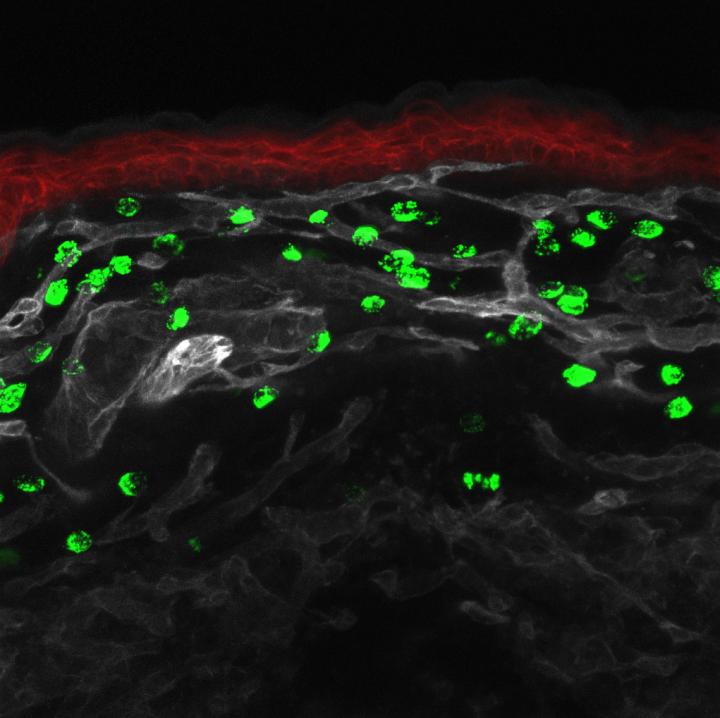
IMAGE

Credit: Rebecca Gentek

Mast cells are immune system cells that play a role in inflammatory processes in the body. They provide an initial line of defence against certain pathogens and play a vital role in allergic reactions. Until now, research on these cells has shown that they are produced in bone marrow, as are most cells found in blood.

In this study, scientists from CNRS, INSERM and AMU identified other mast cells generated in the embryonic stage of life. Called "primitive mast cells", these cells are produced in the yolk sac, an extra-embryonic organ known to supply nutrients to the embryo and generate certain blood cells. In mice, these primitive mast cells are generated after the 8th day of embryonic development. They then migrate to what will be the dermis and remain there until birth, gradually disappearing as the embryo begins to produce the other "definitive" mast cells.

Given that an embryo is already protected by the physical and immune barriers of its mother, researchers concur that primitive mast cells do not serve an immune-related purpose. The next step for researchers is to understand why the body produces two successive waves of mast cells with what appears to be same genetic origin but different functions. The study is also an opportunity for the scientific community to approach the subject from a different angle.

###

Media Contact

Juliette Dunglas
[email protected]
33-014-496-4634

http://www.cnrs.fr

Original Source

http://www2.cnrs.fr/en/3126.htm http://dx.doi.org/10.1016/j.immuni.2018.04.025

Share13Tweet8Share2ShareShareShare2

Related Posts

In-Depth Analysis Reveals Advances in Multiple Sclerosis Research Models — Biology

In-Depth Analysis Reveals Advances in Multiple Sclerosis Research Models

May 18, 2026
Uncovering C. elegans Immunity via Genetic Screens — Biology

Uncovering C. elegans Immunity via Genetic Screens

May 16, 2026

Single mother must adapt swiftly — the survival of her colony depends on it

May 15, 2026

Why Are Nearly Everyone Right-Handed? It Might Be Linked to How We Learned to Walk

May 15, 2026
Please login to join discussion

POPULAR NEWS

  • Research Indicates Potential Connection Between Prenatal Medication Exposure and Elevated Autism Risk

    844 shares
    Share 338 Tweet 211
  • New Study Reveals Plants Can Detect the Sound of Rain

    731 shares
    Share 292 Tweet 182
  • Salmonella Haem Blocks Macrophages, Boosts Infection

    62 shares
    Share 25 Tweet 16
  • Breastmilk Balances E. coli and Beneficial Bacteria in Infant Gut Microbiomes

    58 shares
    Share 23 Tweet 15

About

We bring you the latest biotechnology news from best research centers and universities around the world. Check our website.

Follow us

Recent News

Elevated Epithelial Alarmins and Food Challenge Results

Brain’s Garbage Collectors Stop Working in Fatal Disease

Once-Nightly Pill Targets Airway Collapse to Control Sleep Apnea

Subscribe to Blog via Email

Enter your email address to subscribe to this blog and receive notifications of new posts by email.

Join 82 other subscribers
  • Contact Us

Bioengineer.org © Copyright 2023 All Rights Reserved.

Welcome Back!

Login to your account below

Forgotten Password?

Retrieve your password

Please enter your username or email address to reset your password.

Log In
No Result
View All Result
  • Homepages
    • Home Page 1
    • Home Page 2
  • News
  • National
  • Business
  • Health
  • Lifestyle
  • Science

Bioengineer.org © Copyright 2023 All Rights Reserved.