When Hurricane Michael made landfall in 2018 near Mexico Beach, it was the first time a Category 5 hurricane hit Florida since 1992. It posed a risk for all residents but especially for people whose physical or cognitive impairments required them to use the state’s special needs shelters.
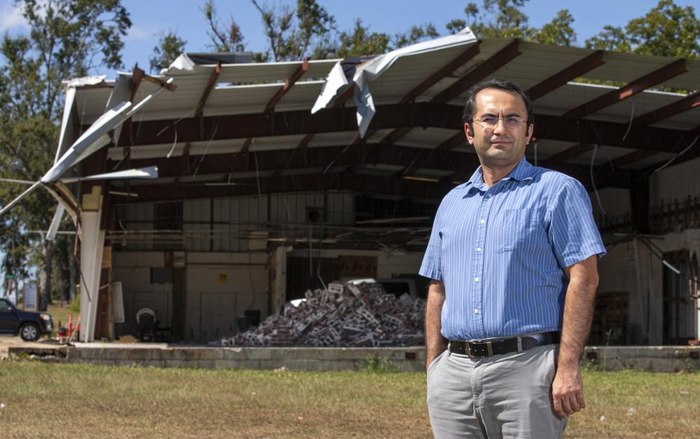
Credit: Mark Wallheiser/FAMU-FSU College of Engineering
When Hurricane Michael made landfall in 2018 near Mexico Beach, it was the first time a Category 5 hurricane hit Florida since 1992. It posed a risk for all residents but especially for people whose physical or cognitive impairments required them to use the state’s special needs shelters.
New research from the FAMU-FSU College of Engineering and the Resilient Infrastructure and Disaster Response Center (RIDER) shows how repurposing regular shelters could cut travel times for vulnerable populations.
In work published in the journal Transportation Planning and Technology, researchers showed that repurposing one regular shelter into a special needs shelter in the Panama City area would lower the average travel time to reach it from 28.5 minutes to 7.4 minutes. The travel time went down to 4.3 minutes when three regular shelters were repurposed.
“We hope with the improved methodology, we will save lives and provide a roadmap for other areas that are susceptible to hurricanes,” said Eren Ozguven, RIDER director and an associate professor in the Department of Civil and Environmental Engineering at the college.
The researchers incorporated storm surge modeling into their GIS analysis of how quickly residents could reach the shelters. Flooding that disrupts roads and bridges could cause intense traffic congestion, which makes evacuating especially difficult for special needs populations.
Although this study used data specific to Panama City, the model is applicable to other locations that experience hurricanes. After Hurricane Irma hit southwest Florida in 2017, the researchers completed similar work to incorporate traffic congestion and storm surges into an analysis of the most effective evacuation routes.
“We incorporated storm surge modeling into hurricane planning in Panama City because it is close to the landfall location where Hurricane Michael hit,” said co-author Wenrui Huang, a professor in the Department of Civil and Environmental Engineering. “Integrating the uncertainty of hurricane tracks into evacuation planning is critical for the impacted communities, as recent hurricanes have shown.”
Hurricanes and their accompanying storm surges are a major emergency management challenge. More than 375,000 Floridians were mandated to evacuate ahead of Hurricane Michael’s landfall. For the most vulnerable residents, the decision to leave is often complicated.
“There are many reasons people don’t leave when evacuations are ordered,” Ozguven said. “Sometimes they may have disabilities or cognitive impairment or can’t drive, and some may require access to a special needs shelter, but these types of shelters aren’t always available or easy to get to.”
Paper co-authors included FAMU-FSU College of Engineering doctoral student Jieya Yang, RIDER postdoctoral researcher Onur Alisan, Louisiana State University postdoctoral researcher Linoj Vijayan, Mahyar Ghorbanzadeh from HTNB Corporation, and Simone Burns from Kimley-Horn Associates.
This research was supported by the National Science Foundation.
Journal
Transportation Planning and Technology
DOI
10.1080/03081060.2022.2162053
Article Title
Integrating storm surge modeling and accessibility analysis for planning of special-needs hurricane shelters in Panama City, Florida
Article Publication Date
2-Jan-2023
COI Statement
No potential conflict of interest was reported by the author(s).