Credit: The Protein Society
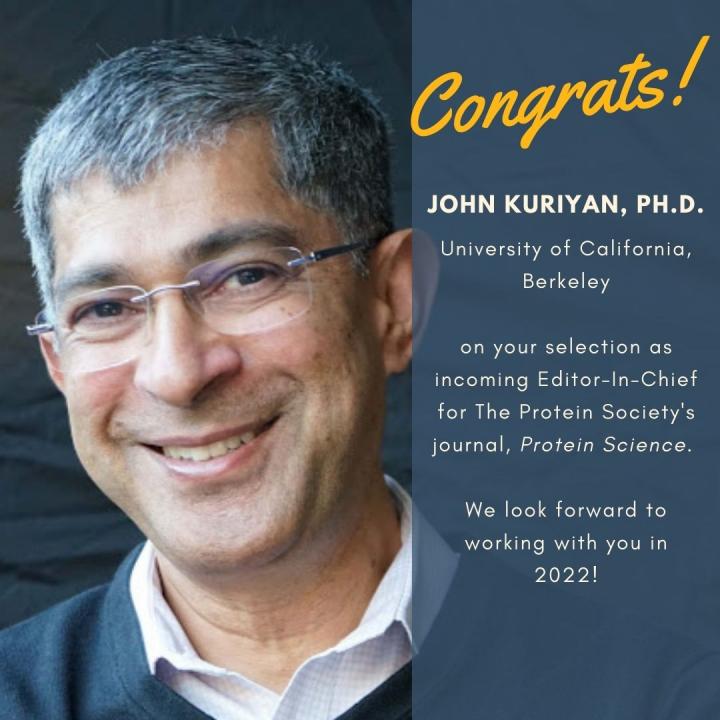
CANYON COUNTRY, CA – The Protein Society is thrilled to announce the appointment of John Kuriyan, Ph.D., University of California, Berkeley as Editor-in-Chief of Protein Science, effective January 1, 2022. He will succeed outgoing editor Dr. Brian Matthews, who has served in this role since 2005 and provided continuous outstanding service to our society and the broader community.
Protein Science, the flagship journal of The Protein Society, serves as an international forum for publishing original reports on all scientific aspects of protein molecules. The journal publishes papers by leading scientists from all over the world that report on advances in the understanding of proteins in the broadest sense. Protein Science aims to unify this field by cutting across established disciplinary lines and focusing on “protein-centered” science.
Amy E. Keating, Professor of Biology and Biological Engineering at the Massachusetts Institute of Technology, and Protein Society President stated:
“To identify an appropriate successor to Brian Matthews, we conducted an extensive search and considered many excellent candidates. I couldn’t be more excited to have Dr. Kuriyan coming on board as our next Editor-in-Chief. His deep appreciation of proteins and their fascinating properties, along with his thoughtful insights and innumerable scientific contributions, make him an ideal next leader for Protein Science. Dr. Kuriyan’s recognition of the fast pace of change in science and in scientific publishing will also benefit the society as we work to support our members and the global protein science community.”
Dr. Kuriyan earned his Ph.D. in 1986 from the Massachusetts Institute of Technology. He was a post-doctoral fellow with Professors Martin Karplus (Harvard) and Gregory A. Petsko (MIT). From 1987 to 2001, he was on the faculty of The Rockefeller University, New York, where he was promoted to full Professor in 1993. He is currently Professor of Molecular and Cell Biology and Professor of Chemistry at the University of California, Berkeley, a position he has held since 2001. Dr. Kuriyan is also an investigator of the Howard Hughes Medical Institute, a member of both the US National Academies of Sciences and Medicine, and a long-time member of the Protein Society.
Dr. Kuriyan’s major scientific contributions have been in understanding the regulation of eukaryotic cell signaling proteins, particularly protein kinases such as the Src-family kinases, Abelson tyrosine kinase (Abl), the epidermal growth factor receptor (EGFR) and Ca2+/calmodulin-dependent kinase II (CaMKII). His laboratory uses structural analysis and computer simulations, as well as biochemical, biophysical, and cell biological analyses to elucidate mechanisms. His lab has also made fundamental contributions to understand the structural basis for high-speed DNA replication.
Among many awards, Dr. Kuriyan has received The Protein Society DuPont-Merck Award (1997) and the highest honor of our society, the Stein & Moore Award (2017). He served as Program Committee Chair for the 31st Annual Symposium of the Protein Society in Montreal, Canada.
The Protein Society is indebted to Dr. Matthews for his exceptional service to the journal and looks forward to working alongside Dr. Kuriyan to continue the journal’s success.
###
The Protein Society is the leading international Society devoted to furthering research and development in protein science. Founded in 1986, the purpose of the Society is to provide international forums to facilitate communication, cooperation, and collaboration regarding all aspects of the study of proteins. In support of these goals, the Society publishes Protein Science, the premier journal in the field, hosts an annual international symposium, and facilitates the education of early-career protein scientists across all lines of discipline. The Protein Society members represent a wide spectrum of academic, industry, governmental, and non-profit institutions from more than 50 countries around the world. Media inquiries can be directed to Raluca Cadar, Executive Director at 844.377.6834.
Media Contact
Raluca Cadar
[email protected]
Original Source
https:/