• HOME
  • NEWS
  • EXPLORE
    • CAREER
      • Companies
      • Jobs
    • EVENTS
    • iGEM
      • News
      • Team
    • PHOTOS
    • VIDEO
    • WIKI
  • BLOG
  • COMMUNITY
    • FACEBOOK
    • INSTAGRAM
    • TWITTER
Tuesday, September 1, 2026
BIOENGINEER.ORG
No Result
View All Result
  • Login
  • HOME
  • NEWS
  • EXPLORE
    • CAREER
      • Companies
      • Jobs
        • Lecturer
        • PhD Studentship
        • Postdoc
        • Research Assistant
    • EVENTS
    • iGEM
      • News
      • Team
    • PHOTOS
    • VIDEO
    • WIKI
  • BLOG
  • COMMUNITY
    • FACEBOOK
    • INSTAGRAM
    • TWITTER
  • HOME
  • NEWS
  • EXPLORE
    • CAREER
      • Companies
      • Jobs
        • Lecturer
        • PhD Studentship
        • Postdoc
        • Research Assistant
    • EVENTS
    • iGEM
      • News
      • Team
    • PHOTOS
    • VIDEO
    • WIKI
  • BLOG
  • COMMUNITY
    • FACEBOOK
    • INSTAGRAM
    • TWITTER
No Result
View All Result
Bioengineer.org
No Result
View All Result
Home NEWS Science News Biology

The power of healthy breast adipocytes in the fight against breast cancer

Bioengineer by Bioengineer
July 13, 2023
in Biology
Reading Time: 2 mins read
0
Samples of breast tissue in patients and healthy individuals
Share on FacebookShare on TwitterShare on LinkedinShare on RedditShare on Telegram

Researchers have found a possible explanation as to why higher breast density and older age increase the risk of breast cancer.
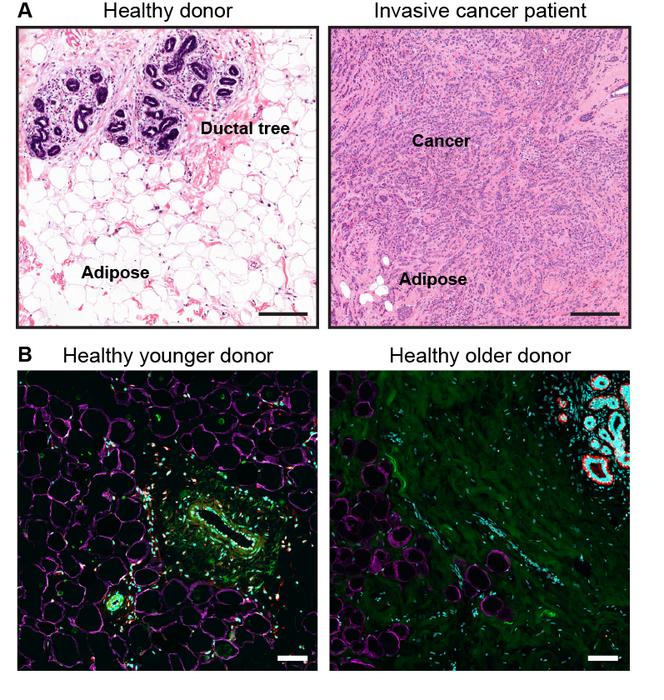
Samples of breast tissue in patients and healthy individuals

Credit: University of Turku

Researchers have found a possible explanation as to why higher breast density and older age increase the risk of breast cancer.

In an innovative study, researchers at the Turku Bioscience Centre, InFLAMES Flagship of the University of Turku, and Turku University Hospital, Finland, have made an extraordinary discovery that turns conventional wisdom on its head. Their findings reveal that healthy fat cells in the breast, also known as adipocytes, secrete a potent factor called IGFBP2, which acts as a barrier against invasive breast cancer progression.

“Adipocytes generally get a bad rap for promoting cancer progression, but this study demonstrates that healthy breast fat can play a protective role in the maintenance of tissue homeostasis and cancer containment,” explained Dr. Emilia Peuhu, a key collaborator in the study. “It’s time to re-evaluate our assumptions and recognize the important role of these unsung heroes.”

Breast cancer patients who experience the transition from pre-malignant ductal carcinoma in situ (DCIS) to invasive ductal carcinoma (IDC) face a considerably poorer prognosis and an increased risk of developing metastatic disease. The research team’s work focuses on identifying factors that impede this invasive progression, with IGFBP2 emerging as a key factor secreted by healthy adipocytes.

In addition to the loss of adipocytes that occurs as women age, this study found that older women had reduced expression of IGFBP2, suggesting that the anti-cancer activities of breast adipocytes might also decrease with age.

InFLAMES group leader, Professor Johanna Ivaska, the principle investigator on the project, expressed their astonishment at the findings, highlighting that, “increasing age and higher breast density, with fewer adipocytes, are two well established risk factors for the development of breast cancer. Our research provides a possible explanation for this increased risk, as we found that IGFBP2 levels are also reduced in older individuals and that healthy breast adipocytes can secrete factors, such as IGFBP2, to inhibit tumour progression.”

The implications of this discovery extend to the understanding of mammary density and its connection with poorer prognosis. Dr. James Conway, the lead researcher of the team, added, “While restoring IGFBP2 into the mammary environment might not be possible, the use of antibody-based inhibitors of IGF-II could help to contain non-invasive breast lesions by acting in a similar fashion to IGFBP2 itself, which we have already observed in our model systems.” 

The team is now exploring the therapeutic avenues that have opened up as a result of these recent findings.

The research findings have been published in the esteemed journal Science Advances: https://www.science.org/doi/10.1126/sciadv.adg1840.


Journal

Science Advances

DOI

10.1126/sciadv.adg1840

Article Title

IGFBP2 secretion by mammary adipocytes limits breast cancer invasion

Article Publication Date

12-Jul-2023

Share12Tweet8Share2ShareShareShare2

Related Posts

Methylation puts parasites in motion

Methylation puts parasites in motion

August 31, 2026
Desiccation promotes DNA damage and rifampin resistance in Mycobacterium tuberculosis

Desiccation promotes DNA damage and rifampin resistance in Mycobacterium tuberculosis

August 31, 2026

Gastrointestinal Parasitism in Cattle and Water Buffaloes in Pakistan: Prevalence and Associated Risk Factors

August 31, 2026

Development of HPLC–PDA method for steviol glycosides analysis in food matrices

August 31, 2026

POPULAR NEWS

  • β-Sitosterol from Ipomoea carnea Jacq. As a promising anti-inflammatory agent: Evidence from in silico modeling and in vitro validation

    29 shares
    Share 12 Tweet 7
  • Design, fabrication and characterization of a wearable Fiber Bragg grating sensor for cardiorespiratory monitoring using finger plethysmography

    29 shares
    Share 12 Tweet 7
  • KAIST opens the era of industrial-scale microbial foods, proposing growth strategies for the next-generation protein market

    29 shares
    Share 12 Tweet 7
  • Virologist awarded $2 million NIH grant to investigate how virus-infected cells live and die

    29 shares
    Share 12 Tweet 7

About

We bring you the latest biotechnology news from best research centers and universities around the world. Check our website.

Follow us

Recent News

β-Sitosterol from Ipomoea carnea Jacq. As a promising anti-inflammatory agent: Evidence from in silico modeling and in vitro validation

Design, fabrication and characterization of a wearable Fiber Bragg grating sensor for cardiorespiratory monitoring using finger plethysmography

KAIST opens the era of industrial-scale microbial foods, proposing growth strategies for the next-generation protein market

Subscribe to Blog via Email

Enter your email address to subscribe to this blog and receive notifications of new posts by email.

Join 85 other subscribers
  • Contact Us

Bioengineer.org © Copyright 2023 All Rights Reserved.

Welcome Back!

Login to your account below

Forgotten Password?

Retrieve your password

Please enter your username or email address to reset your password.

Log In
No Result
View All Result
  • Homepages
    • Home Page 1
    • Home Page 2
  • News
  • National
  • Business
  • Health
  • Lifestyle
  • Science

Bioengineer.org © Copyright 2023 All Rights Reserved.