• HOME
  • NEWS
  • EXPLORE
    • CAREER
      • Companies
      • Jobs
    • EVENTS
    • iGEM
      • News
      • Team
    • PHOTOS
    • VIDEO
    • WIKI
  • BLOG
  • COMMUNITY
    • FACEBOOK
    • INSTAGRAM
    • TWITTER
Saturday, February 7, 2026
BIOENGINEER.ORG
No Result
View All Result
  • Login
  • HOME
  • NEWS
  • EXPLORE
    • CAREER
      • Companies
      • Jobs
        • Lecturer
        • PhD Studentship
        • Postdoc
        • Research Assistant
    • EVENTS
    • iGEM
      • News
      • Team
    • PHOTOS
    • VIDEO
    • WIKI
  • BLOG
  • COMMUNITY
    • FACEBOOK
    • INSTAGRAM
    • TWITTER
  • HOME
  • NEWS
  • EXPLORE
    • CAREER
      • Companies
      • Jobs
        • Lecturer
        • PhD Studentship
        • Postdoc
        • Research Assistant
    • EVENTS
    • iGEM
      • News
      • Team
    • PHOTOS
    • VIDEO
    • WIKI
  • BLOG
  • COMMUNITY
    • FACEBOOK
    • INSTAGRAM
    • TWITTER
No Result
View All Result
Bioengineer.org
No Result
View All Result
Home NEWS Science News Biology

The need for speed

Bioengineer by Bioengineer
March 12, 2020
in Biology
Reading Time: 2 mins read
0
IMAGE
Share on FacebookShare on TwitterShare on LinkedinShare on RedditShare on Telegram

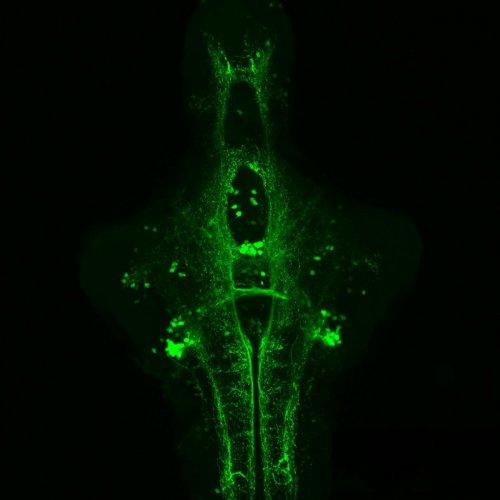
Zebrafish study at NCBS
IMAGE

Credit: Vatsala Thirumalai


Whether running away from a predator or to win an Olympic gold, how fast we run determines the final outcome. Locomotion is produced when limb muscles contract in a co-ordinated fashion. This, in turn, is caused by electrical impulses sent by nerve cells called motor neurons located in the spinal cord. Earlier work showed that based on an animal’s momentary needs, brain circuits select a suitable course of action and set the frequency of motion. Then, just like engaging gears in an automobile, spinal ‘speed’ modules are selectively activated to achieve a certain speed. Thus, motor neurons belonging to the fast module are activated only during fast frequency movements, but are silent during slower frequency movements. Now, scientists at the National Centre for Biological Sciences (NCBS), Bangalore show that parallel neural pathways that bypass the brain’s tight frequency control enable animals to move faster.

In their study, the scientists chose to study speed regulation in larval zebrafish during a reflex behavior called optomotor response. This behavior allows zebrafish to maintain a stable position in streams by generating swims to counter any drift. They evoked this behavior in the lab by playing black and white moving bars (gratings) on a screen placed underneath the fish. While larvae were pinned on a dish to allow measurement of electrical activity from motor neurons, they still responded reliably to the visual stimulus by producing motor commands for swimming. Using this preparation it was possible to probe mechanisms of speed regulation at a single cell level.

Dopamine, a chemical produced by some nerve cells, is released at multiple sites including onto motor neurons. The researchers at NCBS discovered that when the receptors for dopamine were activated, zebrafish larvae swam faster for the same grating stimulus. On closer examination, they found that larvae could swim faster because for every tail beat, the tail made larger amplitude bends. This implies that to achieve faster swims, more motor neurons were activated. Recording the electrical activity of single motor neurons, the researchers found that not only was the slow speed module activated more vigorously after dopamine receptor activation, but fast module motor neurons, which were hitherto silent, were also activated. This was caused by direct actions of dopamine on the motor neurons, which caused the motor neurons to be more excitable.

These results are exciting because they show that motor neurons, which are thought to mostly only relay the command coming to them, are capable of altering behavioral output via modulation of their activity patterns. This study shows that, even after the brain has issued the command for a movement, changing the properties of motor neurons can alter the final behavioral outcome. Such motor neuronal plasticity can be exploited for rehabilitation after spinal cord injury or stroke.

###

Media Contact
Dr. Vatsala Thirumalai
[email protected]

Related Journal Article

http://dx.doi.org/10.1016/j.cub.2019.12.064

Tags: BiologyCell Biology
Share12Tweet8Share2ShareShareShare2

Related Posts

Florida Cane Toad: Complex Spread and Selective Evolution

Florida Cane Toad: Complex Spread and Selective Evolution

February 7, 2026
New Study Uncovers Mechanism Behind Burn Pit Particulate Matter–Induced Lung Inflammation

New Study Uncovers Mechanism Behind Burn Pit Particulate Matter–Induced Lung Inflammation

February 6, 2026

DeepBlastoid: Advancing Automated and Efficient Evaluation of Human Blastoids with Deep Learning

February 6, 2026

Navigating the Gut: The Role of Formic Acid in the Microbiome

February 6, 2026
Please login to join discussion

POPULAR NEWS

  • Robotic Ureteral Reconstruction: A Novel Approach

    Robotic Ureteral Reconstruction: A Novel Approach

    82 shares
    Share 33 Tweet 21
  • Digital Privacy: Health Data Control in Incarceration

    63 shares
    Share 25 Tweet 16
  • Study Reveals Lipid Accumulation in ME/CFS Cells

    57 shares
    Share 23 Tweet 14
  • Breakthrough in RNA Research Accelerates Medical Innovations Timeline

    53 shares
    Share 21 Tweet 13

About

We bring you the latest biotechnology news from best research centers and universities around the world. Check our website.

Follow us

Recent News

Evaluating Pediatric Emergency Care Quality in Ethiopia

TPMT Expression Predictions Linked to Azathioprine Side Effects

Improving Dementia Care with Enhanced Activity Kits

Subscribe to Blog via Email

Success! An email was just sent to confirm your subscription. Please find the email now and click 'Confirm' to start subscribing.

Join 73 other subscribers
  • Contact Us

Bioengineer.org © Copyright 2023 All Rights Reserved.

Welcome Back!

Login to your account below

Forgotten Password?

Retrieve your password

Please enter your username or email address to reset your password.

Log In
No Result
View All Result
  • Homepages
    • Home Page 1
    • Home Page 2
  • News
  • National
  • Business
  • Health
  • Lifestyle
  • Science

Bioengineer.org © Copyright 2023 All Rights Reserved.