HIV, Ebola and most recently, COVID-19 viruses have had an enormous impact on our societies world-wide. All these viruses are ‘enveloped viruses,’ viruses that have an exterior envelope that surrounds them largely composed of its host’s cells. This envelope increases the virus’s ability to hide from their host’s immune system and to access the host’s cells. It also, however, gives researchers a target, an opportunity to interrupt viral transmission.
Credit: Yu Nakagawa, Nagoya University
HIV, Ebola and most recently, COVID-19 viruses have had an enormous impact on our societies world-wide. All these viruses are ‘enveloped viruses,’ viruses that have an exterior envelope that surrounds them largely composed of its host’s cells. This envelope increases the virus’s ability to hide from their host’s immune system and to access the host’s cells. It also, however, gives researchers a target, an opportunity to interrupt viral transmission.
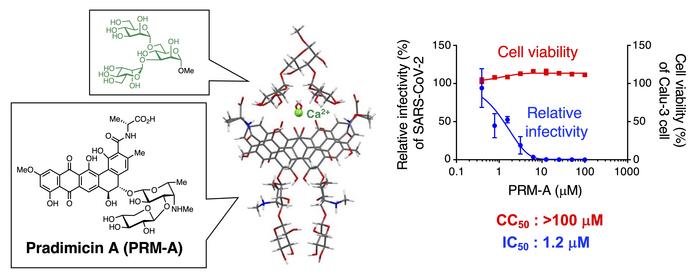
Japanese researchers have been working on the issue of halting viral transmission in these types of viruses. “The development of vaccines and antiviral drugs against COVID-19 has successfully reduced the risk of death, but complete suppression of viral transmission is still challenging. Under such circumstances, we evaluated the potential of naturally occurring pradimicin A (PRM-A) as a new anti-SARS-CoV-2 drug that suppresses SARS-CoV-2 transmission,” said Yu Nakagawa, the lead author on the paper and an associate professor in the Institute for Glyco-core Research (iGCORE) at Nagoya University, Nagoya, Japan.
There is strong evidence that PRM-A is a viral entry inhibitor, in other words it stops viruses from entering a host’s cells. It does this by binding to N-glycans, which are found on the surface of several types of enveloped viruses including the SARS-CoV-2 virus. However, there is still little known about how exactly PRM-A binds to the viral N-glycans.
Their research was published in Bioorganic & Medicinal Chemistry on May 1.
To infect a cell, a virus’s envelope uses specific receptors on its surface called spike proteins—which are usually glycoproteins, meaning carbohydrates, specifically sugar (oligosaccharides) attached to proteins—to bind to the cellular membrane of a host’s cell, causing a conformational change in the cell membrane which allows the virus to enter the cells. Once there, it uses the cell’s resources to replicate its own genome, safe from the host’s immune system.
Initially researchers looking at interrupting viral transmission focused on lectins, carbohydrate-binding proteins that are derived from plants or bacteria, which showed strong promise as a viral entry inhibitor. They bind with the viruses’ glycoproteins and stop its advance into a cell. However, they are often expensive, easily targeted by the host’s immune system, and may be toxic to the host’s cells. Lectin mimics have many of the carbohydrate-binding ability of the lectin without the expensive and dangerous side effects.
The Japanese team looked at PRM-A, a naturally occurring lectin mimic. It has shown promise as a viral entry inhibitor as there is evidence it binds to the N-glycans of the viruses’ envelope glycoproteins. To determine the molecular basis of the binding, they used molecular modelling and ran binding assays which measure the reactions between PRM-A and N-glycans as they bind. They also carried out in vitro experiments to test PRM-A’s ability to inhibit SARS-CoV-2.
They found that PRM-A binds selectively to branched oligomannose structures found in high mannose-type and hybrid-type N-glycans on viral spike proteins. Mannose is the specific sugar found in these N-glycans. They also found that PRM-A did inhibit the infectivity of SARS-CoV-2. In fact, the inhibition occurred through the interaction between the PRM-A and the branched oligomannose-containing N-glycans.
“We demonstrated for the first time that PRM-A can inhibit SARS-CoV-2 infection by binding to viral glycans. It is also noteworthy that PRM-A was found to bind preferentially to branched oligomannose motifs of viral glycans via simultaneous recognition of two terminal mannose residues. This finding provides essential information needed to understand the antiviral mechanism of PRM-A,” said Nakagawa.
Nakagawa and their team are already busy working on the next step in their research. “Our ultimate goal is to develop anti-SARS-CoV-2 drugs based on PRM-A. The glycan-targeted antiviral action of PRM-A has never been observed in major classes of the existing chemotherapeutics, underscoring its potential as a promising lead for antiviral drugs with the novel mode of action. Especially, considering that glycan structures are hardly changed by viral mutation, we expect that PRM-A-based antiviral drugs would be effective against mutated viruses. Toward this goal, we are now examining in vivo antiviral activity of PRM-A using hamsters, and also developing PRM-A derivatives that are more suitable for therapeutic applications,” said Nakagawa.
Other contributors include Masato Fujii, Nanaka Ito and Makoto Ojika of the Department of Applied Biosciences, Graduate School of Bioagricultural Sciences, Nagoya University, Furo-cho, Chikusa-ku, Nagoya 464-8601, Japan. Dai Akase of the Graduate School of Advanced Science and Engineering, Hiroshima University, 1-3-1 Kagamiyama, Higashi-Hiroshima, Hiroshima 739-8526, Japan. Misako Aida of the Office of Research and Academia-Government-Community Collaboration, Hiroshima University, 1-3-2 Kagamiyama, Higashi-Hiroshima, Hiroshima 739-8511, Japan. Takaaki Kinoshita, Yasuteru Sakurai and Jiro Yasuda of the Department of Emerging Infectious Diseases, National Research Center for the Control and Prevention of Infectious Diseases (CCPID), Nagasaki University, 1-12-4 Sakamoto, Nagasaki 852-8523, Japan. Yasuhiro Igarashi of the Biotechnology Research Center, Toyama Prefectural University, 5180 Kurokawa, Imizu, Toyama 939-0398, Japan. Yukishige Ito of the Graduate School of Science, Osaka University, 1-1 Machikaneyama-cho, Toyonaka, Osaka 560-0043, Japan.
This work was partly supported by JSPS KAKENHI grant (to Y.N.), the Cooperative Research Project Program of the National Research Center for the Control and Prevention of Infectious Diseases, Nagasaki University (to Y.N.), the Agricultural Chemical Research grant from the Japan Society for Bioscience, Biotechnology, and Agrochemistry (to Y.N.). Candida rugosa AJ 14513 was provided by Ajinomoto Co., Inc. (Kanagawa, Japan). SARS-CoV-2 strain, JPN/NGS/SC-1/2020 (GISAID Accession ID: EPI_ISL_481254) was provided by Nagasaki University through the National BioResource Project (Human pathogenic viruses) of MEXT, Japan.
Journal
Bioorganic & Medicinal Chemistry
DOI
10.1016/j.bmc.2024.117732
Method of Research
Experimental study
Subject of Research
Not applicable
Article Title
Molecular basis of N-glycan recognition by pradimicin a and its potential as a SARS-CoV-2 entry inhibitor
Article Publication Date
1-May-2024