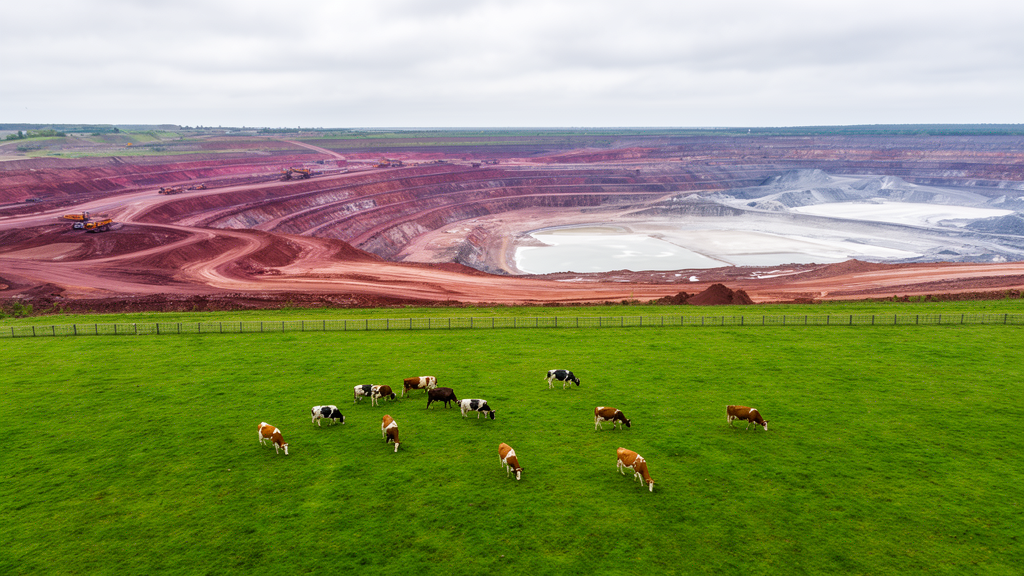
Every carton of eggs, fillet of salmon, and kilogram of chicken sold around the world carries an environmental story that has largely gone untold. While scientists and consumers have scrutinized soy plantations, palm oil plantations, and the wild fish reduced to feed, a quieter ingredient has escaped attention: the minerals. A new scoping review published in npj Sustainable Agriculture reveals that the mineral supplements added to animal feeds—components sourced overwhelmingly from mining—are almost universally missing from the life cycle assessments (LCAs) that underpin sustainability claims for farmed animal products. The finding suggests that the environmental footprints of meat, dairy, eggs, and farmed seafood may be systematically underestimated, in some cases by amounts large enough to reshape how we rank the impacts of different foods.
The research team, led by Beth Penrose of Charles Darwin University and colleagues at the University of Tasmania and CSIRO, systematically searched three major scientific databases—Scopus, Web of Science, and Google Scholar—following the PRISMA-ScR framework for scoping reviews. From an initial pool of 300 screened articles, they identified 104 peer-reviewed papers containing 109 unique life cycle assessments of feed for cattle, pigs, chickens, fish, and crustaceans. For each study, the reviewers asked a deceptively simple question: did the assessment actually account for the mineral premix that every nutritionist knows is blended into commercial feed? The answer, in the overwhelming majority of cases, was no.
The numbers are striking. Sixty-four percent of the reviewed LCAs excluded mineral supplements entirely from their inventories and impact calculations. The omission was worst in aquaculture, where 84 percent of fish and crustacean studies left minerals out altogether, followed by cattle studies at 73 percent. Chicken and pig studies fared somewhat better, but even there roughly half of the assessments omitted the mineral component. When minerals were included at all, the treatment was often superficial: of the 39 LCAs that did account for mineral supplements, two-thirds relied on proxies—stand-in substances such as calcium carbonate or limestone—rather than modelling the actual premixes specified in the feed formulations. In the end, only 14 of the 109 assessments, about one in eight, modelled the real mineral supplements described in the associated feed profiles.
The choice of proxy matters because mineral requirements vary enormously across species, and a single stand-in cannot capture that diversity. Laying hens, for instance, need nearly four times the calcium that pigs require—roughly 4 percent of the diet versus 0.46 percent—because of the relentless demands of eggshell formation. Iron is a critical supplement for farmed fish yet unnecessary for cattle, which obtain ample iron from forage. Aquatic species complicate the picture further: freshwater fish absorb minerals directly through their gills, saltwater fish take them up through both gills and gut as they drink seawater, and diadromous species such as Atlantic salmon shift their requirements entirely when they migrate from freshwater to ocean pens during production. Dairy cattle are even often deliberately over-supplemented, with National Research Council recommendations suggesting 120 percent of required mineral levels. A uniform limestone proxy flattens all of this biological nuance into a single, misleading number.
Why does the omission matter so much? Because mineral supplements are not grown—they are mined. Ore extraction carries environmental pressures that agricultural and fishery-based feed ingredients do not: land-use change, greenhouse gas emissions, waste rock, soil contamination, and water pollution. Unlike a wheat field or a managed fishery, a mine draws on a finite, non-renewable resource base, and the extraction and processing steps can generate impact intensities far exceeding those of crop production. The review cites greenhouse gas estimates ranging from 774 kilograms of carbon dioxide equivalent per tonne for mono-dicalcium phosphate up to 8,812 for elemental phosphorus, and between 2,000 and 6,120 for zinc mining and processing. Wheat, by comparison, sits at roughly 423 to 735 kilograms of carbon dioxide equivalent per tonne. A kilogram of phosphorus supplement can therefore carry an order of magnitude more embedded emissions than a kilogram of the grain it sits alongside in the feed ration.
Small inclusion rates, multiplied across global production, translate into enormous hidden emissions. The authors illustrate this with two back-of-envelope calculations. United States feedlots used an estimated 83.8 million tonnes of feed in 2025; assuming a phosphorus inclusion of 0.48 percent and the high-end emissions figure for phosphorus mining and processing, phosphorus supplementation alone would account for nearly 72 million tonnes of carbon dioxide equivalent per year. Norwegian salmon farming, which used roughly 1.98 million tonnes of feed in 2020, would add an extra 163,700 tonnes of carbon dioxide equivalent from phosphorus supplements under the same assumptions. These are impacts that, in most published assessments, simply vanish from the ledger.
Aquaculture deserves particular scrutiny because the problem is growing. As the industry moves away from fishmeal and fish oil toward plant-based diets, the demand for supplemental minerals rises, since plant ingredients contain anti-nutritional factors and lower bioavailability of key elements, requiring higher supplementation than older formulations based on marine ingredients. Yet fish and crustacean LCAs were the least likely of any sector to include minerals at all, with 95 percent of studies omitting the mineral component entirely. The sector with the fastest-changing feed composition is, in effect, the one flying blindest.
The review also points to impact pathways that no proxy can capture. Mineral processing introduces environmental pressures with no agricultural analogue—sulfuric acid production during zinc processing, for example, generates impacts entirely absent from feed assessments that exclude or misrepresent minerals. Moreover, the authors mapped the global distribution of mines extracting cobalt, copper, magnesium, manganese, molybdenum, phosphorus, and zinc against terrestrial and marine species richness data, revealing that many mining operations sit in ecologically rich regions. The authors are careful to note that spatial overlap alone does not demonstrate biodiversity loss, but it highlights biodiversity-related exposure risks that are invisible when premixes are excluded or represented by generic limestone. Extraction locations, transport routes, and processing methods all vary widely, and none of that geographic reality survives a proxy-based assessment.
The authors are candid about why these omissions happen. Exact mineral concentrations and chemical forms—whether selenium arrives as sodium selenite or selenomethionine, for example—are often treated as confidential commercial information by feed manufacturers. Data on where ore is mined, how it is transported, and how it is processed are patchy, making it nearly impossible to trace the provenance of minerals in a specific batch of feed. Minerals can also arrive through multiple routes: phosphorus may come from mined rock or from animal bone byproducts, each with different and location-dependent impacts. The reviewers acknowledge that confidential industry LCAs may routinely include minerals, and they invite feed companies to share whether and how they do so.
Still, the authors argue, none of these challenges justifies leaving minerals out altogether. The FAO’s Livestock Environmental Assessment and Performance Partnership published guidance in 2020 advising that vitamin and mineral premixes be included in livestock feed LCAs, with proxies permitted only as a last resort. Life cycle inventory data already exist for the extraction, processing, and transport of many feed-relevant minerals—zinc, for instance, is required by every farmed species in the review, yet it is captured by none of the common proxies and even studies listing it in their inventories often fail to quantify its impacts. The reviewers propose practical fixes: life cycle inventory databases such as EcoInvent could offer proxies that better resemble real mineral inputs; researchers and industry could co-develop a comprehensive, regularly updated database of mineral supplements and their environmental profiles; and supplement suppliers could provide impact data for their premixed products without revealing proprietary formulations. Better collaboration between feed manufacturers, mineral suppliers, and assessment practitioners, the authors conclude, is the key to making the footprints of the world’s farmed animal foods honest, complete, and comparable.
Subject of Research: Representation of mined mineral feed supplements in life cycle assessments of farmed animal production
Article Title: Uncharted links from mining to fed animal systems: a scoping review
Article References: Penrose, B., Zhan, X., Reimer, T., Clawson, G., Amoroso, G., Prasad, S. S., Carter, C. G., Blanchard, J. L., & Cottrell, R. S. (2026). Uncharted links from mining to fed animal systems: a scoping review. npj Sustainable Agriculture, 4(1), Article 82. https://doi.org/10.1038/s44264-026-00193-2
Image Credits: AI Generated
DOI: 10.1038/s44264-026-00193-2
Keywords: life cycle assessment, animal feed, mineral supplements, mining, aquaculture, livestock, sustainability, carbon footprint, phosphorus, zinc, biodiversity, food systems
News Source: Alan Morgan. (October 9, 2026). The Hidden Mining Footprint Missing From Farm Animal Sustainability Studies. Scienmag.