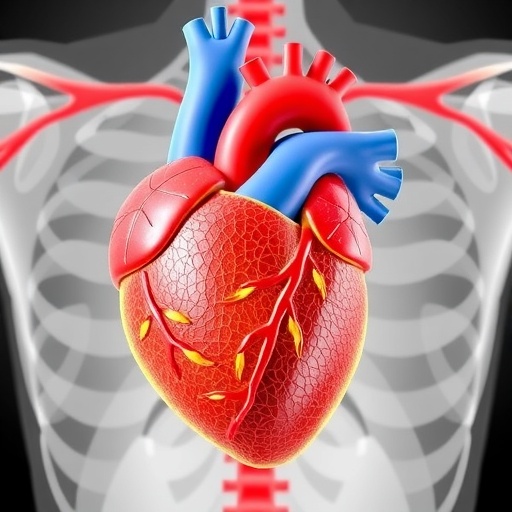
A groundbreaking study unveiled by researchers at the University of East Anglia (UEA) and the Norfolk and Norwich University Hospital illuminates a fascinating, inherent feature of the human heart: a natural bypass system capable of sustaining cardiac muscle despite prolonged artery blockages. This intrinsic network of minute collateral vessels emerges as a vital determinant in assessing myocardial viability, potentially transforming clinical decisions and sparing countless patients from invasive and high-risk cardiac interventions.
For decades, the prevailing medical assumption has been stark: a fully occluded coronary artery unequivocally condemns the heart tissue downstream to irreversible damage and necrosis. However, this latest research punctures this narrative by revealing that the human body, remarkably, sometimes mounts an adaptive response. It generates tiny, alternative blood vessels that circumvent the obstruction, reminiscent of a biological detour, sustaining the vitality of myocardial tissue that would otherwise be doomed. These collateral microvessels quietly perform the function of an emergency backup, maintaining perfusion and oxygen delivery in conditions that previously spelled cardiac disaster.
The research team centered their investigation on patients diagnosed with chronic total occlusion (CTO), a common complication in coronary artery disease, characterized by arteries that have been completely blocked for months. Chronic total occlusions challenge clinicians because determining the viability of the myocardium beyond the blockage is pivotal to identifying which patients will truly benefit from revascularization procedures such as percutaneous coronary intervention (PCI). The researchers recruited 56 human subjects presenting with CTO, subjecting them to rigorous clinical evaluation combining angiographic imaging and high-resolution cardiac magnetic resonance imaging (MRI).
Critical to this study was the employment of the Rentrop scoring system—a relatively straightforward angiographic metric assessing the development and functional capacity of collateral vessels around the blocked artery. The Rentrop score ranges from zero to three, with higher scores indicating more robust collateral circulation. The team meticulously correlated these angiographic findings with MRI assessments, which are widely regarded as the gold standard for discerning live myocardium from scar tissue, thereby validating the predictive power of these natural bypass vessels.
The results were compelling. Patients exhibiting Rentrop scores exceeding one demonstrated a significantly higher likelihood of preserved myocardial viability despite the chronic blockage. Statistical analysis underscored that each incremental increase in collateral grade more than doubled the probability that the cardiac tissue downstream remained alive and functional rather than irreversibly damaged. Intriguingly, amongst all variables examined, the Rentrop score emerged as the solitary independent predictor of myocardial viability, firmly establishing its clinical relevance.
This revelation heralds a paradigm shift in cardiac diagnostics and management. The ability to rapidly evaluate collateral vessel development during routine angiography presents clinicians with a powerful, accessible tool to stratify patients who may benefit from additional diagnostic imaging or revascularization therapy. Given the complex and resource-intensive nature of interventions aimed at opening fully occluded coronary arteries, identifying viable myocardium beforehand is both a safety imperative and a pathway to optimizing clinical outcomes.
Interventional cardiologist and lead investigator Dr. Pankaj Garg emphasizes the transformative potential of this approach: “Opening a completely blocked artery is no small matter. These procedures are long, complex, and resource-heavy, and not every patient benefits. Our findings empower doctors to make faster, more informed decisions using information already present during angiograms, potentially reducing unnecessary risks and expediting tailored treatment strategies.”
Beyond clinical efficiencies, the natural bypass vessels offer insightful physiological information about the heart’s resilience and reparative capacity. The collateral circulation developed in CTO is part of the heart’s intrinsic adaptability—a manifestation of angiogenesis and arteriogenesis pathways driven by hypoxia and biomechanical stress. Understanding the nuances of these collateral networks not only aids in immediate patient care but opens doors for novel therapeutic strategies aiming to enhance natural bypass formation in ischemic heart disease.
While advanced cardiac MRI remains the definitive modality for myocardial tissue characterization, access is often limited due to cost, availability, or patient contraindications. The angiographic Rentrop scoring thus emerges as a pragmatic surrogate, providing immediate viability insights at the catheterization lab bedside. This democratization of cardiac diagnostic capability is especially vital in healthcare environments with constrained resources, potentially elevating standards of care across diverse clinical settings.
Furthermore, this research illuminates the intricate balance within the pathophysiology of chronic coronary occlusions. The presence of collateral vessels often correlates with better-preserved cardiac function, reduced ischemic burden, and improved symptom profiles. This finding challenges clinicians to reconsider aggressive treatment thresholds and advocates for a more nuanced, individualized approach bolstered by objective viability assessments.
The study was a collaborative achievement involving UEA, Norfolk and Norwich University Hospitals NHS Foundation Trust, and Leiden University Medical Centre, and the results are published in the journal Open Heart under the article titled “Rentrop collateral grade predicts myocardial viability in chronic total occlusion on cardiac magnetic resonance.” This contribution not only enriches the scientific discourse but offers tangible, actionable knowledge for cardiologists worldwide.
In summary, the research underscores an elegant, life-sustaining feature within the human cardiovascular system—the heart’s inherent formation of collateral vessels acting as a natural bypass during prolonged arterial occlusions. It equips clinicians with a potent, evidence-based method to refine patient selection for further imaging and invasive treatment, promising safer interventions, reduced healthcare burden, and tailored patient care. Far from spelling automatic doom, a fully blocked artery may now signal a complex interplay of damage and resilience, amenable to finely tuned clinical strategies driven by nature’s own ingenious detours.
Subject of Research: People
Article Title: ‘Rentrop collateral grade predicts myocardial viability in chronic total occlusion on cardiac magnetic resonance’
News Publication Date: 28-May-2026
Keywords: Heart, Blood vessels, Circulatory system, Heart muscle, Cardiac function, Cardiology, Physiology, Chronic total occlusion, Myocardial viability, Angiogram, Rentrop score, Collateral vessels