• HOME
  • NEWS
  • EXPLORE
    • CAREER
      • Companies
      • Jobs
    • EVENTS
    • iGEM
      • News
      • Team
    • PHOTOS
    • VIDEO
    • WIKI
  • BLOG
  • COMMUNITY
    • FACEBOOK
    • INSTAGRAM
    • TWITTER
Friday, July 3, 2026
BIOENGINEER.ORG
No Result
View All Result
  • Login
  • HOME
  • NEWS
  • EXPLORE
    • CAREER
      • Companies
      • Jobs
        • Lecturer
        • PhD Studentship
        • Postdoc
        • Research Assistant
    • EVENTS
    • iGEM
      • News
      • Team
    • PHOTOS
    • VIDEO
    • WIKI
  • BLOG
  • COMMUNITY
    • FACEBOOK
    • INSTAGRAM
    • TWITTER
  • HOME
  • NEWS
  • EXPLORE
    • CAREER
      • Companies
      • Jobs
        • Lecturer
        • PhD Studentship
        • Postdoc
        • Research Assistant
    • EVENTS
    • iGEM
      • News
      • Team
    • PHOTOS
    • VIDEO
    • WIKI
  • BLOG
  • COMMUNITY
    • FACEBOOK
    • INSTAGRAM
    • TWITTER
No Result
View All Result
Bioengineer.org
No Result
View All Result
Home NEWS Science News Chemistry

The formation of switchable and metastable discrete structures through chiral self-sorting

Bioengineer by Bioengineer
November 20, 2023
in Chemistry
Reading Time: 2 mins read
0
Thermo-/mechano-chromism originating from monomer-dimer transformation
Share on FacebookShare on TwitterShare on LinkedinShare on RedditShare on Telegram

This paper describes chiral coordination dimers that emerge based on effectively exclusive chiral self-sorting. The complex also exhibits thermo-/mechano-chromism originating from monomer-dimer transformation. The homochiral dimer is comprised of a coordinatively unsaturated iridium(III) complex, which features an n-butyl-substituted benzo[h]quinoline moiety and helical chirality at the metal center. Construction of the appropriate binding model and analysis of the fundamental physical parameters based on spectroscopic data reveal that the strong preference for homochiral dimerization is an entropic-driven effect originating from steric repulsions of alkyl chains in the coordination sphere of the corresponding heterochiral dimer. Furthermore, the metastable nature of dimer crystals allows for color variation (from yellow to red) upon mechanical cleavage of its coordination bonds (i.e., dimer-to-monomer transformation). This feature might be exploited for the dynamic control of coordination geometry and related functionalities, such as catalytic applications. Emergence of strong homochiral self-sorting preference and connected thermo-/mechano-chromic behaviour is based on matched propeller-shaped chirality and subtle steric repulsions of substituents that render particular homochiral dimers switchable and metastable.
This work provides substantial insight into chiral self-sorting in discrete supramolecular systems and its application in the rational design of switchable and metastable dynamic molecular structures with potential as advanced catalysts, sensors, or optoelectronic devices.
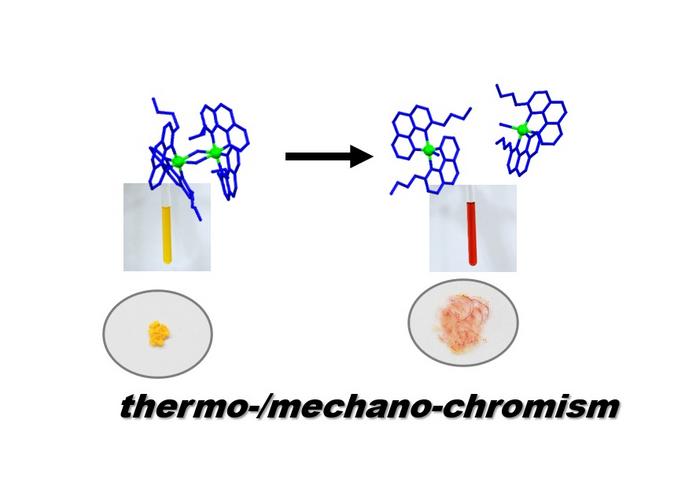
 

Thermo-/mechano-chromism originating from monomer-dimer transformation

Credit: Kazuyoshi Takimoto (Kitasato University)

This paper describes chiral coordination dimers that emerge based on effectively exclusive chiral self-sorting. The complex also exhibits thermo-/mechano-chromism originating from monomer-dimer transformation. The homochiral dimer is comprised of a coordinatively unsaturated iridium(III) complex, which features an n-butyl-substituted benzo[h]quinoline moiety and helical chirality at the metal center. Construction of the appropriate binding model and analysis of the fundamental physical parameters based on spectroscopic data reveal that the strong preference for homochiral dimerization is an entropic-driven effect originating from steric repulsions of alkyl chains in the coordination sphere of the corresponding heterochiral dimer. Furthermore, the metastable nature of dimer crystals allows for color variation (from yellow to red) upon mechanical cleavage of its coordination bonds (i.e., dimer-to-monomer transformation). This feature might be exploited for the dynamic control of coordination geometry and related functionalities, such as catalytic applications. Emergence of strong homochiral self-sorting preference and connected thermo-/mechano-chromic behaviour is based on matched propeller-shaped chirality and subtle steric repulsions of substituents that render particular homochiral dimers switchable and metastable.
This work provides substantial insight into chiral self-sorting in discrete supramolecular systems and its application in the rational design of switchable and metastable dynamic molecular structures with potential as advanced catalysts, sensors, or optoelectronic devices.


Journal

Journal of the American Chemical Society

DOI

10.1021/jacs.3c05866
Share12Tweet8Share2ShareShareShare2

Related Posts

Graz University of Technology Deciphers the Structural Secrets of MOF Thin Films — Chemistry

Graz University of Technology Deciphers the Structural Secrets of MOF Thin Films

July 2, 2026
Breaking Thermodynamic Limits: Wavelength-Driven Catalysis Advances Ammonia Synthesis — Chemistry

Breaking Thermodynamic Limits: Wavelength-Driven Catalysis Advances Ammonia Synthesis

July 2, 2026

From Quantum Mechanics to AI-Powered Materials Discovery: MARVEL Marks 12 Years of Transforming Computational Science

July 2, 2026

Djire Recognized with National Award for Outstanding Contributions in Research and Teaching

July 2, 2026

POPULAR NEWS

  • Detection of EDCs in Breast Milk and Infant Urine Up to Six Months Highlights Early Exposure Risks

    77 shares
    Share 31 Tweet 19
  • Saying Goodbye to PGY-6: Pediatric Fellowship Realities

    103 shares
    Share 41 Tweet 26
  • New Drug Candidate Developed at McMaster Shows Potential for Treating Brain Cancer

    58 shares
    Share 23 Tweet 15
  • KTU Researchers Explore Ultrasound’s Role in Enhancing Blood Flow Beyond Diagnostics

    53 shares
    Share 21 Tweet 13

About

BIOENGINEER.ORG

We bring you the latest biotechnology news from best research centers and universities around the world. Check our website.

Follow us

Recent News

Steatosis Drives Liver Metastasis Diversity in CRC

Unlocking the Mysteries of Alzheimer’s Disease

Pensoft Introduces New Peer-Reviewed Journal of Regeneration to Advance Restorative Biology Across Species

Subscribe to Blog via Email

Enter your email address to subscribe to this blog and receive notifications of new posts by email.

Join 83 other subscribers
  • Contact Us

Bioengineer.org © Copyright 2023 All Rights Reserved.

Welcome Back!

Login to your account below

Forgotten Password?

Retrieve your password

Please enter your username or email address to reset your password.

Log In
No Result
View All Result
  • Homepages
    • Home Page 1
    • Home Page 2
  • News
  • National
  • Business
  • Health
  • Lifestyle
  • Science

Bioengineer.org © Copyright 2023 All Rights Reserved.