• HOME
  • NEWS
  • EXPLORE
    • CAREER
      • Companies
      • Jobs
    • EVENTS
    • iGEM
      • News
      • Team
    • PHOTOS
    • VIDEO
    • WIKI
  • BLOG
  • COMMUNITY
    • FACEBOOK
    • INSTAGRAM
    • TWITTER
Sunday, May 10, 2026
BIOENGINEER.ORG
No Result
View All Result
  • Login
  • HOME
  • NEWS
  • EXPLORE
    • CAREER
      • Companies
      • Jobs
        • Lecturer
        • PhD Studentship
        • Postdoc
        • Research Assistant
    • EVENTS
    • iGEM
      • News
      • Team
    • PHOTOS
    • VIDEO
    • WIKI
  • BLOG
  • COMMUNITY
    • FACEBOOK
    • INSTAGRAM
    • TWITTER
  • HOME
  • NEWS
  • EXPLORE
    • CAREER
      • Companies
      • Jobs
        • Lecturer
        • PhD Studentship
        • Postdoc
        • Research Assistant
    • EVENTS
    • iGEM
      • News
      • Team
    • PHOTOS
    • VIDEO
    • WIKI
  • BLOG
  • COMMUNITY
    • FACEBOOK
    • INSTAGRAM
    • TWITTER
No Result
View All Result
Bioengineer.org
No Result
View All Result
Home NEWS Science News Chemistry

The first hydroxide conductivity in anion conducting polymer thin films

Bioengineer by Bioengineer
May 7, 2021
in Chemistry
Reading Time: 2 mins read
0
IMAGE
Share on FacebookShare on TwitterShare on LinkedinShare on RedditShare on Telegram

Researchers from Japan Advanced Institute of Science and Technology (JAIST) have successfully established a new humidity in situ measurements for anion conducting polymer thin films
IMAGE

Credit: Yuki Nagao from JAIST

Ishikawa, Japan – As decarbonization progresses rapidly in the world, fuel cells offer potentially higher electrical efficiency than conventional power-generating systems. Anion exchange membrane fuel cells offer advantages of using non-precious metal catalysts than proton exchange membrane fuel cells. One of the challenges of this next-generation fuel cell is to clarify the hydroxide ion conductivity in the ion conductive polymer around the electrode catalyst. The difficulty of studying the hydroxide ion conductivity at the electrode interface is that the hydroxide ion, which is a carrier, easily reacts with carbon dioxide in the air. To solve this problem, all evaluation devices were improved so that the sample did not come into contacting with air.

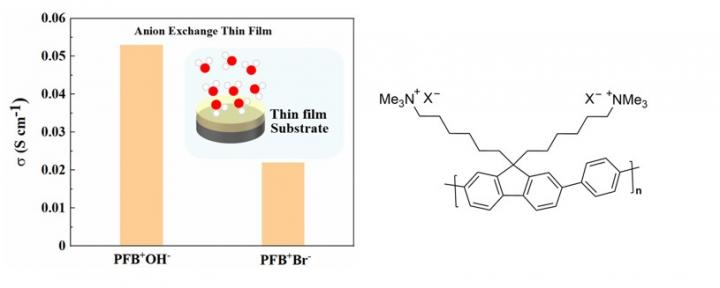
In a new study published in ChemSusChem (Accepted Article), researchers from Japan Advanced Institute of Science and Technology (JAIST), namely Associate Professor Yuki Nagao and Ph.D. students Fangfang Wang and Dongjin Wang, succeeded in precisely identifying the hydroxide ion conductivity and the water amount contained in the sample without exposing the thin film sample to air. Fluorene-based cationic polymers were synthesized, and Br– and OH– samples as counter anions were prepared for comparison. It was revealed that the 270-nm-thick thin film containing hydroxide ions exhibits a high hydroxide ion conductivity of 0.05 S cm-1. This ionic conductivity was more than twice as high as the value of the thin film containing Br– ions as shown in Figure 1.

Surprisingly, it was also revealed that the hydroxide ion conductivity of the thin film form containing hydroxide ions was comparable to that of the thick membrane form. This tendency seems to be different from the results reported in proton conductive polymers.

“Developing a better understanding of these properties and their impacts on hydroxide ion conduction will be important for both clarifying hydroxide ion conduction mechanisms and improving fuel cell performance,” explains Associate Professor Yuki Nagao from JAIST. New findings seem to be a solid step toward a hydrogen society.

###

Funding information

This study was funded by Grant-in-Aid for KAKENHI grants (JP18K05257 and JP21H01997), a Grant-in-Aid for Scientific Research on Innovative Areas “hydrogenomics “project (JP21H00020) from Japan Society for the Promotion of Science (JSPS).

Media Contact
Yuki Nagao
[email protected]

Related Journal Article

http://dx.doi.org/10.1002/cssc.202100711

Tags: Chemistry/Physics/Materials SciencesEnergy/Fuel (non-petroleum)Polymer Chemistry
Share12Tweet8Share2ShareShareShare2

Related Posts

Miniature Sensor Uses Light to Detect Touch — Chemistry

Miniature Sensor Uses Light to Detect Touch

May 8, 2026
Iron Minerals Determine Whether Dissolved Organic Matter Fuels Microbes or Becomes Long-Term Carbon Storage — Chemistry

Iron Minerals Determine Whether Dissolved Organic Matter Fuels Microbes or Becomes Long-Term Carbon Storage

May 8, 2026

Kate Evans Appointed Associate Lab Director for Biological and Environmental Systems Science at ORNL

May 8, 2026

Advancing Multiscale Modeling and Overcoming Operational Challenges in Autothermal COâ‚‚-to-Methanol Reactors

May 8, 2026
Please login to join discussion

POPULAR NEWS

  • Research Indicates Potential Connection Between Prenatal Medication Exposure and Elevated Autism Risk

    840 shares
    Share 336 Tweet 210
  • New Study Reveals Plants Can Detect the Sound of Rain

    727 shares
    Share 290 Tweet 181
  • Scientists Investigate Possible Connection Between COVID-19 and Increased Lung Cancer Risk

    68 shares
    Share 27 Tweet 17
  • Salmonella Haem Blocks Macrophages, Boosts Infection

    61 shares
    Share 24 Tweet 15

About

We bring you the latest biotechnology news from best research centers and universities around the world. Check our website.

Follow us

Recent News

Evaluating Digoxin Use in Patients with Symptomatic Rheumatic Heart Disease

Evaluating the Effectiveness and Safety of Digitalis Glycosides in Treating Heart Failure

Urdu Fall Risk Questionnaire Adapted for Elderly

Subscribe to Blog via Email

Enter your email address to subscribe to this blog and receive notifications of new posts by email.

Join 82 other subscribers
  • Contact Us

Bioengineer.org © Copyright 2023 All Rights Reserved.

Welcome Back!

Login to your account below

Forgotten Password?

Retrieve your password

Please enter your username or email address to reset your password.

Log In
No Result
View All Result
  • Homepages
    • Home Page 1
    • Home Page 2
  • News
  • National
  • Business
  • Health
  • Lifestyle
  • Science

Bioengineer.org © Copyright 2023 All Rights Reserved.