• HOME
  • NEWS
  • EXPLORE
    • CAREER
      • Companies
      • Jobs
    • EVENTS
    • iGEM
      • News
      • Team
    • PHOTOS
    • VIDEO
    • WIKI
  • BLOG
  • COMMUNITY
    • FACEBOOK
    • INSTAGRAM
    • TWITTER
Thursday, May 14, 2026
BIOENGINEER.ORG
No Result
View All Result
  • Login
  • HOME
  • NEWS
  • EXPLORE
    • CAREER
      • Companies
      • Jobs
        • Lecturer
        • PhD Studentship
        • Postdoc
        • Research Assistant
    • EVENTS
    • iGEM
      • News
      • Team
    • PHOTOS
    • VIDEO
    • WIKI
  • BLOG
  • COMMUNITY
    • FACEBOOK
    • INSTAGRAM
    • TWITTER
  • HOME
  • NEWS
  • EXPLORE
    • CAREER
      • Companies
      • Jobs
        • Lecturer
        • PhD Studentship
        • Postdoc
        • Research Assistant
    • EVENTS
    • iGEM
      • News
      • Team
    • PHOTOS
    • VIDEO
    • WIKI
  • BLOG
  • COMMUNITY
    • FACEBOOK
    • INSTAGRAM
    • TWITTER
No Result
View All Result
Bioengineer.org
No Result
View All Result
Home NEWS Science News

The first high-speed straight motion of magnetic skyrmion at room temperature demonstrated

Bioengineer by Bioengineer
November 19, 2019
in Science News
Reading Time: 2 mins read
0
IMAGE
Share on FacebookShare on TwitterShare on LinkedinShare on RedditShare on Telegram

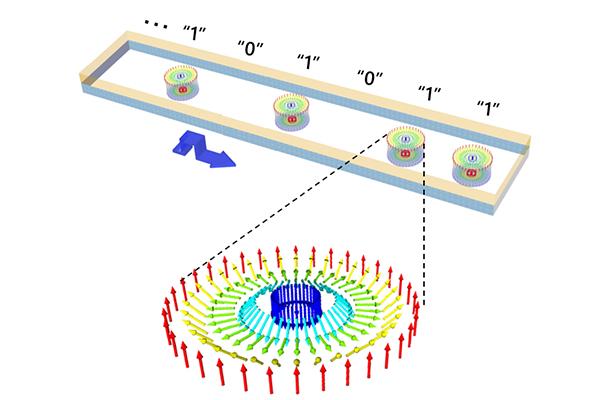
IMAGE

Credit: Takaaki Dohi and Shunsuke Fukami


Researchers at Tohoku University have, for the first time, successfully demonstrated a formation and current-induced motion of synthetic antiferromagnetic magnetic skyrmions. The established findings are expected to pave the way towards new functional information processing and storage technologies.

Magnetic skyrmion is known to be a topological object, emerged in magnetic systems. It possesses the ability to be made at nanoscale and to be driven by a current, showing promise for various applications where information is represented by the presence, absence, number, or state of the skyrmion. However, there remains one stumbling block – the skyrmion Hall effect.

The skyrmion Hall effect entails the skyrmion not moving along the current, but in the direction diagonal to the current because of the inherent angular momentum of the skyrmion, degrading the efficiency and stability of devices. As such, demand is high for technology that overcomes the skyrmion Hall effect.

The research group – which includes Professor Hideo Ohno (current Tohoku University President), Associate Professor Shunsuke Fukami, and Ph.D. candidate Mr. Takaaki Dohi – developed a magnetic stack structure in which the skyrmion is moved along the current, avoiding the skyrmion Hall effect.

The developed structure effectively exploits three spintronics effects, Ruderman-Kittel-Kasuya-Yosida (RKKY) interaction, Dzyaloshinskii-Moriya (DM) interaction, and spin-orbit (SO) interaction. Due to the RKKY and DM interactions, a synthetic antiferromagnetically-coupled (SyAF) skyrmion is successfully formed. In addition, thanks to the SO interaction, the SyAF skyrmion is moved with a much smaller current than conventional single ferromagnetic skyrmion. Moreover, suppression of skyrmion Hall effect is confirmed for the SyAF system.

This is the first demonstration of the formation and current-induced motion of magnetic skyrmion circumventing the skyrmion Hall effect at room temperature. Ultimately, the present finding is expected to open the pathway to newer spintronics devices in which topology arising in magnetic materials is fully utilized.

###

Media Contact
Shunsuke Fukami
[email protected]
81-222-175-555

Original Source

https://www.tohoku.ac.jp/en/press/straight_motion_magnetic_skyrmion.html

Related Journal Article

http://dx.doi.org/10.1038/s41467-019-13182-6

Tags: Computer ScienceElectrical Engineering/ElectronicsTechnology/Engineering/Computer Science
Share12Tweet8Share2ShareShareShare2

Related Posts

α-Synuclein Fibrils Trigger LRRK2, Disrupt Synapses

May 14, 2026

Synchronous Climbing Fibers Drive Cerebellar Learning Signals

May 14, 2026

FAU’s CA-AI Awarded $2.2M U.S. Air Force Grant to Advance Next-Generation Autonomous Systems

May 14, 2026

Parkinson’s in Isolated Congenital Anosmia Case

May 14, 2026
Please login to join discussion

POPULAR NEWS

  • Research Indicates Potential Connection Between Prenatal Medication Exposure and Elevated Autism Risk

    842 shares
    Share 337 Tweet 211
  • New Study Reveals Plants Can Detect the Sound of Rain

    729 shares
    Share 291 Tweet 182
  • Salmonella Haem Blocks Macrophages, Boosts Infection

    62 shares
    Share 25 Tweet 16
  • Breastmilk Balances E. coli and Beneficial Bacteria in Infant Gut Microbiomes

    57 shares
    Share 23 Tweet 14

About

We bring you the latest biotechnology news from best research centers and universities around the world. Check our website.

Follow us

Recent News

α-Synuclein Fibrils Trigger LRRK2, Disrupt Synapses

Synchronous Climbing Fibers Drive Cerebellar Learning Signals

FAU’s CA-AI Awarded $2.2M U.S. Air Force Grant to Advance Next-Generation Autonomous Systems

Subscribe to Blog via Email

Enter your email address to subscribe to this blog and receive notifications of new posts by email.

Join 82 other subscribers
  • Contact Us

Bioengineer.org © Copyright 2023 All Rights Reserved.

Welcome Back!

Login to your account below

Forgotten Password?

Retrieve your password

Please enter your username or email address to reset your password.

Log In
No Result
View All Result
  • Homepages
    • Home Page 1
    • Home Page 2
  • News
  • National
  • Business
  • Health
  • Lifestyle
  • Science

Bioengineer.org © Copyright 2023 All Rights Reserved.