• HOME
  • NEWS
  • EXPLORE
    • CAREER
      • Companies
      • Jobs
    • EVENTS
    • iGEM
      • News
      • Team
    • PHOTOS
    • VIDEO
    • WIKI
  • BLOG
  • COMMUNITY
    • FACEBOOK
    • INSTAGRAM
    • TWITTER
Sunday, May 10, 2026
BIOENGINEER.ORG
No Result
View All Result
  • Login
  • HOME
  • NEWS
  • EXPLORE
    • CAREER
      • Companies
      • Jobs
        • Lecturer
        • PhD Studentship
        • Postdoc
        • Research Assistant
    • EVENTS
    • iGEM
      • News
      • Team
    • PHOTOS
    • VIDEO
    • WIKI
  • BLOG
  • COMMUNITY
    • FACEBOOK
    • INSTAGRAM
    • TWITTER
  • HOME
  • NEWS
  • EXPLORE
    • CAREER
      • Companies
      • Jobs
        • Lecturer
        • PhD Studentship
        • Postdoc
        • Research Assistant
    • EVENTS
    • iGEM
      • News
      • Team
    • PHOTOS
    • VIDEO
    • WIKI
  • BLOG
  • COMMUNITY
    • FACEBOOK
    • INSTAGRAM
    • TWITTER
No Result
View All Result
Bioengineer.org
No Result
View All Result
Home NEWS Science News Chemistry

The expanding possibilities of bio-based polymers

Bioengineer by Bioengineer
March 2, 2021
in Chemistry
Reading Time: 3 mins read
0
IMAGE
Share on FacebookShare on TwitterShare on LinkedinShare on RedditShare on Telegram

Researchers from the Kleij group present a new route to prepare biobased polyesters with tuneable properties
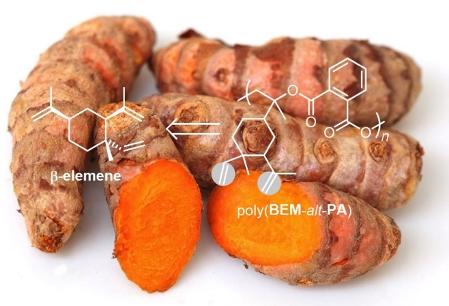
IMAGE

Credit: ICIQ/Francesco Della Monica

Finding innovative and sustainable solutions to our material needs is one of the core objectives of green chemistry. The myriad plastics that envelop our daily life – from mattresses to food and cars – are mostly made from oil-based monomers which are the building blocks of polymers. Therefore, finding bio-based monomers for polymer synthesis is attractive to achieve more sustainable solutions in materials development.

In a paper published in ACS Sustainable Chemistry & Engineering, researchers from the Kleij group present a new route to prepare biobased polyesters with tuneable properties. The researchers are building upon the multifunctional structure of the terpene β-elemene: three double bonds which have distinct reactivity, allowing to selectively transform these bonds and thus tweaking the functionalities in the backbone of the polymer. “This multi-functional terpene scaffold is rather unique and allows to fine-tune structural diversity and prospectively to modulate polymer and material properties,” explains Arjan Kleij, ICIQ group leader and ICREA professor.

In collaboration with the company Isobionics, the researchers utilised β-elemene obtained through an innovative sugar-fermentation route. This process has proved to be a promising start for the use of β-elemene as a raw material for polymerisation. “Isobionic’s sugar-fermentation route completely changes the scale of β-elemene availability, which now can be used in polymer production,” explains Francesco Della Monica, postdoctoral researcher in the Kleij group working in the European SUPREME project, an MSCActions Individual Fellowship and first author of the paper.

Via a ring-opening copolymerisation reaction (ROCOP), the researchers combined β-elemene oxides and phthalic anhydride (a common monomer used in the preparation of polyesters) to create the biobased linear polymer poly(BEM-alt-PA) and its related structure, crosslinked-poly(BED-alt-PA). These transformations were achieved with catalytic systems (iron and aluminium aminotriphenolate complexes combined with bis-(triphenylphosphine) iminium chloride) developed previously by the group using non-critical, abundant elements for catalytic polymerisation.

Once the polyester is prepared, there are two remaining double bonds from the original terpene building block that can be easily and selectively addressed and functionalised, allowing to tailor the final polyester. “These post-modification reactions on a biobased polymer are quite rare. Most of the biobased monomers that are available don’t present functionalities,” remarks Della Monica.

The paper is a starting point for further development of β-elemene based polymers that allow tailoring the properties of the final material (depending on its use) through easy post-polymerisation modifications. The paper does not address the biodegradation of the material, although for Della Monica, “depending on the final use, the ideal thing may not be biodegradation but to create a recyclable polymer: i.e., take a starting material, create the polymer, use it, recover it, and then degrade it in a controlled fashion and reuse that material. Now that we have the idea of a circular economy within grasp, we need circular processes,” concludes the scientist.

###

Media Contact
Berta Carreño
[email protected]

Original Source

https://www.iciq.org/the-expanding-possibilities-of-bio-based-polymers/

Related Journal Article

http://dx.doi.org/10.1021/acssuschemeng.0c09189

Tags: Chemistry/Physics/Materials SciencesPolymer Chemistry
Share12Tweet8Share2ShareShareShare2

Related Posts

Miniature Sensor Uses Light to Detect Touch — Chemistry

Miniature Sensor Uses Light to Detect Touch

May 8, 2026
Iron Minerals Determine Whether Dissolved Organic Matter Fuels Microbes or Becomes Long-Term Carbon Storage — Chemistry

Iron Minerals Determine Whether Dissolved Organic Matter Fuels Microbes or Becomes Long-Term Carbon Storage

May 8, 2026

Kate Evans Appointed Associate Lab Director for Biological and Environmental Systems Science at ORNL

May 8, 2026

Advancing Multiscale Modeling and Overcoming Operational Challenges in Autothermal CO₂-to-Methanol Reactors

May 8, 2026
Please login to join discussion

POPULAR NEWS

  • Research Indicates Potential Connection Between Prenatal Medication Exposure and Elevated Autism Risk

    840 shares
    Share 336 Tweet 210
  • New Study Reveals Plants Can Detect the Sound of Rain

    727 shares
    Share 290 Tweet 181
  • Scientists Investigate Possible Connection Between COVID-19 and Increased Lung Cancer Risk

    68 shares
    Share 27 Tweet 17
  • Salmonella Haem Blocks Macrophages, Boosts Infection

    61 shares
    Share 24 Tweet 15

About

We bring you the latest biotechnology news from best research centers and universities around the world. Check our website.

Follow us

Recent News

Evaluating Digoxin Use in Patients with Symptomatic Rheumatic Heart Disease

Evaluating the Effectiveness and Safety of Digitalis Glycosides in Treating Heart Failure

Urdu Fall Risk Questionnaire Adapted for Elderly

Subscribe to Blog via Email

Enter your email address to subscribe to this blog and receive notifications of new posts by email.

Join 82 other subscribers
  • Contact Us

Bioengineer.org © Copyright 2023 All Rights Reserved.

Welcome Back!

Login to your account below

Forgotten Password?

Retrieve your password

Please enter your username or email address to reset your password.

Log In
No Result
View All Result
  • Homepages
    • Home Page 1
    • Home Page 2
  • News
  • National
  • Business
  • Health
  • Lifestyle
  • Science

Bioengineer.org © Copyright 2023 All Rights Reserved.