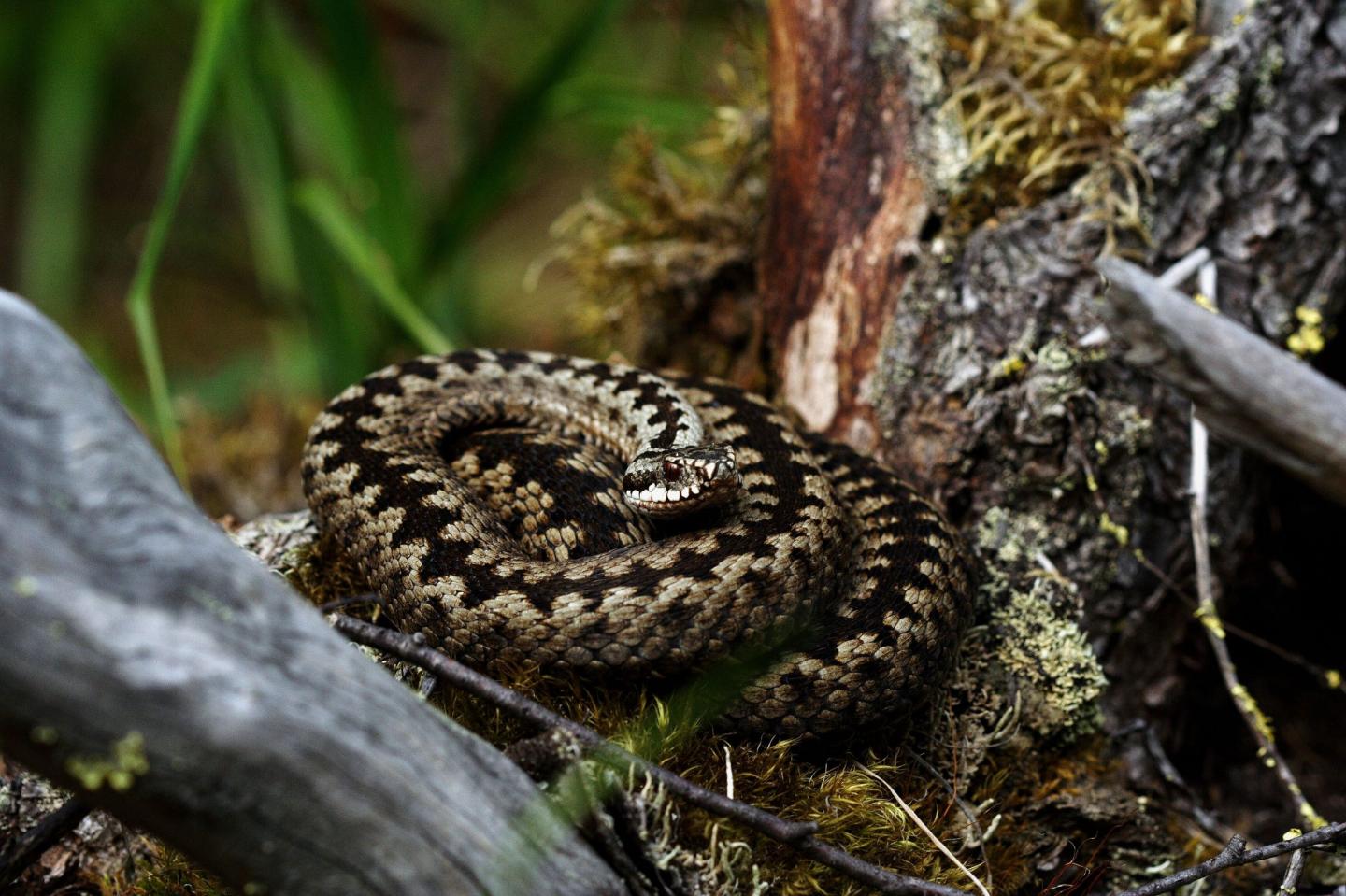
Credit: The University of Jyväskylä/Janne Valkonen
Research of the University of Jyväskylä demonstrate that the characteristic zig-zag pattern on a viper’s back performs seemingly opposing functions during a predation event. At first, the zig-zag pattern helps the snake remain undetected. But upon exposure, it provides a conspicuous warning of the snake’s dangerous defense. Most importantly the zig-zag can also produce an illusionary effect that may hide the snake’s movement as it flees. The research, published in Animal Behaviour 164 (2020), reveals how a single color pattern can have multiple effects during a predation event, thereby expanding the discussion on protective coloration and anti-predator adaptations.
Protective coloration is one of the simplest but most effective tools that prey species use to evade predators. Typically, different color patterns are useful at different stages of a predation event. Some color patterns are cryptic, obscuring the prey from being detected – think chameleons. Other patterns are aposematic, which blatantly advertise a warning to predators – think wasps. Finally, some patterns can produce optical illusions to startle or confuse predators and give the prey an escape opportunity – think zebras.
But a recent series of experiments, by a team headed by Janne Valkonen and Johanna Mappes at the University of Jyväskylä (Finland), suggests that European vipers (Vipera sp.) can achieve all three tricks with a single color pattern – their characteristic zig-zag.
At first, the zig-zag pattern helps the viper to hide. The researchers hid plasticine models of snakes with different color patterns along paths and noted how often they were detected by people walking the trail. Models with the zig-zag pattern were detected less often than plainly colored models. This is the first confirmation that the viper’s zig-zag pattern provides a cryptic function. But even if the viper is detected, the zig-zag can still work its magic – instead of hiding the snake, the pattern now functions to make it more obvious. Previous research has already established that the pattern warns predators about the snake’s dangerous bite.
The rapid flickering from the zigs and zags of a fleeing snake can produce a a ‘flicker-fusion effect’ to mammalian predators
The most significant contribution from Dr. Janne Valkonen’s study deals with a particular class of illusion generated by the zig-zag pattern. Just as how a rapid series of still pictures can produce a smooth animation, the rapid flickering from the zigs and zags of a fleeing snake can produce a solid shape.
Team measured the speed of fleeing snakes and calculated the flicker rate of the zig-zag. To an observer, a rapidly changing stimulus (such as a moving zig-zag, or spinning helicopter blade) is perceived as continuous if the flicker rate exceeds a threshold in the visual system.
The researchers found that the zig-zag moved quickly enough to produce such a ‘flicker-fusion effect’ to mammalian predators, although the quicker eyes of a raptor won’t be fooled. The effect of this illusion may change the appearance of the moving snake, making it harder to catch. So, like a skilled illusionist, the viper hides by revealing.
The viper’s zig-zag seems to be a simple pattern, but it is a masterful illusion that can hide, reveal, and paradoxically achieve both at the same time. Similarly, this research resolves theoretical tensions between apparently opposing functions of color patterns. That is, crypsis and aposematism seem mutually exclusive: one is meant to blend an animal into its surroundings, the other to make it stand out.
However, through the magic of movement and optics, both functions can be gained through the same pattern at different stages in the predation sequence. Furthermore, the one-to-many aspect of the zig-zag to its antipredator functions implies a far broader scope for the evolution of color patterns and antipredator adaptations than simple one pattern-to-one function relations.
###
Link to research in Animal Behaviour -publication (number 164) in May 2020: https:/
For further information:
Dr. Janne Valkonen, tel. +358 40 5137455, [email protected]
Academy Professor Johanna Mappes, tel +358 40 537 2263, [email protected]
Communications officer Tanja Heikkinen, [email protected], tel. +358 50 581 8351
The Faculty of Mathematics and Science:
https:/
FB: jyuscience Twitter: jyscience
Media Contact
Academy Professor Johanna Mappes
[email protected]
Original Source
https:/
Related Journal Article
http://dx.