• HOME
  • NEWS
  • EXPLORE
    • CAREER
      • Companies
      • Jobs
    • EVENTS
    • iGEM
      • News
      • Team
    • PHOTOS
    • VIDEO
    • WIKI
  • BLOG
  • COMMUNITY
    • FACEBOOK
    • INSTAGRAM
    • TWITTER
Saturday, February 7, 2026
BIOENGINEER.ORG
No Result
View All Result
  • Login
  • HOME
  • NEWS
  • EXPLORE
    • CAREER
      • Companies
      • Jobs
        • Lecturer
        • PhD Studentship
        • Postdoc
        • Research Assistant
    • EVENTS
    • iGEM
      • News
      • Team
    • PHOTOS
    • VIDEO
    • WIKI
  • BLOG
  • COMMUNITY
    • FACEBOOK
    • INSTAGRAM
    • TWITTER
  • HOME
  • NEWS
  • EXPLORE
    • CAREER
      • Companies
      • Jobs
        • Lecturer
        • PhD Studentship
        • Postdoc
        • Research Assistant
    • EVENTS
    • iGEM
      • News
      • Team
    • PHOTOS
    • VIDEO
    • WIKI
  • BLOG
  • COMMUNITY
    • FACEBOOK
    • INSTAGRAM
    • TWITTER
No Result
View All Result
Bioengineer.org
No Result
View All Result
Home NEWS Science News

The Darknet protects itself by being more robust against attacks

Bioengineer by Bioengineer
March 6, 2017
in Science News
Reading Time: 2 mins read
0
Share on FacebookShare on TwitterShare on LinkedinShare on RedditShare on Telegram
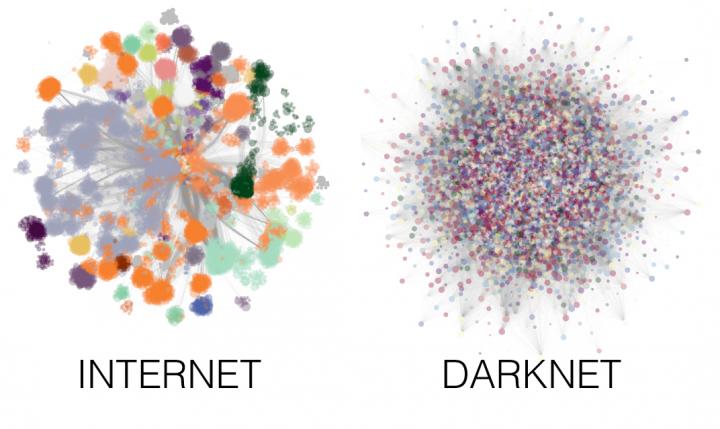
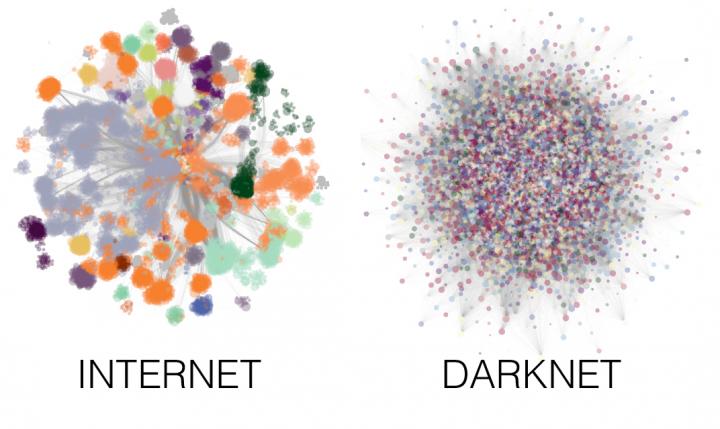
IMAGE

Credit: ©URV

The Darknet is a part of the internet that people can access and use anonymously. This privacy and the ability to work away from prying eyes means that the network is frequently used for anonymous exchanges of sensitive information and for illegal activities such as drug trafficking, sharing child pornography or exchanging protected intellectual property free of charge.

Cyberattacks are frequently launched against this network but usually with little success. Now, the researchers Manlio De Domenico and Alex Arenas from the URV's Department of Computer Engineering and Mathematics have manged to determine why the Darknet is so difficult to attack. In an article published in Physical Review E, the Darknet is practically impenetrable because of its unique topology, which is significantly different from the rest of the internet.

To demonstrate this, the researchers have used data published by the Internet Research Lab of the University of California (Los Angeles) and network analysis to quantify the resilience of the Darknet. They have described its topology and have developed a model that shows how information is transmitted using the "onion router", a technique that encrypts messages in multiple layers.

This has allowed them to simulate how the Darknet would respond to three types of attack: attacks on a specific node, attacks that cause certain nodes to fail randomly, and attacks that unleash a wave of errors that are propagated across the network.

The study's results show that to cause significant disruption an attack on the Darknet's various nodes needs to be four times stronger than an attack against the internet's nodes. Furthermore, the Darknet is able to easily counter the waves of attacks through its different nodes by simply adding more network capacity. The authors attribute this resilience to a more decentralised topology that emerges spontaneously from the Darknet's onion router protocol. In comparison, the internet's structure is much more heterogeneous.

###

Manlio De Domenico and Alex Arenas. "Modeling Structure and Resilience of the Dark Network". Physical Review, 2017. E. DOI: 10.1103/PhysRevE.95.022313

Media Contact

Alex Arenas
[email protected]
34-977-559-687
@universitatURV

http://www.urv.cat

############

Story Source: Materials provided by Scienmag

Share12Tweet8Share2ShareShareShare2

Related Posts

Scientists Identify SARS-CoV-2 PLpro and RIPK1 Inhibitors Showing Potent Synergistic Antiviral Effects in Mouse COVID-19 Model

February 7, 2026

Neg-Entropy: The Key Therapeutic Target for Chronic Diseases

February 7, 2026

Multidisciplinary Evidence-Based Guidelines for Therapeutic Drug Monitoring of Biologics in Inflammatory Bowel Disease

February 7, 2026

Early Tuberculosis Treatment Lowers Sepsis Mortality in People with HIV

February 7, 2026
Please login to join discussion

POPULAR NEWS

  • Robotic Ureteral Reconstruction: A Novel Approach

    Robotic Ureteral Reconstruction: A Novel Approach

    82 shares
    Share 33 Tweet 21
  • Digital Privacy: Health Data Control in Incarceration

    63 shares
    Share 25 Tweet 16
  • Study Reveals Lipid Accumulation in ME/CFS Cells

    57 shares
    Share 23 Tweet 14
  • Breakthrough in RNA Research Accelerates Medical Innovations Timeline

    53 shares
    Share 21 Tweet 13

About

We bring you the latest biotechnology news from best research centers and universities around the world. Check our website.

Follow us

Recent News

Scientists Identify SARS-CoV-2 PLpro and RIPK1 Inhibitors Showing Potent Synergistic Antiviral Effects in Mouse COVID-19 Model

Neg-Entropy: The Key Therapeutic Target for Chronic Diseases

Multidisciplinary Evidence-Based Guidelines for Therapeutic Drug Monitoring of Biologics in Inflammatory Bowel Disease

Subscribe to Blog via Email

Enter your email address to subscribe to this blog and receive notifications of new posts by email.

Join 73 other subscribers
  • Contact Us

Bioengineer.org © Copyright 2023 All Rights Reserved.

Welcome Back!

Login to your account below

Forgotten Password?

Retrieve your password

Please enter your username or email address to reset your password.

Log In
No Result
View All Result
  • Homepages
    • Home Page 1
    • Home Page 2
  • News
  • National
  • Business
  • Health
  • Lifestyle
  • Science

Bioengineer.org © Copyright 2023 All Rights Reserved.