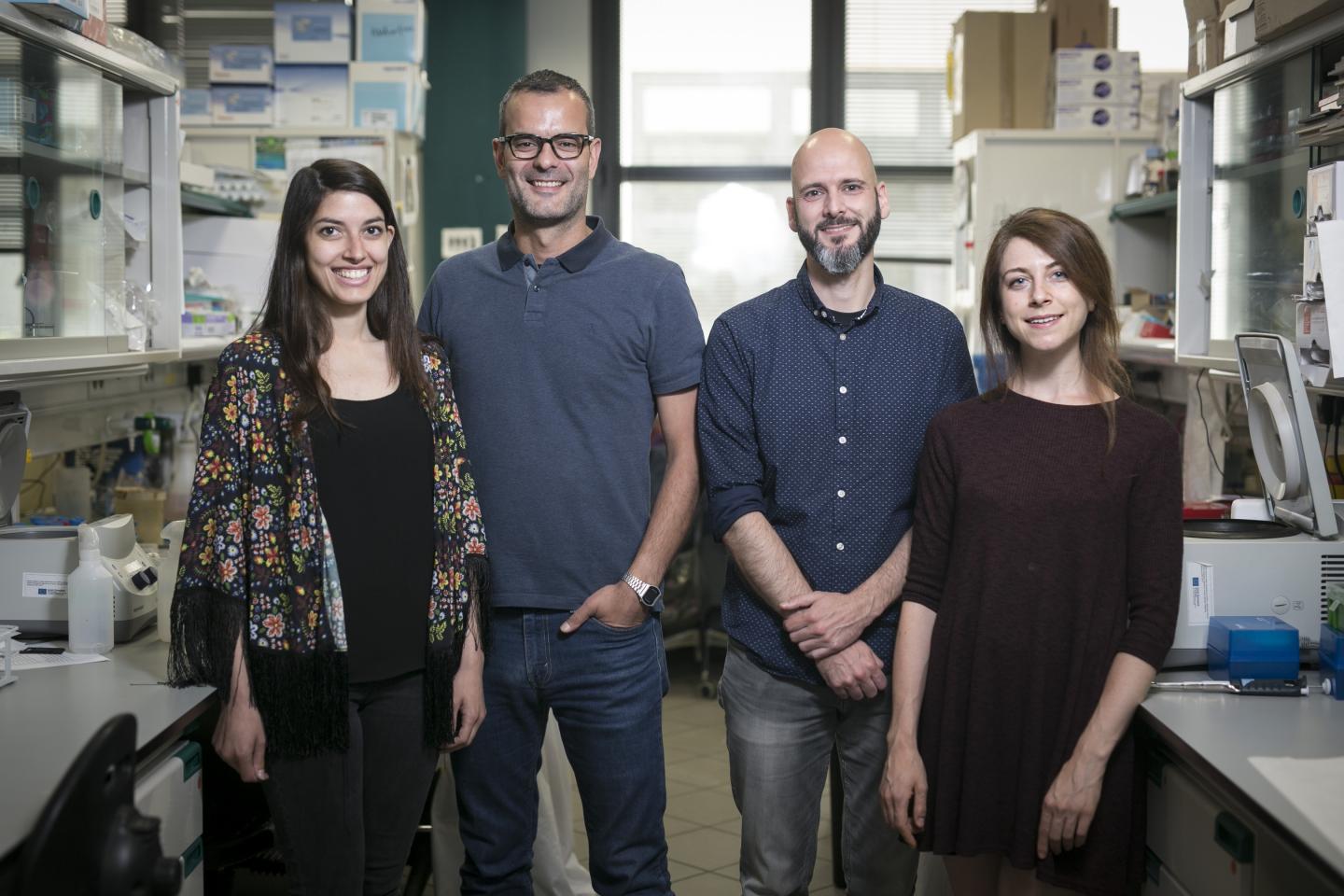
Credit: IRB Barcelona
During the day, we experience a series of physical, mental and behavioural changes know as circadian rhythms. These changes are governed by a central clock, located in the hypothalamus, which lies in the centre of the brain. This clock is responsible for synchronizing our tissues to ensure that their functions are coordinated and that they work with the same clock.
Scientists at the Institute for Research in Biomedicine (IRB Barcelona) have revealed that although each tissue receives information from the central clock in order to coordinate its functions, each one also has the capacity to respond independently to variations in light and to detect changes in light intensity between the day and night.
Published in two papers in the journal Cell, the studies confirm that this autonomy allows tissues to maintain minimal functions even when another tissue in our body is failing. “The results of these studies are likely to be particularly relevant during aging and in diseases in which high tissue interdependence would lead to a general deterioration of the organism,” says Salvador Aznar Benitah, head of the Stem Cells and Cancer Laboratory at IRB Barcelona.
Until now, there was no suitable animal model in which to test whether the clock regulating all our organs and tissues is coordinated by the brain or, as has been observed, whether these organs and tissue are capable of responding directly to the cyclic environmental changes that occur every day. This study, which has been conducted by IRB Barcelona, in collaboration with Paolo Sassone-Corsi’s team at the University of California, Irvine (US), has been possible thanks to a new mouse model that has allowed researchers to isolate the communication of each tissue from the rest.
The first authors of this work, postdoctoral fellow Patrick Simon Welz and “La Caixa” PhD student Valentina María Zinna, both at IRB Barcelona, compared the circadian rhythms of the epidermis and liver of this mouse model–in which there is no communication between different tissues–with those of healthy mice and mice with an impaired central clock. Using this approach, they confirmed the autonomy of both kinds of tissue to respond to the variation in light that occurs as the day progresses.
The central clock communicates with the entire body
As already mentioned, although each tissue is autonomous, this does not imply the absence of communication with the rest of the body. “We confirmed that the central clock communicates from the brain with the rest of the body, providing useful information to ensure its correct function, informing, for example, the gastrointestinal tract, liver and pancreas that it is time to eat and allowing them to prepare for digestion. But when this communication fails, each organ is able to know what time it is and thus to perform their basic functions,” explains ICREA researcher Salvador Aznar Benitah.
“Our results have important implications for health,” adds Aznar Benitah. Our current lifestyle exposes us to light when we should be in darkness. Given that each organ is able to respond independently to light, body functions that should occur during the day take place at night. This daily phase difference or social jet-lag might be responsible for premature aging and the development of certain pathologies.
###
The studies have been supported by the European Research Council (ERC), the Catalan Government, the Ministry of Science, Innovation and Universities (previously called MIMECO), the Botín Foundation, Banco Santander Universidades, the EU’s Horizon 2020 Framework programme, and the “La Caixa” Banking Foundation.
Reference article:
Welz PS#, Zinna VM, Symeonidi A, Koronowski K, Kinouchi K, Smith JG, Guillén IM, Castellanos A, Prats N, Caballero JM, Sassone-Corsi P# and Benitah SA#.
Bmal1-drive tissue clocks respond independently to light to regulate homeostasis.
Cell (2019) DOI: 10.1016/j.cell.2019.05.009
Kevin B. Koronowski1*, Kenichiro Kinouchi1*, Patrick-Simon Welz2, Valentina Maria Zinna2, Jiejun Shi3,4, Muntaha Samad5, Siwei Chen5, Jacob G. Smith1, Jason Kinchen6, Wei Li3,4, Pierre Baldi5, Salvador Aznar Benitah#, and Paolo Sassone-Corsi1#.
Defining the autonomy of the liver circadian clock.
Cell (2019) DOI: 10.1016/j.cell.2019.04.025
Media Contact
Communication IRB Barcelona
[email protected]
Original Source
https:/
Related Journal Article
http://dx.