• HOME
  • NEWS
  • EXPLORE
    • CAREER
      • Companies
      • Jobs
    • EVENTS
    • iGEM
      • News
      • Team
    • PHOTOS
    • VIDEO
    • WIKI
  • BLOG
  • COMMUNITY
    • FACEBOOK
    • INSTAGRAM
    • TWITTER
Monday, August 31, 2026
BIOENGINEER.ORG
No Result
View All Result
  • Login
  • HOME
  • NEWS
  • EXPLORE
    • CAREER
      • Companies
      • Jobs
        • Lecturer
        • PhD Studentship
        • Postdoc
        • Research Assistant
    • EVENTS
    • iGEM
      • News
      • Team
    • PHOTOS
    • VIDEO
    • WIKI
  • BLOG
  • COMMUNITY
    • FACEBOOK
    • INSTAGRAM
    • TWITTER
  • HOME
  • NEWS
  • EXPLORE
    • CAREER
      • Companies
      • Jobs
        • Lecturer
        • PhD Studentship
        • Postdoc
        • Research Assistant
    • EVENTS
    • iGEM
      • News
      • Team
    • PHOTOS
    • VIDEO
    • WIKI
  • BLOG
  • COMMUNITY
    • FACEBOOK
    • INSTAGRAM
    • TWITTER
No Result
View All Result
Bioengineer.org
No Result
View All Result
Home NEWS Science News Health

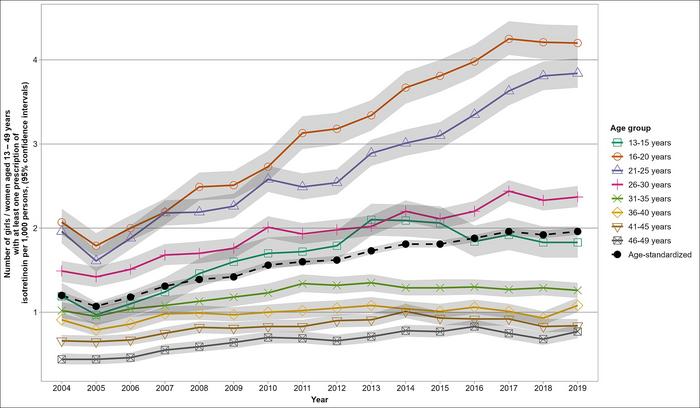
The anti-acne medicine isotretinoin, which can cause defects in a developing fetus, is now used by almost 2 in 1,000 girls and women of childbearing age, according to analysis of German database of 25 million
Bioengineer by Bioengineer
January 25, 2024
in Health
Reading Time: 2 mins read
0
The anti-acne medicine isotretinoin, which can cause defects in a developing fetus, is now used by almost 2 in 1,000 girls and women of childbearing age, according to analysis of German database of 25 million
Share on FacebookShare on TwitterShare on LinkedinShare on RedditShare on Telegram

The anti-acne medicine isotretinoin, which can cause defects in a developing fetus, is now used by almost 2 in 1,000 girls and women of childbearing age, according to analysis of German database of 25 million

The anti-acne medicine isotretinoin, which can cause defects in a developing fetus, is now used by almost 2 in 1,000 girls and women of childbearing age, according to analysis of German database of 25 million

Credit: Reinold J, et al., 2024, PLOS Medicine, CC-BY 4.0 (https://creativecommons.org/licenses/by/4.0/)

The anti-acne medicine isotretinoin, which can cause defects in a developing fetus, is now used by almost 2 in 1,000 girls and women of childbearing age, according to analysis of German database of 25 million


#####

In your coverage, please use this URL to provide access to the freely available paper in PLOS Medicine: http://journals.plos.org/plosmedicine/article?id=10.1371/journal.pmed.1004339

Article Title: Use of isotretinoin among girls and women of childbearing age and occurrence of isotretinoin-exposed pregnancies in Germany: A population-based study

Author Countries: Germany

Funding: The study was partly funded by the German Federal Institute for Drugs and Medical Devices, Bonn (BfArM, V-18281/ 68605 / 2019-2020) (https://www.bfarm.de). The study proposal was submitted by UH. The funders had no role in study design, data collection and analysis, decision to publish, or preparation of the manuscript.


Journal

PLoS Medicine

DOI

10.1371/journal.pmed.1004339

COI Statement

Competing Interests: see manuscript

Share12Tweet8Share2ShareShareShare2

Related Posts

Wearable monitor improves diagnosis of heart rhythm disorders after fainting

August 31, 2026

Visualisation of magnetic field-induced nanoparticle clusters and mechanical property changes in a breast phantom for inductive moderate hyperthermia

August 31, 2026

Multidisciplinary intervention in frail elderly patients with cardiovascular diseases: a multicentre, single-blinded, randomised controlled trial

August 31, 2026

Machine Learning Model Development and Evaluation for Non-contact Lower Limb Injury Risk Prediction in Elite Male Rugby Union: A Multi-team, Multi-season Analysis

August 31, 2026

POPULAR NEWS

  • β-Sitosterol from Ipomoea carnea Jacq. As a promising anti-inflammatory agent: Evidence from in silico modeling and in vitro validation

    29 shares
    Share 12 Tweet 7
  • Design, fabrication and characterization of a wearable Fiber Bragg grating sensor for cardiorespiratory monitoring using finger plethysmography

    29 shares
    Share 12 Tweet 7
  • KAIST opens the era of industrial-scale microbial foods, proposing growth strategies for the next-generation protein market

    29 shares
    Share 12 Tweet 7
  • Virologist awarded $2 million NIH grant to investigate how virus-infected cells live and die

    29 shares
    Share 12 Tweet 7

About

We bring you the latest biotechnology news from best research centers and universities around the world. Check our website.

Follow us

Recent News

β-Sitosterol from Ipomoea carnea Jacq. As a promising anti-inflammatory agent: Evidence from in silico modeling and in vitro validation

Design, fabrication and characterization of a wearable Fiber Bragg grating sensor for cardiorespiratory monitoring using finger plethysmography

KAIST opens the era of industrial-scale microbial foods, proposing growth strategies for the next-generation protein market

Subscribe to Blog via Email

Enter your email address to subscribe to this blog and receive notifications of new posts by email.

Join 85 other subscribers
  • Contact Us

Bioengineer.org © Copyright 2023 All Rights Reserved.

Welcome Back!

Login to your account below

Forgotten Password?

Retrieve your password

Please enter your username or email address to reset your password.

Log In
No Result
View All Result
  • Homepages
    • Home Page 1
    • Home Page 2
  • News
  • National
  • Business
  • Health
  • Lifestyle
  • Science

Bioengineer.org © Copyright 2023 All Rights Reserved.