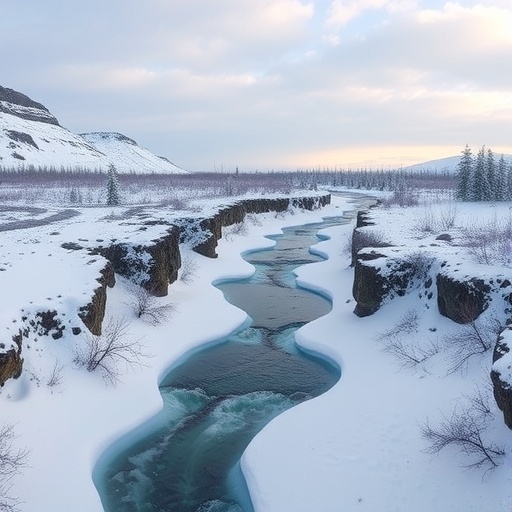
A groundbreaking study recently published in Nature challenges prevailing assumptions about permafrost thawing and its contribution to global carbon emissions. Conducted by an international team of researchers from Umeå University in Sweden and East China Normal University, this comprehensive investigation sheds new light on how rock weathering processes modulate carbon dioxide (CO₂) dynamics in river systems across the Qinghai–Tibet Plateau. Their findings reveal a complex interplay between biological carbon release and geological carbon sequestration, indicating that the degradation of permafrost exposes reactive minerals that accelerate chemical weathering and facilitate the consumption of atmospheric CO₂.
Permafrost thawing has long been recognized primarily as a potent source of greenhouse gases. As ancient organic carbon trapped in frozen soils thaws, it becomes available for microbial metabolism, releasing CO₂ and methane into the atmosphere, amplifying climate warming feedback loops. However, this new research overturns the simplistic narrative by demonstrating that thawing permafrost also triggers geological processes capable of partially offsetting these emissions. Specifically, rivers flowing through thawing landscapes engage in intensified water–rock interactions that dissolve minerals and sequester carbon in inorganic forms, a process known as chemical weathering.
The study focused on 50 river catchments distributed throughout the Qinghai–Tibet Plateau, the Earth’s largest high-altitude cryosphere outside the polar regions. This region presents a natural laboratory to explore permafrost and its associated carbon cycling under rapidly changing climatic conditions. By integrating diverse datasets—including direct measurements of riverine CO₂ efflux, dissolved carbon concentrations, isotopic tracers, and detailed geochemical modeling—the researchers reconstructed carbon fluxes with unprecedented resolution. Their multifaceted approach provided compelling evidence that geological carbon uptake via rock weathering is intricately linked to permafrost degradation.
One of the most striking outcomes of the study is the observation that river CO₂ emissions diminish as permafrost coverage declines, while weathering-driven carbon sequestration concurrently intensifies. Liwei Zhang, a biogeochemist at East China Normal University and lead author, explains that this inverse relationship is due to enhanced exposure of reactive mineral surfaces and increased water-rock contact times as formerly frozen terrains thaw. The reactive minerals undergo dissolution reactions that consume CO₂ from the atmosphere, thereby reducing net greenhouse gas emissions from the riverine environment.
Beyond this general trend, the data revealed that in some river basins characterized by discontinuous or patchy permafrost, chemical weathering processes can sequester more carbon than is emitted through biological respiration. In these localized regions, geological carbon uptake exceeded 100 percent of riverine CO₂ emissions. This finding suggests a critical reevaluation of the relative roles of biological and geological carbon fluxes in thawing permafrost landscapes. Rather than being exclusive carbon sources, thawing regions may simultaneously foster conditions conducive to significant inorganic carbon sequestration.
To better understand these dynamics, the researchers analyzed isotopic signatures and geochemical tracers indicative of different carbon sources and weathering pathways. Their results confirmed that the carbon consumed during mineral dissolution is largely of atmospheric origin, implicating enhanced rock weathering as a direct sink for CO₂. Moreover, variations in catchment geology influenced the extent of this carbon uptake, with silicate-rich bedrock promoting more effective CO₂ consumption compared to carbonate-dominated systems where weathering reactions can sometimes release CO₂.
The implications of this study extend to the broader understanding of climate feedback mechanisms in cold-region ecosystems. The tight coupling between biological and geological carbon cycles unveiled here complicates predictions of net carbon balance in permafrost regions. While biological degradation of ancient organic carbon undoubtedly accelerates atmospheric greenhouse gas concentrations, geological processes acting in parallel exert a counterbalancing effect through inorganic carbon sequestration. This duality necessitates integrated models that incorporate both biotic and abiotic drivers to more accurately forecast future climate trajectories.
Despite these illuminating discoveries, the authors caution against interpreting rock weathering as a panacea for climate change mitigation. The efficiency and permanence of this geological carbon sink depend heavily on mineralogical composition, hydrological conditions, and landscape evolution—all factors subject to complex feedbacks under ongoing warming. Some weathering reactions may release CO₂, and transient factors such as sediment transport and river morphology changes further complicate the carbon budget. Consequently, rock weathering represents a nuanced climate factor that demands careful inclusion in earth system modeling.
Jan Karlsson, professor at Department of Ecology, Environment and Geoscience at Umeå University and co-author of the study, emphasizes that future climate assessments must broaden their focus beyond solely biological carbon emissions. He highlights the need to incorporate geological carbon sources and sinks emerging from thawing permafrost landscapes. This comprehensive perspective is essential not only for accurate climate projections but also for devising effective policy responses grounded in the full complexity of Earth’s carbon cycling processes.
This revelatory research underscores the critical importance of multidisciplinary approaches combining field observations, laboratory analyses, and modeling efforts to unravel the intricate carbon dynamics in permafrost regions. Understanding the balance between carbon release and uptake mechanisms will be pivotal for predicting the net impact of thawing permafrost on global climate and for guiding mitigation strategies aimed at stabilizing atmospheric CO₂ concentrations.
As the cryosphere continues to respond to accelerating climate change, river systems on high-altitude plateaus and polar landscapes emerge as key sites where biological and geological forces converge to regulate carbon fluxes. The Qinghai–Tibet Plateau study exemplifies how uncovering such hidden interactions can refine scientific insights and inform global climate dialogues, highlighting the multifaceted nature of the Earth’s response to warming.
In summary, this research reveals that thawing permafrost activates intensified rock weathering in river catchments, which significantly counterbalances, and in some cases exceeds, biological carbon emissions. These findings prompt a paradigm shift in how we conceptualize carbon cycling in cold environments and stress the imperative to integrate geological carbon sinks into climate assessments. By advancing our understanding of these processes, the study opens new avenues for exploring natural carbon regulation mechanisms amid a warming world.
Subject of Research: Not applicable
Article Title: Rock weathering can counteract river CO2 emissions induced by permafrost thaw
News Publication Date: 17-Jun-2026
Web References: https://doi.org/10.1038/s41586-026-10664-8
References: Nature, 2026 June 17, DOI: 10.1038/s41586-026-10664-8
Image Credits: Liwei Zhang
Keywords
Permafrost thaw, rock weathering, carbon cycle, CO₂ sequestration, Qinghai–Tibet Plateau, chemical weathering, geological carbon sink, river CO₂ emissions, climate feedbacks, biogeochemistry, inorganic carbon, cryosphere
Tags: biological versus geological carbon releasechemical weathering and carbon sequestrationgeological carbon uptake processesgreenhouse gas emissions from permafrosthidden carbon sink in riversimpact of permafrost degradation on climateinternational research on permafrost carbon feedbackmitigation potential of permafrost thawpermafrost thawing and carbon cycleQinghai–Tibet Plateau river systemsrock weathering and CO2 dynamicswater-rock interactions in thawing landscapes