


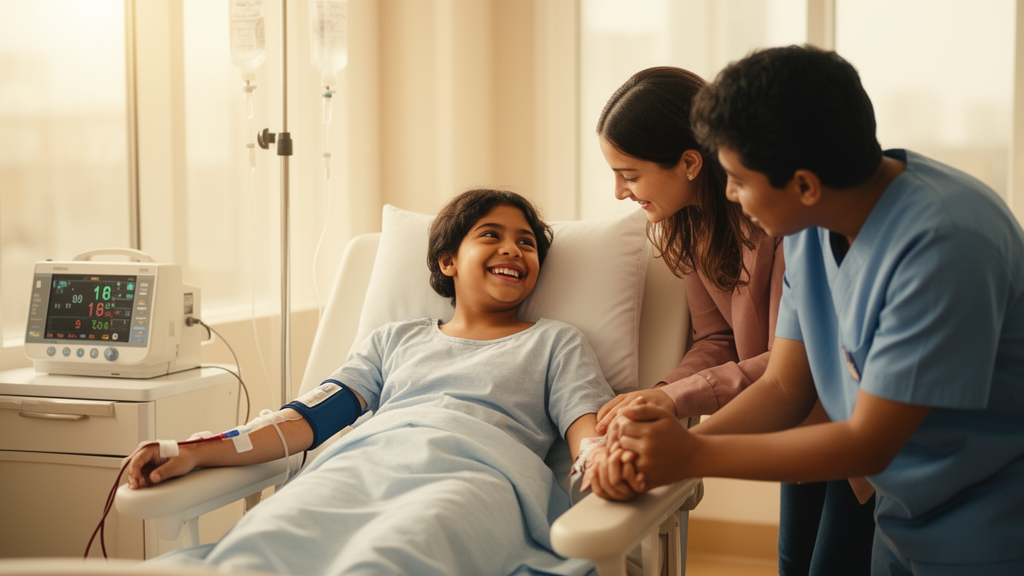
The open-access research, published in Discover Social Science and Health, compared psychological measures between 64 thalassemia patients and 64 healthy controls.
The researchers matched each healthy participant to a patient by age and education level, a design choice intended to isolate the psychological profile associated with living with the disorder rather than differences in demographic background. All 128 participants completed three standardized instruments: the Perceived Stress Scale (PSS-14), the Coping Inventory for Stressful Situations short form (CISS-SF), and the Fleming Social Support Scale.
The stress results were striking. The abstract reports perceived stress scores of 22.6 ± 5.0 versus 28.2 ± 5.2 (P < 0.001) and states that patients' perceived stress was significantly higher than that of healthy individuals, though it does not clearly label which group each numeric value belongs to. This indicates that people managing thalassemia perceive substantially more stress in their daily lives than their healthy peers of similar age and education.
Social support showed the opposite pattern. Patients reported significantly higher overall support, averaging 16.8 ± 3.1 versus 14.9 ± 3.7 in the control group (P = 0.003).
Coping styles also differentiated the two groups. The study therefore paints a picture of patients facing more stress, drawing on more social support, but employing these two coping styles less frequently than their healthy counterparts.
The authors draw a practical implication from their findings: the study recommends that healthcare professionals work to enhance coping strategies against stress in the care of thalassemia patients. The elevated stress levels observed, they write, underscore the need for targeted interventions to improve coping skills for these individuals. Because the coping instruments measure habitual responses to stressful situations rather than the outcomes of any intervention, the results identify where support might be directed, not which programs work.
The team is candid about the limits of the evidence. They point to the study’s limited sample size and its sampling method, and recommend that future research use a larger, randomly sampled survey to produce more generalizable findings. With 64 patients recruited from a single thalassemia center, the psychological profile reported here may not extend to all people with thalassemia, and the matched-control design, while controlling for age and education, cannot establish causal relationships between the disorder and stress, coping, or support.
Even so, the paired findings offer a coherent message for clinicians and families. People living with thalassemia appear to be embedded in supportive networks of family and peers, yet they carry a heavier perceived stress burden and rely less on task-focused and emotion-focused coping strategies. The combination suggests that strengthening individual coping skills, alongside the social support that already exists, could be a meaningful target for psychological care in this population, pending confirmation in larger and more representative samples.
Subject of Research: Perceived stress, coping styles and social support in patients with thalassemia compared with matched healthy controls
Article Title: Stress, coping styles and social support in patients with thalassemia: a case–control study
Article References: Tamaddoni, A., Sefidchian, A., Alijanpour, M., Mohammadi, M., Ghadimi, R., Sepidarkish, M., Aligoltabar, S., Shahrokhi, S., & Faramarzi, M. (2026). Stress, coping styles and social support in patients with thalassemia: a case–control study. Discover Social Science and Health. https://doi.org/10.1007/s44155-025-00302-5
Image Credits: AI Generated
DOI: 10.1007/s44155-025-00302-5
Keywords: thalassemia, perceived stress, coping styles, social support, case-control study, PSS-14, CISS-SF, chronic illness, psychological health, Babol University of Medical Sciences, Stress, coping
News Source: Glenn Wilkins. (October 29, 2026). Thalassemia Patients Report More Stress and Social Support Than Healthy Peers. Scienmag.



