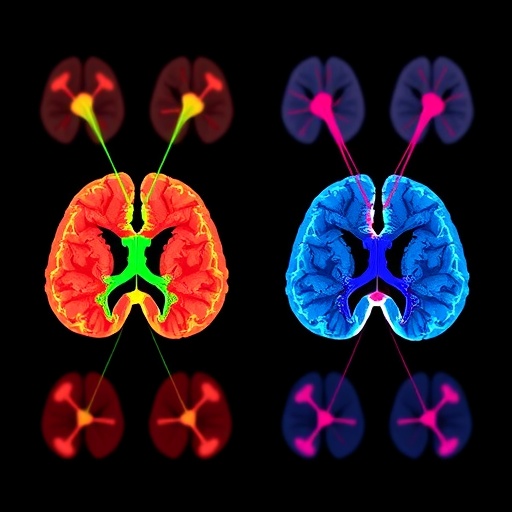
In the ever-changing landscapes of natural environments, organisms face the challenge of making decisions based not only on current stimuli but also on preceding experiences. This cognitive phenomenon, known as serial dependence, equips individuals with the ability to bias decisions in favor of recent past information, thereby optimizing adaptive responses to gradual environmental changes. Although previous large-scale neural recordings have revealed that history-dependent representations permeate multiple brain regions during decision-making, the exact neural circuitry and computations responsible for this bias have remained elusive.
A groundbreaking study led by Zhao, Shan, Liu, and colleagues (2026) has now uncovered a hierarchical brain network in zebrafish that elegantly orchestrates these history-biased decisions. Through innovative whole-brain imaging at cellular resolution paired with behavioral analysis of memory-guided evasive maneuvers, the researchers identified a specialized thalamus–brainstem circuit underpinning the retention and integration of past information to steer future choices. This discovery represents a considerable advance in our understanding of how brains convert sensory history into adaptive behavior, potentially reflecting a generalizable architecture across species.
Central to the findings is the identification of discrete attractor states within the dorsal thalamus. Rather than encoding memory as a fading analog signal, these attractor ensembles maintain a categorical memory trace of the most recent environmental obstacle encountered. This persistent activity, lasting between 10 to 20 seconds, effectively sustains an internal representation of prior experience that can bias subsequent action selection. The attractor states act much like stable basins in the neural landscape, enabling robustness against transient noise and ensuring reliable memory retention over behaviorally relevant timescales.
The researchers further demonstrated causality by optogenetically manipulating the dorsal thalamus. Suppression of this region eliminated the natural serial bias observed in zebrafish decision-making, while its artificial activation imposed a contrived bias aligned with the induced attractor state. This compelling evidence highlights the necessity and sufficiency of dorsal thalamic circuits in sustaining history-dependent biases and causally influencing decisions, moving beyond mere correlational observations to pinpoint a functional substrate.
Downstream of the thalamus, the study revealed a brainstem integrator circuit that assimilates both the persistent thalamic input and ongoing sensory signals. Unlike the categorical attractor, this integrator produces graded neural responses that represent the accumulation of multi-trial history. This stepwise integration allows for flexible sensory processing tuned by past experience, enabling zebrafish to reconcile immediate sensory cues with a nuanced internal context, ultimately guiding nuanced motor outputs during evasive maneuvers.
To systematically map and test this complex neural architecture, Zhao et al. leveraged a comprehensive zebrafish whole-brain atlas. Employing computational modeling grounded in empirical data, they constructed a biologically plausible attractor–integrator framework that faithfully reproduced observed behavior and neural dynamics. Intriguingly, the model predicted that heterogeneous inhibitory neuron subtypes play a pivotal role in facilitating state transitions within attractor networks, thus enabling flexible adaptation across diverse behavioral contexts.
This attractor–integrator scheme provides a novel and unifying principle that reconciles two fundamental requirements of decision-making: the need for robust memory retention of past events and the capability for flexible integration of current sensory inputs. By modularizing these functions into distinct yet interacting circuits, the zebrafish brain exemplifies a hierarchical computation in service of history-biased choices, a mechanism likely conserved across vertebrates given the evolutionary conservation of thalamic and brainstem structures.
The methodological innovation enabling these discoveries is notable. The team utilized advanced light-sheet microscopy techniques for whole-brain functional imaging at cellular resolution, allowing simultaneous capture of neural activity across thousands of neurons in freely behaving zebrafish. This approach bridges the gap between microscopic neuronal dynamics and macroscopic brain-wide computations, facilitating unprecedented insight into distributed neural mechanisms underlying cognition.
Historically, serial dependence has been documented in humans, primates, and rodents, often linked to perceptual and mnemonic processes distributed throughout cortical and subcortical regions. However, pinpointing discrete circuit elements that maintain history-specific internal states has been challenging. This study addresses this gap by demonstrating how discrete dorsal thalamic attractors embody categorical memories and by elucidating their impact on downstream integrator circuits to shape gradual behavioral adjustments linked to environmental regularities.
Beyond basic neuroscience, these findings carry broader implications for understanding decision-making disorders where history dependence is maladaptive, such as addiction or obsessive-compulsive disorder. The modular architecture uncovered here suggests potential targets for neuromodulation or pharmacological intervention aimed at recalibrating aberrant serial biases, thereby restoring flexible, goal-directed behavior.
Finally, this attractor–integrator model encourages a rethinking of how brains balance stability with flexibility. Rather than relying solely on continuous attractors or transient synaptic changes, the integration of persistent categorical memories with graded, integrative circuits offers a versatile computational motif. Such an arrangement might support a wide range of cognitive functions beyond decision-making, including working memory, attention, and learning, highlighting the profound significance of thalamic and brainstem circuits in shaping complex behaviors.
In conclusion, Zhao and colleagues have illuminated a fundamental neural mechanism by which the brain harnesses past experiences to inform future decisions. The synergy of discrete dorsal thalamic attractors coupled with graded brainstem integrators reveals an elegant hierarchical network capable of sustaining, integrating, and applying sensory history across time. This work not only deepens our understanding of serial dependence but also sets the stage for future explorations into how such universal principles manifest throughout the animal kingdom, shaping the very fabric of adaptive behavior.
Subject of Research:
Neural circuits underlying serial dependence and history-biased decision-making in zebrafish.
Article Title:
A thalamus–brainstem attractor network drives history-biased decisions.
Article References:
Zhao, S., Shan, H., Liu, X. et al. A thalamus–brainstem attractor network drives history-biased decisions. Nature (2026). https://doi.org/10.1038/s41586-026-10623-3
Image Credits:
AI Generated
DOI:
https://doi.org/10.1038/s41586-026-10623-3
Tags: adaptive behavior in natural environmentscross-species neural architecturedorsal thalamus attractor stateshierarchical brain networkshistory-dependent neural representationsmemory-guided evasive behaviorneural circuitry of biased decisionssensory history integrationserial dependence in decision-makingthalamus-brainstem networkwhole-brain cellular resolution imagingzebrafish brain imaging