Tablet manufacturing is, at its core, a physical transformation. Powders are conveyed, blended, granulated and compressed, and along the way they continuously change in density, dimensions, morphology and microstructure before being dosed into compacts of defined mass. According to researcher Moritz Anuschek, whose doctoral and postdoctoral work at the University of Copenhagen and Novo Nordisk in Denmark has focused on this problem, it is precisely these changes in physical material attributes that ultimately drive product and process variability in pharmaceutical production. Yet the analytical tools that the industry relies on most heavily were not designed to see them.
Since the United States Food and Drug Administration published its process analytical technology, or PAT, guidance document in 2004, the field has developed largely around compositional analysis, such as confirming blend homogeneity. Near-infrared and Raman spectroscopy in particular are now routinely used during process development and manufacturing, and they form a central part of Quality-by-Design and continuous manufacturing strategies. These techniques excel at answering a chemical question: what is in the product, and is it evenly distributed?
The difficulty, Anuschek argues, is that ensuring the correct chemical composition of the final dosage form, while essential, overlooks the physical nature of tablet manufacturing. Physical sources of variability such as powder densification, lubrication, tablet porosity and microstructure, or tablet mass are often assessed only indirectly, using contact-based or destructive methods, or are not monitored in-process at all. In his view, this limited ability to monitor and control physical attributes represents one of the key analytical challenges standing in the way of greater automation, process integration and adaptive operation in pharmaceutical manufacturing, because it hinders direct observation of the underlying drivers of process and product variability.
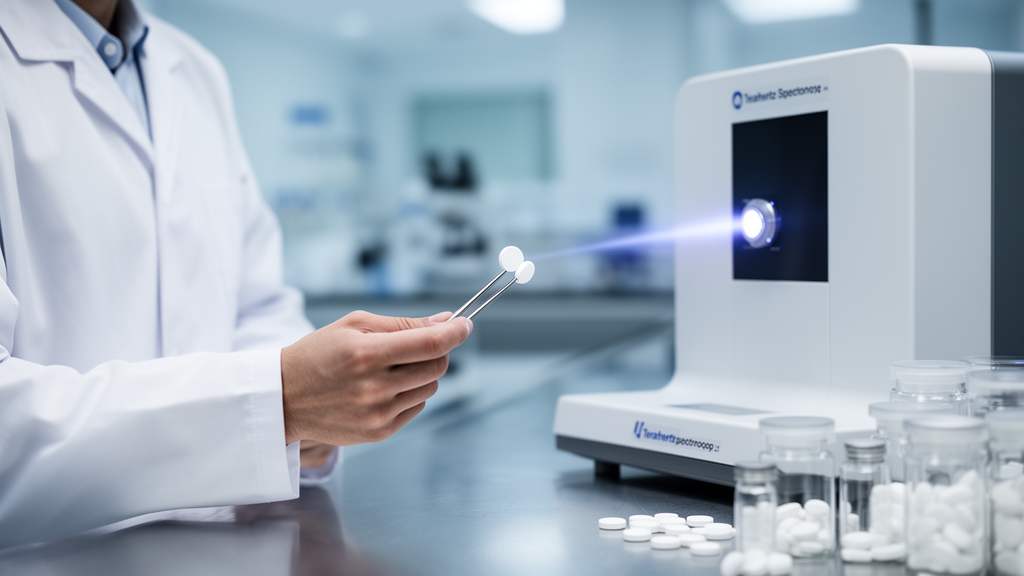
His response to that challenge has been to advance terahertz time-domain spectroscopy, known as THz-TDS, as one example of a broader class of analytical technologies capable of monitoring physical attributes during manufacturing. Unlike conventional PAT tools that primarily probe chemical composition, THz-TDS has been shown to be sensitive to a range of physical parameters. The trick lies in what the technique measures. By capturing signal time-delay in addition to amplitude, THz-TDS is sensitive to changes in refractive index and travelled path length, both of which are strongly related to physical material properties. In other words, the terahertz pulse effectively carries information about how much material it has passed through and how densely that material is packed.
Anuschek’s PhD work demonstrated that tablet thickness, mass and porosity can be simultaneously assessed via a single non-contact measurement on timescales relevant to manufacturing, using a reflection-based THz-TDS approach. His team went on to develop automated measurement strategies and a prototype interface that demonstrated the feasibility of implementing THz-TDS directly within pharmaceutical manufacturing environments. The importance of these particular attributes emerges from their close link to product performance: tablet porosity is closely linked to mechanical strength and drug release, while tablet mass co-determines the total drug content delivered to the patient.
Across multiple studies, Anuschek and colleagues, along with other research groups, have shown that THz-TDS-derived porosity measurements could serve as surrogates for a range of performance-determining attributes, including disintegration time and tensile strength. That surrogate relationship matters practically, because it suggests a single non-destructive optical measurement could stand in for tests that would otherwise require breaking tablets apart or waiting for them to disintegrate in the laboratory.
Upstream process variability, however, can strongly influence these relationships, and this is where the work becomes particularly instructive for manufacturers. Common lubricants such as magnesium stearate alter the relation between tensile strength and porosity, and the effect depends not only on the lubricant’s concentration but also on the shear history experienced during powder processing, which can be difficult to assess retrospectively. Anuschek’s team showcased that THz-TDS could non-destructively monitor shear-induced changes in powder bulk density directly through blend containers, meaning the technique can look inside sealed equipment while the powder is still being processed. A natural extension of this work was to combine blend-level and tablet-level analysis, allowing prediction of mechanical strength while accounting for both shear-related and porosity-related factors.
A final contribution of the research is the use of THz-TDS to characterise tablet microstructure, including changes in pore structure and particle size distributions within finished tablets. These structural attributes are closely linked to tablet performance and may provide additional opportunities for process monitoring and control. Anuschek notes, however, that PAT applications based on microstructural characterisation have been less explored than compositional monitoring, leaving considerable room for development in this area.
Anuschek is careful not to oversell THz-TDS as a singular solution. While it presents one promising approach, he writes, it is not unique: a range of analytical technologies has emerged that can provide information about physical attributes non-destructively. Together, these techniques could enable a PAT framework that extends beyond compositional analysis and integrates monitoring of physical attributes as drivers of manufacturing variability and product performance. Such an integrated framework could, in turn, enable the prediction of complex quality attributes, supporting real-time release testing and targeted process adjustments on the production line.
His background spans an industrial and academic route through pharmaceutical science: a B.Sc. in Pharmaceutical Chemistry from Cologne University of Applied Sciences, an M.Sc. in Pharmaceutical Sciences from Ludwig Maximilian University of Munich that included a research stay with Prof. Axel Zeitler at the University of Cambridge, and a PhD in Pharmaceutical Sciences from the University of Copenhagen completed through an industrial collaboration with Novo Nordisk under the supervision of Prof. Jukka Rantanen, followed by a two-year postdoctoral fellowship at Novo Nordisk. His PhD thesis, which forms the backbone of this article, was recently recognised as the most outstanding doctoral thesis in pharmaceutical sciences for the academic year 2024/25 by the International Association for Pharmaceutical Technology and Industrial Pharmacy (APV). Looking ahead, he is particularly interested in integrating physical process analytics with modelling and advanced control strategies, envisioning manufacturing processes that continuously adapt to raw material variability and process disturbances, and perhaps, he adds optimistically, to dynamic product-specification targets.
Subject of Research: Using terahertz time-domain spectroscopy to monitor physical material attributes during tablet manufacturing
Article Title: Spotlighting rising researcher Moritz Anuschek: monitoring physical attributes in tablet manufacturing using terahertz spectroscopy
Article References: Anuschek, M. (2026). Spotlighting rising researcher Moritz Anuschek: monitoring physical attributes in tablet manufacturing using terahertz spectroscopy. AAPS Open, 12(1), Article 58. https://doi.org/10.1186/s41120-026-00195-x
Image Credits: AI Generated
DOI: 10.1186/s41120-026-00195-x
Keywords: terahertz spectroscopy, THz-TDS, tablet manufacturing, process analytical technology, porosity, pharmaceutical manufacturing, non-destructive testing, powder processing, microstructure, Quality-by-Design, Novo Nordisk, University of Copenhagen
News Source: Denise Maddox. (October 29, 2026). Terahertz Spectroscopy Moves Tablet Manufacturing Beyond Chemical Analysis. Scienmag.