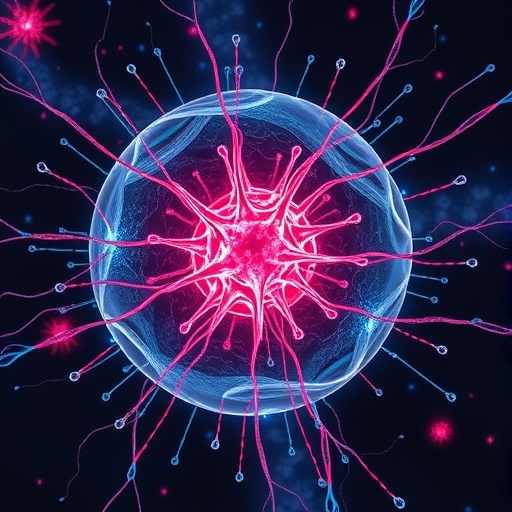
Cells in stretched epithelia don’t simply endure stress—they remodel themselves. In a new study published in Nature Physics, researchers at the Institute for Bioengineering of Catalonia (IBEC) show that prolonged mechanical stretching triggers a dramatic, hours-long reorganization of keratin, the intermediate-filament network that normally fortifies epithelial tissues.
Keratin is known to protect cells from large deformation, but its slow, sustained response to persistent stretching has been unclear. Using engineered epithelial tissue, the team applied controlled long-term stretch with a custom microfluidic device while imaging cells in real time and combining the results with multiscale computational modelling.
The key discovery is that keratin does not react instantly. Instead, individual keratin filaments gradually transform into thick, star-shaped bundles. These bundles connect neighbouring cells, forming supracellular networks that effectively redistribute stress throughout the tissue rather than isolating it inside single cells.
The structural reorganization begins at cell–cell junctions where three cells meet. There, keratin filaments progressively leave the junctional regions and accumulate into increasingly robust bundles, spreading collectively across the tissue. The process resembles a coordinated “re-braiding” of the cytoskeleton, with initially local changes recruiting surrounding cells into expanding clusters.
Modelling provided the missing link to a second phenomenon: nuclear uncaging. As bundle architecture grows and internal dynamics intensify, forces develop that ultimately push the nucleus out of its protective keratin cage. Live-cell microscopy confirmed the prediction—nuclei detach from the surrounding keratin mesh until separation is complete, leaving only a residual filament connection.
Whether this uncaging protects the nucleus or makes it more vulnerable is a central open question. The study highlights two competing possibilities: exposure to mechanical forces versus reduced force transmission when the nucleus becomes decoupled from an intensely stressed cytoskeletal scaffold.
The work also identifies actin as an important regulator. When molecular links between actin and keratin are weakened, keratin bundling accelerates nearly threefold, indicating that cross-talk between cytoskeletal systems tunes how tissues adapt to sustained stretch.
Taken together, the findings suggest a previously underappreciated adaptation strategy: tissues can preserve resilience not only by stiffening components, but by actively restructuring internal networks and reconfiguring organelle mechanics over long timescales.
Ultimately, this mechanism may help explain how tissues withstand repeated deformation during development and in organs that expand and contract, such as the bladder or mammary gland, and it could inform understanding of diseases where keratin organization is disrupted.
Subject of Research: Cells
Article Title: Dynamics of supracellular keratin bundling and nuclear uncaging in stretched epithelia
News Publication Date: 27-Jul-2026
Web References: https://doi.org/10.1038/s41567-026-03371-8
References: Nature Physics, DOI: 10.1038/s41567-026-03371-8
Image Credits: Institute for Bioengineering of Catalonia (IBEC)
Keywords
Keratin, cytoskeleton, epithelial stretching, supracellular networks, nuclear uncaging, intermediate filaments, mechanobiology, actin-keratin coupling, live-cell imaging, computational modelling
Tags: cell mechanotransductioncell–cell junctions in mechanoprotectioncustom microfluidic devices for tissue stretchingepithelial tissue remodeling under mechanical stressintermediate filament network dynamicskeratin bundle formation and re-braidingkeratin filament reorganizationkeratin-mediated stress distribution in tissueslong-term cellular response to stretchingmultiscale computational modeling of cytoskeletal changesnuclear uncaging in stressed epithelial cellssupracellular stress redistribution