Will we ever be able to understand the cacophonous chatter taking place between the 80 million neurons in our brains? Dr. Ofer Yizhar and his group in the Weizmann Institute of Science's Neurobiology Department have taken a large step in this direction with a new research method that can provide scientists with targeted control over vital parts of the brain's communications.
Yizhar works in the relatively new field of optogenetics, in which scientists use genetic engineering and laser light in thin optical fibers to investigate the living brain. With these tools, scientists can modulate and control the activities of nerve circuits in the brain, and thus begin to unravel the networks of links and nodes in the brain's communications systems.
Yizhar is particularly interested in the long-distance communications between nerve cells in different areas of the brain. "The coordination between different brain systems is vital to the normal functioning of the brain. If we can understand the extended lines of communication between cells that are in the different regions of the brain – some of them quite far from one another," says Yizhar, "we might be able, in the future, to understand the changes that take place in the brain in diseases such as depression, anxiety and schizophrenia. Because we do not have an understanding of these diseases on a functional level, we are sorely lacking good ways to treat them."
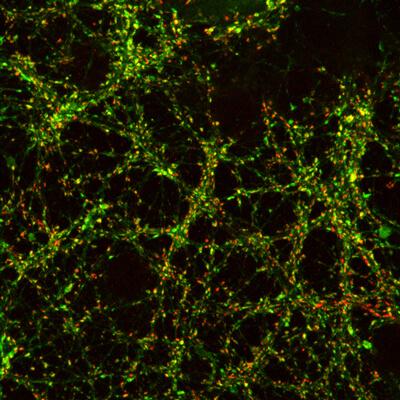
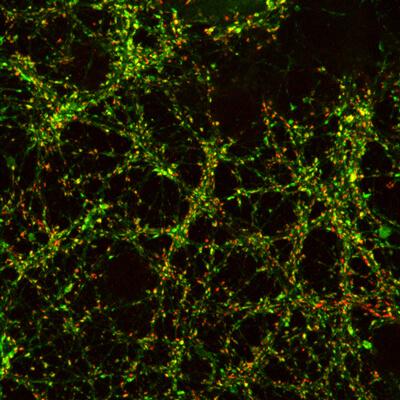
Optogenetics involves inserting a gene for a light-sensitive protein into the neurons, using a modified virus. These neurons then become activated when light is focused on them through the thin optical fibers. Yizhar and his team established a method that allows them to zoom in on a particular part of the brain's network: the "communications cables" that link up the entire brain. These "cables" are the axons – thin extensions of the nerve cells that carry electric pulses from the cells' centers. Some axons are relatively short and linked to nearby neurons, but others can be lengthy, reaching out to distant regions of the brain.
In the new study, which was published in Nature Neuroscience, the team, led by PhD student Mathias Mahn, showed that optogenetic techniques can be used to temporarily silence these long-range axons, effectively leading to a reversible "disconnect" between two distant brain nodes. By observing what happens when crucial connections are disabled, the researchers were able to begin to filling in the picture of the axons' role in the brain's internal conversation. Since mental and neurological diseases are often thought to result from changes in long-range brain connectivity, these studies could contribute to a better understanding of the mechanisms behind health and disease in the brain.
"The research led us to a deeper understanding of the unique properties of the axons and synapses that form the connections between neurons," says Yizhar. "We were able to uncover the responses of axons to various optogenetic manipulations. Understanding these differences will be crucial to unraveling the mechanisms for long-distance communication in the brain."
###
Dr. Ofer Yizhar's research is supported by the Grodetsky Center for Higher Brain Functions; the Henry Chanoch Krenter Institute for Biomedical Imaging and Genomics; the Adelis Foundation; the Carolito Stiftung; the Iby and Aladar Fleischman Foundation; the Candice Appleton Family Trust; the Minna-James-Heineman Stiftung; the Corinne S. Koshland Equipment Endowment Fund; the European Research Council; the Lord Sieff of Brimpton Memorial Fund; the Irving Bieber, M.D. and Toby Bieber, M.D. Memorial Research Fund; the Irving B. Harris Fund for New Directions in Brain Research; the Joseph D. Shane Fund for Neurosciences; and the Paul and Lucie Schwartz, Georges and Vera Gersen Laboratory. Dr. Yizhar is the incumbent of the Gertrude and Philip Nollman Career Development Chair.
The Weizmann Institute of Science in Rehovot, Israel, is one of the world's top-ranking multidisciplinary research institutions. Noted for its wide-ranging exploration of the natural and exact sciences, the Institute is home to scientists, students, technicians and supporting staff. Institute research efforts include the search for new ways of fighting disease and hunger, examining leading questions in mathematics and computer science, probing the physics of matter and the universe, creating novel materials and developing new strategies for protecting the environment.
Media Contact
Yael Edelman
[email protected]
@WeizmannScience
http://www.weizmann.ac.il