Innovation shown to reduce cancer-causing contaminants in drinking water, airports, military sites
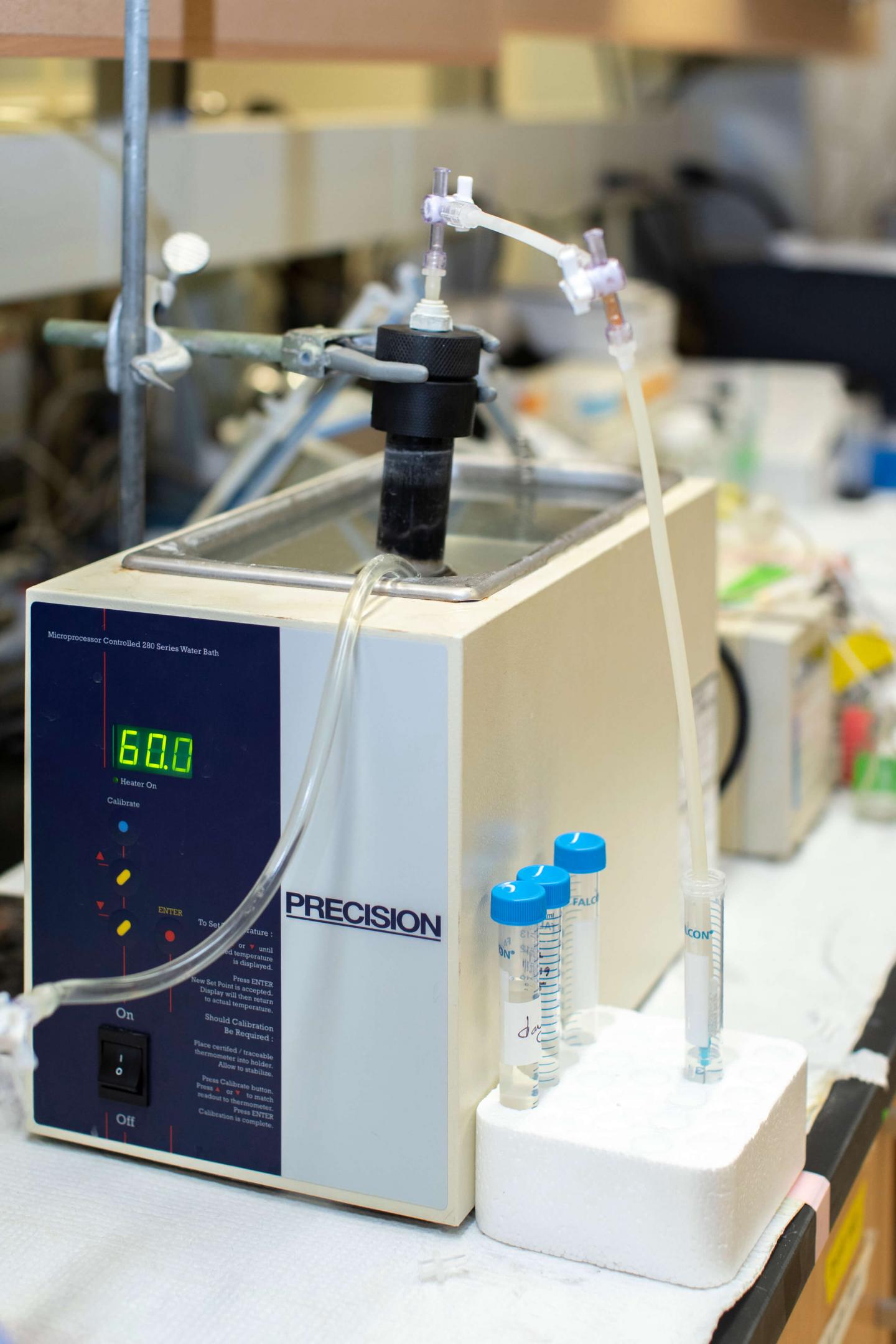
Credit: Oren Darling/Purdue Research Foundation
WEST LAFAYETTE, Ind. – The same chemical concerns found at hundreds of military training sites around the United States are now being raised at airports. It is an issue that is in the spotlight through the upcoming movie “Dark Waters.”
The compounds of concern are called poly- and perfluoroalkyl substances (PFAS). They include perfluorooctanesulfonate (PFOS), perfluorooctanoic acid (PFOA) and other perfluoroalkyl acids (PFAAs) – of which one or more have been linked to cancer, thyroid dysfunction, liver disease, immune system impairment, and other serious medical concerns. The compounds also are found in contaminated drinking water.
“This issue is in the spotlight now thanks to the films “The Devil We Know” and “Dark Waters,'” said Linda Lee, a professor of agronomy in Purdue’s College of Agriculture. “Our approach is different from current technologies, which are focused on capture and not destruction. We target compound destruction with a design that has potential to be used as part of a permeable reactive barrier underground to eradicate these compounds in groundwater to keep them from spreading.”
Lee is an authority on the compounds. She has developed patented technology to address the concerns and has received millions of dollars in federal funding to study these compounds and create new ways to eliminate the substances.
“This is a significant problem because these compounds, which are found in our blood, drinking water, homes and products, do not degrade naturally,” Lee said. “Our team has patented technology involving the use of nickel and iron nanoparticles synthesized onto activated carbon to capture, attack and destroy the compounds.”
PFAAs and PFOSs are found at more than 600 military training sites where firefighter training involved the use of PFAS-containing foams. They also are found at airports, which use similar chemical foams to put out fires.
In September, Lee’s team received part of a $6 million science to achieve results grant from the Environmental Protection Agency to address the issue of the compounds ending up in waste streams and eventually drinking water.
The latest award comes after the team received earlier funding from the National Science Foundation and the Department of Defense. The team’s recent work also has included international partnerships in Pakistan through The National Academies of Sciences, Engineering and Medicine.
Lee patented her nanoparticle innovation through the Purdue Research Foundation Office of Technology Commercialization. She is looking for additional partners to help scale up the work. For more information on licensing a Purdue innovation, contact the Office of Technology Commercialization at [email protected] and reference track code 2017-LEE-67902.
###
About Purdue Research Foundation Office of Technology Commercialization
The Purdue Research Foundation Office of Technology Commercialization operates one of the most comprehensive technology transfer programs among leading research universities in the U.S. Services provided by this office support the economic development initiatives of Purdue University and benefit the university’s academic activities through commercializing, licensing and protecting Purdue intellectual property. Contact the Office of Technology Commercialization at [email protected]. The office is managed by the Purdue Research Foundation, which received the 2016 Innovation and Economic Prosperity Universities Award for Innovation from the Association of Public and Land-grant Universities. The Purdue Research Foundation is a private, nonprofit foundation created to advance the mission of Purdue University.
Writer: Chris Adam, 765-588-3341, [email protected]
Source: Linda Lee, [email protected]
Media Contact
Chris Adam
[email protected]