Credit: SFU
Long-distance couples can share a walk, watch movies together, and even give each other a massage, using new technologies being developed in Carman Neustaedter's Simon Fraser University lab.
It's all about feeling connected, says Neustaedter, an associate professor in SFU's School of Interactive Arts and Technology (SIAT). Student researchers in his Surrey campus-based Connections Lab are working on myriad solutions.
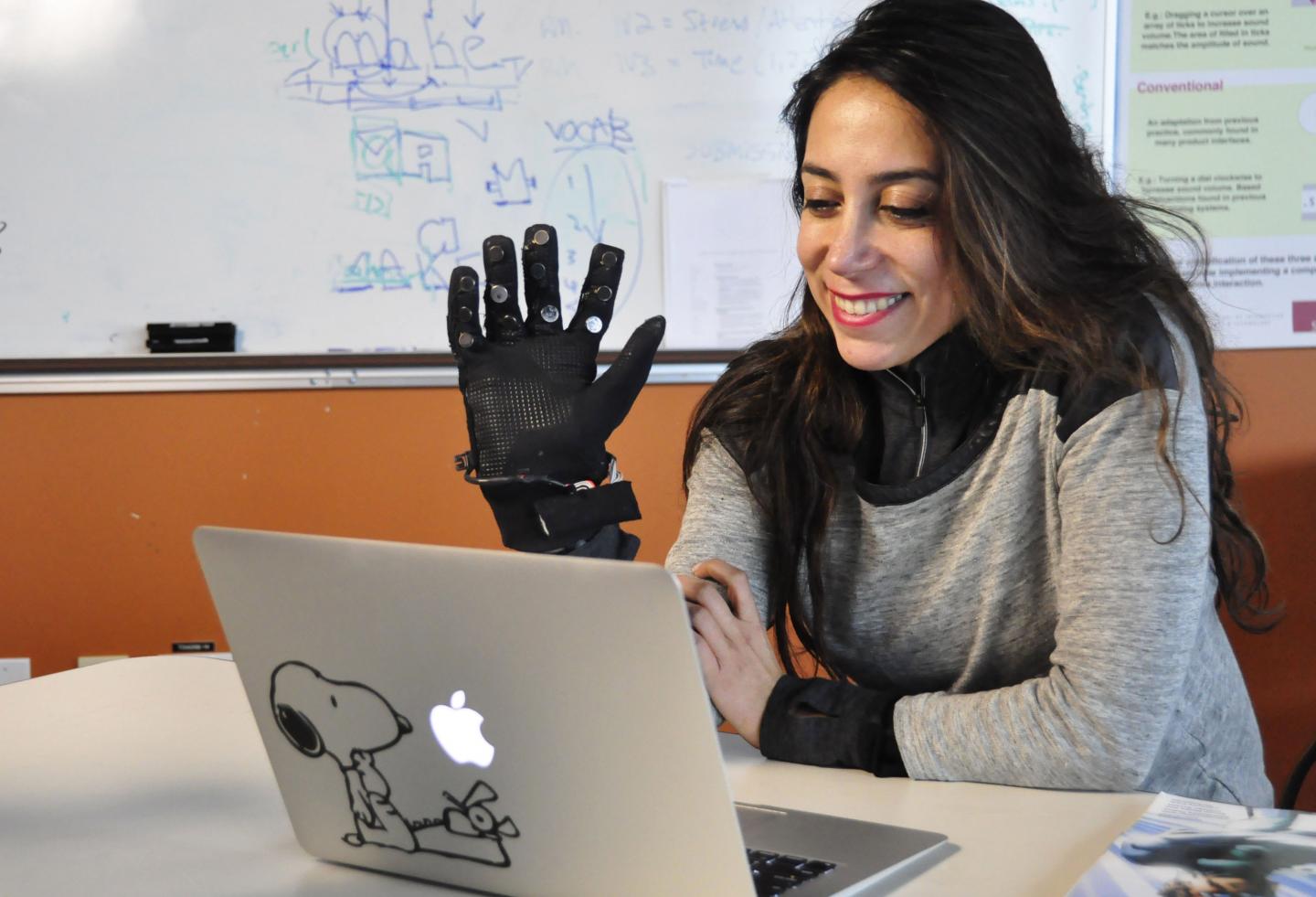
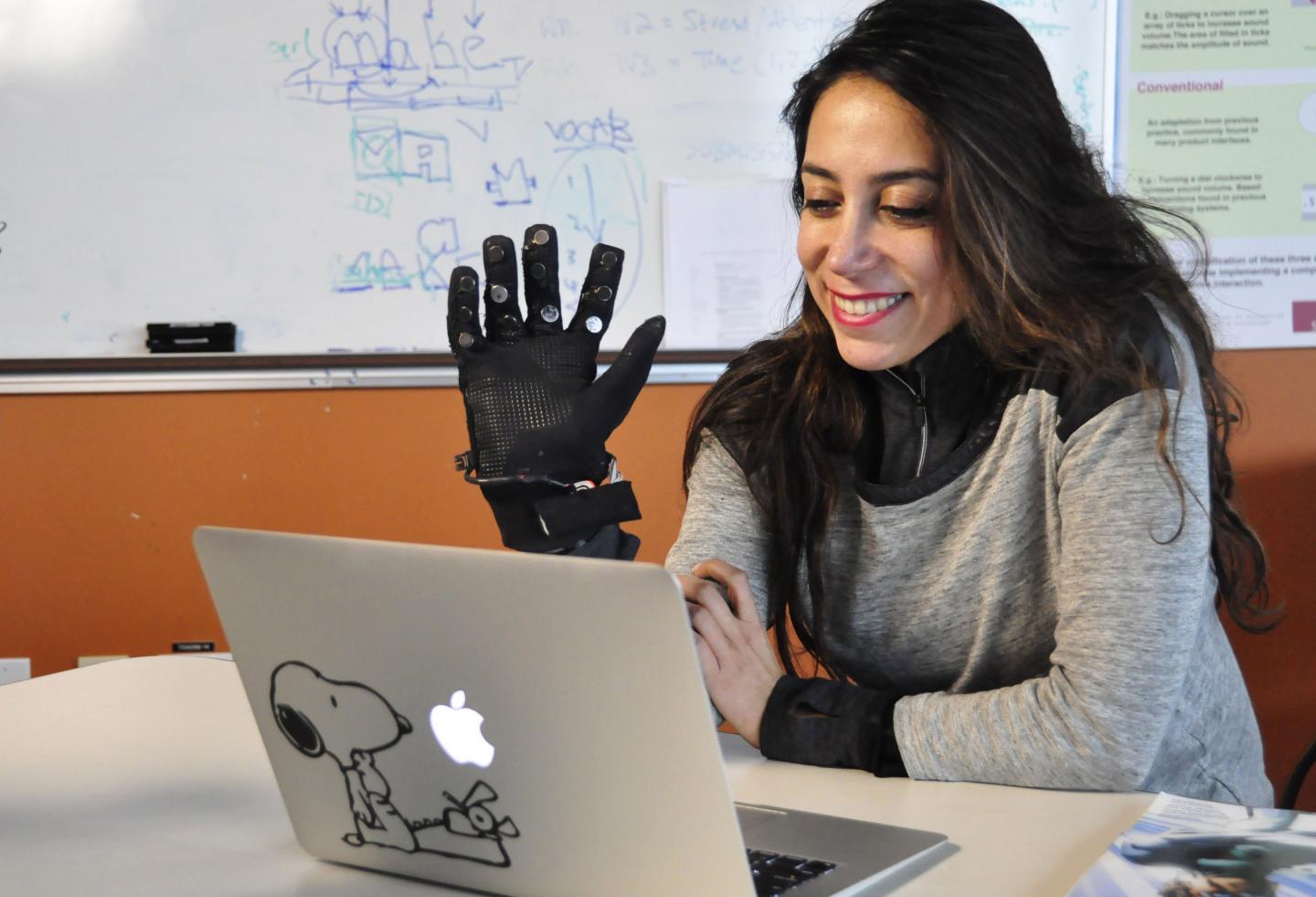
Among them, researchers have designed a pair of interconnected gloves called Flex-N-Feel. When fingers 'flex' in one glove, the actions are transmitted to a remote partner wearing the other. The glove's tactile sensors allow the wearer to 'feel' the movements.
To capture the flex actions, the sensors are attached to a microcontroller. The sensors provide a value for each bend, and are transmitted to the 'feel' glove using a WiFi module.
The sensors are also placed strategically on the palm side of the fingers in order to better feel the touch. A soft-switch on both gloves also allows either partner to initiate the touch.
"Users can make intimate gestures such as touching the face, holding hands, and giving a hug," says Neustaedter. "The act of bending or flexing one's finger is a gentle and subtle way to mimic touch."
The gloves are currently a prototype and testing continues. While one set of gloves enables one-way remote touch between partners, Neustaedter says a second set could allow both to share touches at the same time.
Other projects also focus on shared experiences, including a virtual reality video conferencing system that lets one "see through the eyes" of a remote partner, and another that enables users to video-stream a remote partner's activities to a long-distance partner at home (called Be With Me).
Meanwhile the researchers are also studying how next-generation telepresence robots can help unite couples and participate in activities together.
They've embedded a robot, designed by Suitable Technologies, into several Vancouver homes. There, it connects to countries around the world, including India and Singapore. Researchers continue to monitor how the robot is used. One long-distance couple plans a Valentine's Day 'date' while one partner is in Vancouver, and the other, on Vancouver Island.
"The focus here is providing that connection, and in this case, a kind of physical body," says Neustaedter, who has designed and built eight next-generation telepresence systems for families, and is author of Connecting Families: The Impact of New Communication Technologies on Domestic Life (2012). He has also spent more than a decade studying workplace collaborations over distance, including telepresence attendance at international conferences.
"Long-distance relationships are more common today, but distance don't have to mean missing out on having a physical presence and sharing space," says Neustaedter. "If people can't physically be together, we're hoping to create the next best technological solutions."
###
ABOUT SIMON FRASER UNIVERSITY:
As Canada's engaged university, SFU is defined by its dynamic integration of innovative education, cutting-edge research and far-reaching community engagement. SFU was founded 50 years ago with a mission to be a different kind of university–to bring an interdisciplinary approach to learning, embrace bold initiatives, and engage with communities near and far. Today, SFU is Canada's leading comprehensive research university and is ranked one of the top universities in the world. With campuses in British Columbia's three largest cities – Vancouver, Burnaby and Surrey – SFU has eight faculties, delivers almost 150 programs to over 35,000 students, and boasts more than 145,000 alumni in 130 countries around the world.
Simon Fraser University: Engaging Students. Engaging Research. Engaging Communities.
Media Contact
Carman Neustaedter
[email protected]
778-782-9017
@SFU_Media
http://www.sfu.ca
############
Story Source: Materials provided by Scienmag