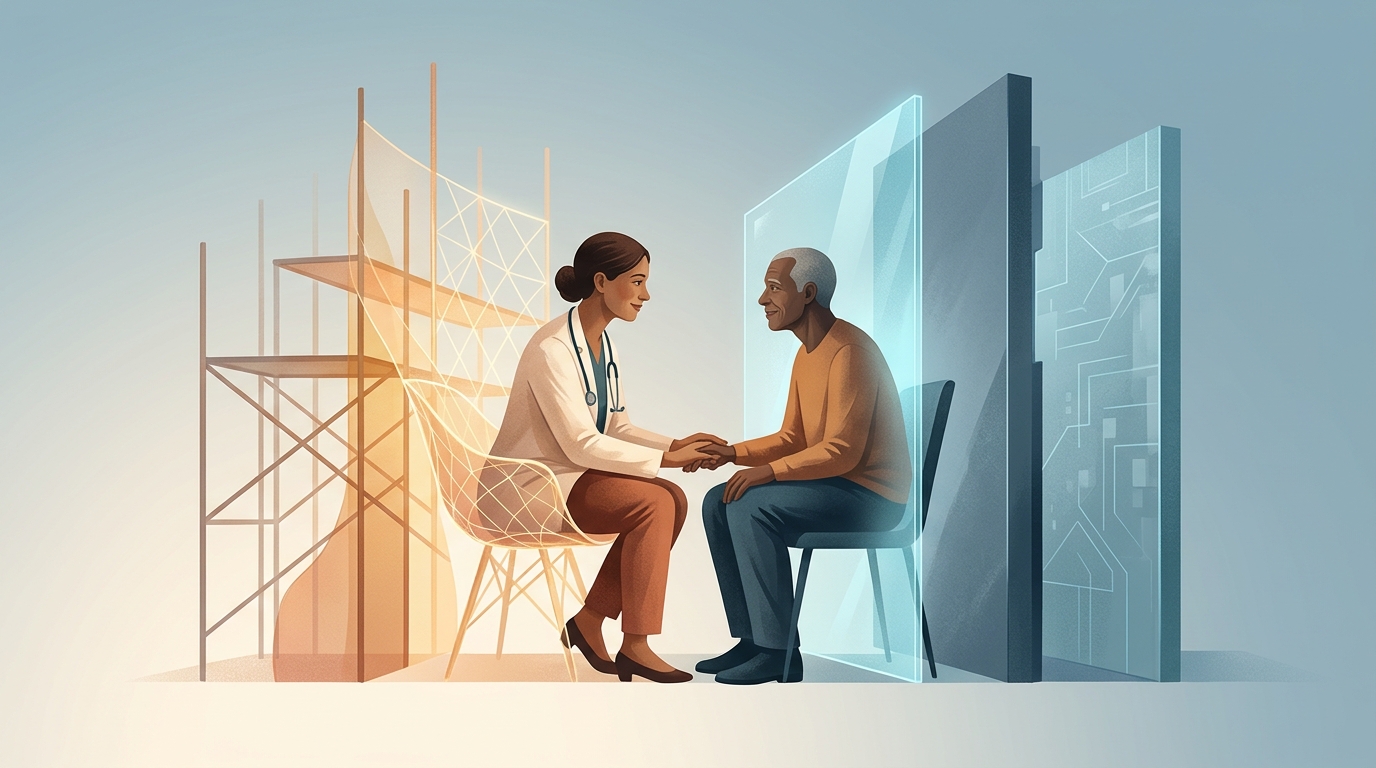
Technology now runs through almost every corner of health care, from documentation, triage and monitoring to diagnosis, counselling and the organisation of entire services. Person-centred care has long been a stated aim of health systems, yet the question of how it can be achieved, preserved, adapted or even redefined in a technological era has remained open. A new editorial in Frontiers in Health Services, written by Júlio Belo Fernandes of the Egas Moniz Center for Interdisciplinary Research in Portugal and Brendan McCormack of the Susan Wakil School of Nursing and Midwifery at the University of Sydney, takes up that question by drawing together fourteen contributions to a Research Topic spanning four continents, from paediatric intensive care and acute hospitals to nursing homes, community clinics and online counselling.
The editorial’s central argument is deliberately unsentimental. Person-centred practice, the authors write, is not defined by digital health. It is grounded in personhood and in relationships built on respect, mutual trust and understanding, enacted by people within the cultures and contexts in which they work. What changes in a technological era is the context in which many of those relationships take place. The authors, who have previously argued that artificial intelligence traverses every domain of person-centred practice and can scaffold or undermine it, now extend that argument beyond AI. Read together, they say, the fourteen contributions show both possibilities, sometimes within the same technology. Technology can support person-centred practice, making pain assessable in people who cannot report it, reaching family caregivers where they are, and giving patient choice a place in the electronic record. It can also introduce new forms of distance, drawing attention away from the encounter or acting on what is written about someone before anyone meets them. How these possibilities unfold, the editorial stresses, depends on how technology is integrated into practice.
The clearest evidence for that dual character comes from studies of everyday care settings. In three Dutch nursing homes, Noordam and colleagues found that monitoring and remote diagnostics reassured relatives and supported more timely responses. Crucially, data became meaningful only when professionals interpreted them through their knowledge of each resident as a person, and the technologies also changed routines, roles and tasks in ways that were not always anticipated. Hardiman and colleagues show what deliberate design can achieve at the other end of the technical spectrum: nurses redesigned more than 120 assessments, diagnoses, interventions and outcomes in a hospital electronic health record so that the record could take account of patients’ choices and relationships rather than flattening them into clinical data points. In online counselling for family caregivers, Gabl and colleagues conclude that digitalisation does not itself determine whether care becomes more or less person-centred; practitioners’ values and practices do.
The reorganisation of care also has a spatial dimension that is easy to overlook. Unzueta-Roch and colleagues argue that automated recording and AI scribes could return time to the bedside, yet one of their illustrations notes that records must sometimes be reviewed in a separate office, away from the patient. Technology, in other words, can draw attention towards the encounter as readily as away from it. At the level of whole services, Yang and colleagues reported fewer complications and a lower travel burden after 45 community clinics adopted a standardised, hospital-supported model of catheter maintenance, suggesting that much of the value came from how care was organised rather than from any single device. Maia and Félix extend the argument to equity, contending that digital transformation supports integrated care only when it goes hand in hand with community rehabilitation and the health literacy that allows people to take part in it.
Some of the most technically ambitious work in the collection concerns what technology can reveal about people who cannot speak for themselves. Félix and colleagues evaluated a Portuguese version of an app that uses AI-based analysis of facial movements to assess pain in people living with dementia who cannot report it. Formal caregivers reported high perceived usability in a simulated setting, and pain that cannot be spoken may, with such tools, become visible. The authors are careful to note the limit: simulation cannot yet show how authentic engagement and sympathetic presence unfold in everyday care. In a parallel review, Fung and colleagues examined ten studies of natural language processing for triaging outpatient referrals and found encouraging accuracy, but most models were tested retrospectively, only one was deployed in routine practice, and none were examined for differences across patient subgroups. Because such tools work with what is written about a person before anyone meets them, the editorial argues, their place is to support triaging clinicians, not to replace them.
What professionals anticipate patients need may also diverge from what patients actually value. Chen and colleagues report that nursing students emphasised monitoring and medical services, whereas older adults placed more weight on daily assistance and emotional support and voiced greater privacy concerns. Two contributions that do not study technology at all point to what might bridge that gap. Zhao and colleagues show that nurses’ narrative competence depends on personal, relational, environmental and organisational factors, and Xu and colleagues report associations between humanistic care competency in prenatal ultrasound, a highly technical encounter, and empathy, humanities training and the support professionals themselves receive. These narrative and humanistic capacities, the editorial suggests, help professionals interpret technological information in relation to the person, keeping care anchored in the question “What matters to you?” rather than “What does the system say about you?”
The collection also delivers a sober assessment of when sophisticated tools fail to earn their complexity. In two cohorts of people living with HIV and intermediate FIB-4 scores, Ramos-Ruperto and colleagues found that machine learning models showed no clear advantage over the simpler, established APRI score in stratifying fibrosis risk. Unzueta-Roch and colleagues note that no validated AI-based predictive tool has yet been implemented in intensive care and propose technology readiness levels adapted to paediatrics as a way of disciplining expectations. The editorial’s framing is that technology supports professional judgement when its added value is weighed against simpler alternatives and its outputs can be interpreted and questioned, and that it displaces judgement when neither condition holds.
Judgement, the authors argue, does not rest on individual competence alone. Schönfelder and colleagues call for a person-centred, value-based AI literacy that lets nurses weigh what AI offers against person-centred values rather than treating technical proficiency as an end in itself. Rachmani and colleagues add a crucial qualification: among 704 healthcare workers in 20 Indonesian hospitals, perceived interface quality, not digital health competency, was the strongest correlate of user experience. Responsibility therefore extends from training professionals to building systems that let them work well, echoing the call by Hardiman and colleagues for nursing leadership in procurement and content governance. Noordam and colleagues show this judgement at work in practice, as nurses used their knowledge of residents to decide which alerts needed an immediate response. Human oversight, the editorial concludes, becomes a genuine safeguard only when professionals have the authority, time and organisational backing to interpret, question and, where needed, override automated outputs.
What remains hardest to see, the authors write, is the relational dimension of care. Most of the fourteen contributions report observations in accuracy, sensitivity, usability, workload, complications, satisfaction or competence. Far fewer capture dignity, authentic engagement, shared meaning or shifts in power, consistent with the authors’ earlier observation that relational outcomes are rarely primary endpoints. The study by Félix and colleagues makes the problem explicit: usability can be demonstrated in simulation, whereas lived presence needs to be studied in real encounters. The direct voice of people receiving care also deserves a larger place. In Noordam and colleagues’ nursing home study, residents were interviewed in only one of three cases, and in another the decision to install monitoring was taken without residents’ or relatives’ perspectives. The same study shows how continuation is decided: one technology was discontinued because financial sustainability and workload reduction could not be demonstrated, another after an internal evaluation whose criteria were not reported, and a third was extended to all beds, although integrating sensor data with clinical context remained difficult. Non-adoption and abandonment are well described in implementation research, and the editorial argues that including relational outcomes in such decisions would give a fuller picture of what a technology actually contributes.
The editorial closes with a research agenda that reads as a challenge to the field. Future work, the authors write, should treat person-centred outcomes as primary endpoints; involve people receiving care, including people living with dementia, children and families, in design and evaluation; compare complex tools with simpler alternatives; account for the work technology creates as well as the work it removes; and use mixed-methods and ethnographic designs in real settings. Evaluation can then move from performance to purpose, asking not only whether a technology works but what kind of care its use makes possible. Person-centred practice, the authors conclude, lives in persons, relationships and cultures, and technology can support that practice, distance care from the person, or do both at once. The task ahead is neither to celebrate technology nor to resist it, but to integrate it critically so that people are known beyond their data and relationships remain places of dialogue and shared meaning.
Subject of Research: How digital technologies reshape person-centred care across hospitals, nursing homes and online services
Article Title: Editorial: Person-centered care: challenges and opportunities in a technological era
Article References: Fernandes, J. B., & McCormack, B. (2026). Editorial: Person-centered care: challenges and opportunities in a technological era. Frontiers in Health Services, 6, Article 2025737. https://doi.org/10.3389/frhs.2026.2025737
Image Credits: AI Generated
DOI: 10.3389/frhs.2026.2025737
Keywords: person-centred care, digital health, artificial intelligence, nursing homes, electronic health records, pain assessment, natural language processing, health equity, AI literacy, relational outcomes, Editorial, Person-centered
News Source: Ophelia Keating. (November 3, 2026). Technology can scaffold or undermine person-centred care, editorial warns. Scienmag.