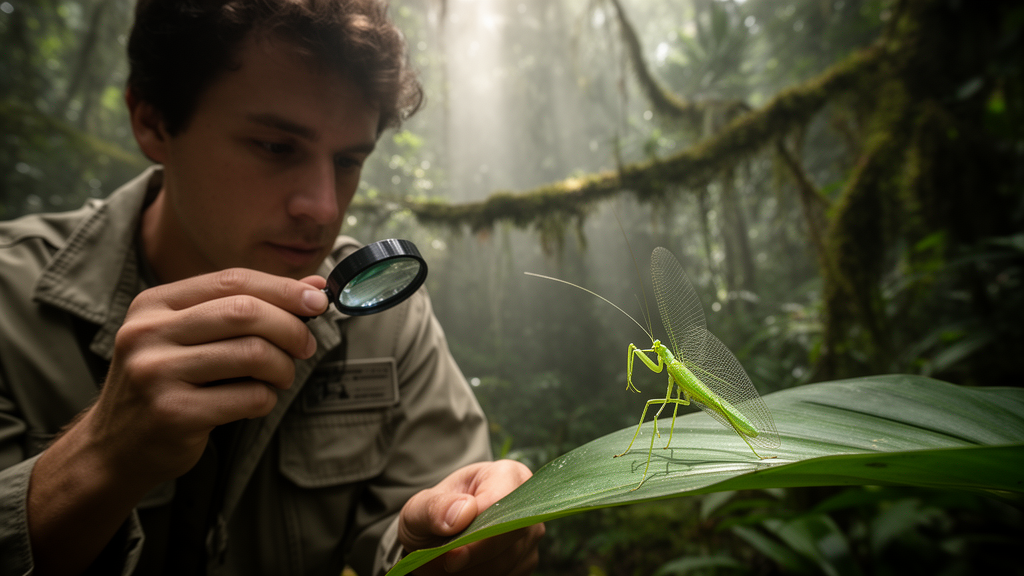
Entomologists have published a comprehensive study that resolves long-standing taxonomic and nomenclatural ambiguities among the Neotropical species of the mantidfly family Mantispidae. Published in the Deutsche Entomologische Zeitschrift, the research addresses a significant backlog of dubious species names that have persisted since the early twentieth century. By examining type specimens housed in European museums that were previously unavailable to recent taxonomic researchers, the study provides a clearer framework for understanding the biodiversity of these insects in the Americas. The work is a critical step in stabilizing the classification of a group of insects that are often mistaken for small praying mantises due to their raptorial forelegs and elongated prothorax.
Mantispidae is a relatively small family within the insect order Neuroptera, yet it possesses a complex taxonomic history that has challenged scientists for decades. In the Neotropical region, the family is represented by all four traditionally recognized subfamilies: Calomantispinae, Drepanicinae, Mantispinae, and Symphrasinae. However, recent phylogenetic studies have suggested a close evolutionary relationship between Symphrasinae and the family Rhachiberothidae. Consequently, Symphrasinae has recently been reclassified as a subfamily within Rhachiberothidae, leaving Mantispidae with a more restricted but distinct set of genera and species in the Neotropical realm. This reclassification underscores the dynamic nature of insect taxonomy and the importance of continuous revision.
The current genus-level classification of Neotropical Mantispidae is largely based on the revisionary study by Hoffman in 2002, which transferred many species previously placed in the European genus Mantispa to six new genera. Despite this progress, a large number of species names remained dubious, primarily because they were proposed by European authors in the early 1900s based on insufficient descriptions and illustrations. Many of these names also suffered from dubious geographic type locations, making it difficult for subsequent researchers to verify their identity. The present study aims to solve these problems by directly examining the original type specimens that were overlooked in previous taxonomic efforts.
The researchers analyzed a total of 28 species names, resulting in 14 new synonyms and six new combinations. Additionally, four names were designated as nomina dubia, meaning they are considered unusable for taxonomic purposes due to a lack of clear type specimens or descriptions. Ten lectotypes were designated to provide a single, definitive reference specimen for species that were originally described based on multiple individuals. High-resolution images of the type specimens for 19 species were provided in the study, offering a valuable visual resource for future researchers. This detailed documentation helps to bridge the gap between historical descriptions and modern taxonomic standards.
One notable finding involves the species Leptomantispa axillaris, which was described by Navás in 1908 from Brazil. For many years, the taxonomic identity of this species was uncertain because the original syntypes were believed to be lost. The study confirms that the types could not be located in the expected collections, but the authors propose treating the name as valid for nomenclatural stability. They note that the interpretation of the species proposed by Penny and Costa in 1983 matches the original description, and many specimens have been recorded in areas close to the type locality. The authors agree that a neotype should eventually be designated but refrain from doing so in this study due to the unavailability of material from the original type locality.
Another significant resolution concerns the species Dicromantispa basalis, originally described as Mantispilla basalis by Navás in 1927 from Bolivia. The original description was based on female specimens, but it was unclear whether one or more individuals were used. The type material is supposedly deposited in Navás’ collection, but no further information could be found. Based on the original description, which highlights a yellowish color and specific markings on the vertex and pronotum, the authors synonymize this name under Dicromantispa gracilis. This decision is supported by the fact that D. gracilis is a widespread species with records from Bolivia, and the characters described for basalis align closely with those of gracilis.
The study also addresses the status of Mantispilla boliviana, described by Navás in 1927 from Santa Cruz, Bolivia. Similar to basalis, the type material is likely lost, and the original description is too unspecific to unambiguously associate the species with any of the current valid genera in South America. Due to the absence of the type series and the ambiguity of the description, the authors consider this species a nomen dubium. This designation highlights the challenges faced by taxonomists when dealing with historical data that lacks clear physical evidence or detailed morphological descriptions.
Further taxonomic clarifications were made for several species in the genus Zeugomantispa. For instance, Mantispilla chlorodes, described from Panama in 1914, was synonymized under Zeugomantispa virescens after the examination of its lectotype. The lectotype, a specimen of unknown sex from the Natural History Museum in London, displays all the major characters of Z. virescens, including a green pterostigma and straight crossveins in the forewing. Similarly, Mantispilla chlorotica, described from Paraguay in 1912, was also synonymized under Z. virescens based on the analysis of its lectotype from the Zoologische Staatssammlung in Munich. These findings reinforce the widespread nature of Z. virescens in the New World and its long list of synonyms.
The research also reveals a significant mislabeling case involving Mantispa latifrons, described by Enderlein in 1910 from Brazil. Upon examination of the male holotype, it became clear that the specimen possesses all the diagnostic characters of the Australian genus Campion, including simple claws on the mid and hind legs. Dissection of the male genitalia further confirmed its placement in Campion. The authors propose the new combination Campion latifrons, noting that the species is likely a synonym of the widespread Australian species C. tenuistriga. This finding suggests that the type specimen was mislabeled and does not actually occur in the New World, a rare but important correction in biogeographic records.
In conclusion, this study makes substantial contributions to the taxonomy of Neotropical Mantispidae by resolving numerous dubious names and providing high-quality documentation of type specimens. The designation of new synonyms and combinations helps to streamline the classification of the family, while the identification of nomina dubia acknowledges the limitations of historical data. The work underscores the importance of revisiting type specimens in museum collections to address taxonomic uncertainties. By combining detailed morphological analysis with historical literature review, the researchers have provided a more accurate and stable framework for future studies on mantidflies in the Neotropical region.
Subject of Research: Solving taxonomic and nomenclatural problems among the Neotropical species of the family Mantispidae (Insecta, Neuroptera)
Article Title: Solving taxonomic and nomenclatural problems among the Neotropical species of the family Mantispidae ( Insecta , Neuroptera )
Article References: Pires Machado, R. J., Li, H., & Ohl, M. (2025). Solving taxonomic and nomenclatural problems among the Neotropical species of the family Mantispidae (Insecta, Neuroptera). Deutsche Entomologische Zeitschrift, 72(1), 57-83. https://doi.org/10.3897/dez.72.148626
Image Credits: AI Generated
Keywords: Solving, taxonomic, nomenclatural, problems, Neotropical, species, family, Mantispidae, Insecta, Neuroptera, scientific research
News Source: Gavin Prescott. (October 18, 2026). Taxonomists Resolve Decades-Old Mysteries in Neotropical Mantispidae. Scienmag.