


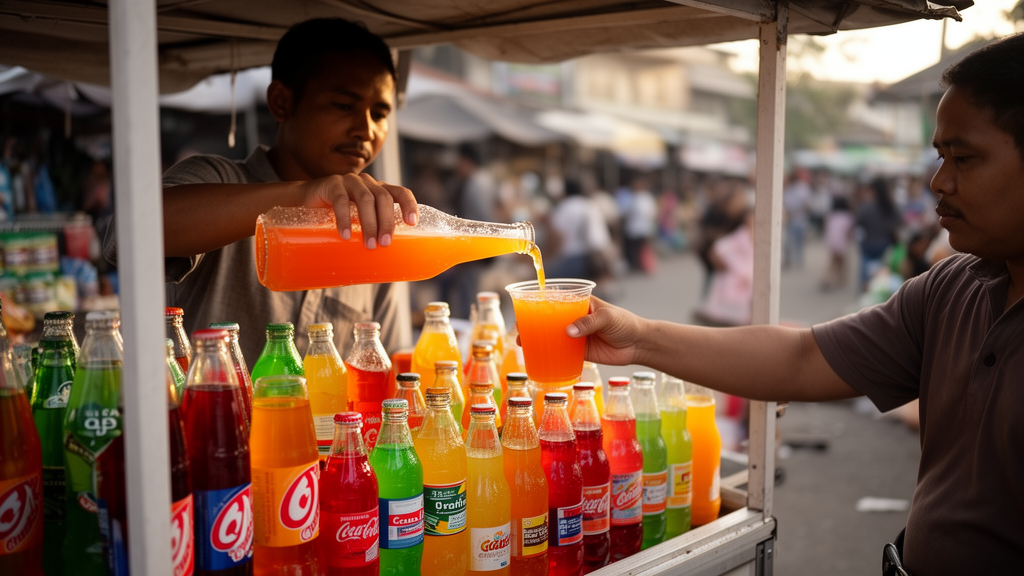
Indonesia has not introduced a tax on sugar-sweetened beverages despite strong international evidence that such taxes reduce consumption, and a new qualitative study argues that taxation by itself would not be enough to change the country’s drinking habits. The research, published in BMC Nutrition, examined how stakeholders across government, academia, economic analysis, and civil society perceive the barriers to controlling sugary drink consumption in Indonesia, and it concludes that effective control would require multilevel, multisectoral, and culturally sensitive approaches backed by stronger cross-sectoral political commitment.
The study team conducted two semi-structured focus group discussions and five in-depth interviews with 17 stakeholders between December 2022 and April 2024. Participants came from government, academic institutions, policy and economics analysis organizations, and civil society organizations. The researchers analyzed the data thematically using a hybrid inductive-deductive approach: they began with open coding of the transcripts, then organized the emerging themes deductively according to the three streams of the Multiple Streams Framework, a policy analysis model that separates a policy problem, the available policy options, and the political dynamics surrounding both.
In the problem stream, the analysis found broad agreement across sectors that sugar-sweetened beverage consumption is a pressing health issue. Nutrition-related non-communicable diseases are a major global health challenge, and in Indonesia the disease burden continues to rise. Excessive intake of sugary drinks is a well-established contributing factor, and consumption levels have been increasing globally. Stakeholders attributed the Indonesian situation to three interacting forces: a deep-rooted “sweet culture,” an obesogenic environment that makes high-calorie choices easy, and a structural regulatory coverage gap for the informal sector, where much beverage sales and preparation occur outside formal regulatory reach.
The policy stream of the framework identified technically feasible interventions operating at government, market, and community levels. Among the options stakeholders discussed were tiered excise taxation on sugar-sweetened beverages, reform of mandatory nutrition labelling, and community education programs grounded in local culture.
The politics stream revealed the study’s central tension. Indonesia already has regulatory frameworks that authorize measures to control sugary drink consumption, and stakeholders identified competing inter-sectoral mandates and interests as the obstacle to action. According to the authors, this combination of recognized problem, available policy options, and existing legal authority indicates that a policy window exists, meaning the conditions for advancing SSB control measures are in place even though the politics stream has not aligned with them.
The study’s conclusion is deliberately broader than a recommendation for a tax. While introducing an SSB tax is described as a promising policy option, the authors state that taxation alone would not be sufficient to control consumption in Indonesia. Instead, they argue for integration across three dimensions: multilevel action spanning government, market, and community settings; multisectoral coordination; and culturally sensitive program design. All of this, they conclude, requires stronger cross-sectoral political commitment to align the politics stream with the existing problem recognition and the policy options already available.
The findings carry the limitations inherent to the study’s design and scope. This was a qualitative study of stakeholder perceptions, not an evaluation of a tax or other intervention, so it reports what informed actors believe about the policy landscape rather than measured effects of any policy on consumption or health. The sample comprised 17 participants drawn from four stakeholder categories, and the data collection stretched over roughly sixteen months, from December 2022 to April 2024. The Multiple Streams Framework structured the analysis, which means the findings are organized around that model’s problem-policy-politics division rather than around an exhaustive inventory of all possible barriers.
For policymakers and public health observers, the study’s contribution is a mapped account of why an evidence-supported intervention has stalled in a specific national context. It documents convergence on the problem, a menu of feasible responses, and a diagnosis of political fragmentation as the binding constraint. The article was published open access on 17 October 2026 under the title “Beyond taxation: a qualitative analysis of policy challenges in controlling sugar-sweetened beverages consumption in Indonesia,” and the version shared at publication is an accepted manuscript subject to further edits before the final version of record.
Subject of Research: Stakeholder perceptions of policy challenges for controlling sugar-sweetened beverage consumption in Indonesia
Article Title: Beyond taxation: a qualitative analysis of policy challenges in controlling sugar-sweetened beverages consumption in Indonesia
Article References: Kurniawan, M., Gamalliel, N., Qorina, F., Khairunnisa, S., GI Kalaij, A., Yunus, R. E., Dharmawan, T., Kusuma, D., & Fuady, A. (2026). Beyond taxation: a qualitative analysis of policy challenges in controlling sugar-sweetened beverages consumption in Indonesia. BMC Nutrition. https://doi.org/10.1186/s40795-026-01509-8
Image Credits: AI Generated
DOI: 10.1186/s40795-026-01509-8
Keywords: sugar-sweetened beverages, Indonesia, SSB taxation, qualitative study, Multiple Streams Framework, non-communicable diseases, nutrition policy, health policy, stakeholder interviews, obesogenic environment, nutrition labelling, public health
News Source: Ophelia Keating. (October 29, 2026). Taxation Alone Won’t Curb Sugary Drinks in Indonesia, Stakeholder Study Finds. Scienmag.



