A phase 2 clinical trial has delivered some of the most striking results yet reported in early-stage classical Hodgkin lymphoma, showing that a regimen pairing two targeted drugs with a stripped-down chemotherapy backbone produced complete responses in 92 percent of patients and kept the disease at bay in an estimated 97 percent of participants two years after treatment. The findings, published in the journal Advances in Therapy as a summary of research originally reported in Blood, come from part C of the SGN35-027 study, a multiple-part clinical trial registered as NCT03646123 that has been testing combinations built around the antibody-drug conjugate brentuximab vedotin across the spectrum of Hodgkin lymphoma.
The regimen under investigation, abbreviated AN + AD, combines brentuximab vedotin and the immune-checkpoint inhibitor nivolumab with two conventional chemotherapy agents, doxorubicin and dacarbazine. Notably absent is bleomycin, the older drug long included in standard front-line Hodgkin lymphoma therapy but increasingly viewed as a liability because of its association with lung toxicity. By substituting targeted agents for bleomycin and, in this study, limiting treatment to just four cycles, the investigators set out to test whether precision medicine could allow patients with favorable disease biology to receive less chemotherapy without sacrificing the exceptional cure rates that define this cancer.
The patient population was carefully defined. The trial enrolled people with nonbulky, early-stage classical Hodgkin lymphoma, meaning their disease was limited to lymph node regions above or below the diaphragm without large tumor masses, a feature that generally predicts a more favorable course. At the time of the analysis, 154 patients had received at least one dose of the four-drug combination, and an overwhelming 98 percent had completed all four planned cycles of treatment. That near-complete adherence to the treatment schedule is itself a meaningful signal in oncology trials, suggesting the regimen was tolerable enough for patients to stay on course.
The efficacy numbers were remarkable across the board. At the end of treatment, the objective response rate, which counts patients whose tumors shrank at least partially, stood at 96 percent. The complete response rate, meaning no detectable disease remained, was 92 percent overall. When the investigators broke the results down by risk group, the picture held steady: patients in the favorable-risk subgroup achieved a complete response rate of 95 percent, while those in the unfavorable subgroup, who typically carry a worse prognosis, still reached 91 percent. The near-identical outcomes across risk categories suggest the addition of the targeted agents may be compressing the historical gap between patient groups that standard chemotherapy has struggled to close.
Durability, the question that matters most in a disease where most patients are young and expected to live decades, also looked strong. Among patients who achieved a complete response, 96 percent maintained it for at least two years. At a median follow-up of 27.9 months, the estimated two-year progression-free survival rate was 97 percent, meaning almost no patients had seen their lymphoma return or worsen within that window. For a disease that strikes disproportionately at young adults, a regimen that combines such high cure indicators with reduced chemotherapy exposure carries implications that extend far beyond the trial population, since late toxicities of Hodgkin lymphoma treatment, including cardiovascular damage and secondary cancers, are a major long-term concern for survivors.
The safety profile, while not benign, was consistent with what is known about the individual components. Any-grade treatment-related side effects occurred in 97 percent of patients, a figure that sounds alarming until placed in context: nearly all cancer regimens produce some side effects in nearly all patients, and the vast majority of these events were low grade. More telling is the grade 3 or higher rate, which captures the serious toxicities that threaten treatment delivery, and here the figure was 34 percent. Strikingly, no cases of febrile neutropenia, the dangerous fever-plus-low-white-blood-count emergency that often drives hospitalization during chemotherapy, were reported at all, a result that speaks to both the tolerability of the regimen and the feasibility of delivering it in community as well as academic settings.
Because nivolumab works by releasing a molecular brake on T cells, the immune-mediated adverse events characteristic of checkpoint inhibitors were a specific focus of monitoring. Treatment-emergent immune-mediated adverse events of any grade occurred in 22 percent of patients. These events, which can include inflammation of the thyroid, skin, lungs, or other organs, arise from the same immune reactivation that makes checkpoint inhibitors effective against cancer, and they are generally manageable with immunosuppressive medication when recognized early. The 22 percent rate provides clinicians with a concrete expectation of how often such monitoring and management will be needed if the regimen moves into routine practice.
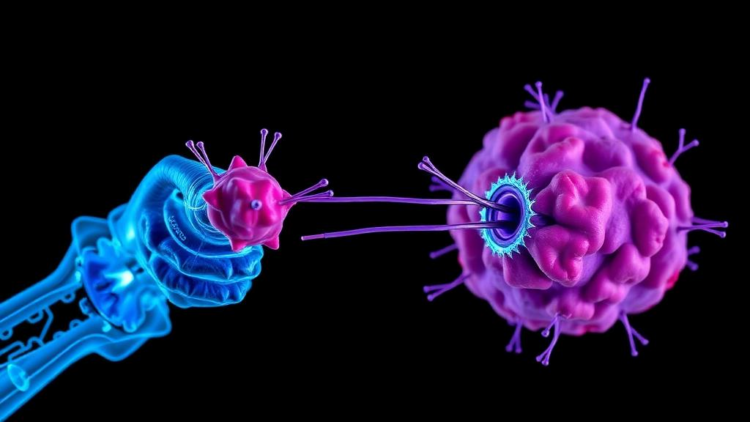
The mechanistic logic behind the combination is one of the reasons the results have generated such attention. Brentuximab vedotin is an antibody-drug conjugate that homes in on CD30, a surface molecule displayed prominently on the malignant Reed-Sternberg cells of Hodgkin lymphoma, and delivers a payload of monomethyl auristatin E that disrupts cell division. Nivolumab blocks the PD-1 pathway, which Hodgkin lymphoma cells exploit to hide from immune attack, in part through genetic alterations that drive overexpression of the PD-L1 ligand. Doxorubicin and dacarbazine provide conventional cytotoxic killing. Preclinical and clinical evidence has suggested that chemotherapy and antibody-drug conjugates can each potentiate antitumor immunity, creating a rationale for pairing them with checkpoint blockade, and the SGN35-027 results lend clinical weight to that hypothesis.
The study was a broad international collaboration, with investigators spanning major cancer centers and community oncology networks across the United States and sites in Europe and Australia. The author group was led by Jeremy S. Abramson of Massachusetts General Hospital and included figures such as David J. Straus of Memorial Sloan Kettering Cancer Center, Nancy L. Bartlett of Washington University School of Medicine, Ryan C. Lynch of Fred Hutchinson Cancer Center, and Wojciech Jurczak of the Maria Sklodowska-Curie National Research Institute of Oncology in Krakow, alongside colleagues from Spain, Italy, Australia, and a range of US centers. Data from the study were previously presented at the 2024 American Society of Hematology Annual Meeting and Exposition in San Diego, and the work received funding support from Seagen, Inc., which was acquired by Pfizer in December 2023, together with Takeda Development Center Americas and Bristol-Myers Squibb, with additional support from a Memorial Sloan Kettering Cancer Center core grant.
The authors and the journal are careful to frame the findings appropriately. The published summary emphasizes that it reports the results of a single study, that results may differ from those of other studies, and that health professionals should make treatment decisions based on all available evidence rather than on one trial. It also notes explicitly that the combination of brentuximab vedotin, nivolumab, doxorubicin, and dacarbazine is not approved for the treatment of people with early-stage classical Hodgkin lymphoma. Those caveats matter, but they do little to dull the significance of the numbers. Classical Hodgkin lymphoma is already one of oncology’s success stories, yet each incremental gain in survival has traditionally been purchased with more intensive therapy and more late effects. A four-cycle, bleomycin-free regimen that pairs two rational targeted agents with limited chemotherapy and delivers 97 percent two-year progression-free survival points toward a future in which curing this cancer requires less treatment, not more, and in which the young patients who make up the bulk of the Hodgkin lymphoma population can look forward not just to survival but to decades of healthier life afterward.
Subject of Research: Combination therapy with brentuximab vedotin, nivolumab, and chemotherapy for nonbulky, early-stage classical Hodgkin lymphoma
Article Title: Summary of Research: Brentuximab Vedotin and Nivolumab in Combination with Chemotherapy for Nonbulky, Early-Stage Classical Hodgkin Lymphoma
Article References: Abramson, J. S., Straus, D. J., Bartlett, N. L., Burke, J. M., Lynch, R. C., Domenech, E. D., Hess, B., Schuster, S. R., Linhares, Y., Gandhi, M., Shah, H. R., Jurczak, W., Re, A., Hahn, U., Prince, H. M., Guo, W., Davis, G., Ho, L., Fanale, M., … Lee, H. J. (2026). Summary of Research: Brentuximab Vedotin and Nivolumab in Combination with Chemotherapy for Nonbulky, Early-Stage Classical Hodgkin Lymphoma. Advances in Therapy. https://doi.org/10.1007/s12325-026-03723-z
Image Credits: AI Generated
DOI: 10.1007/s12325-026-03723-z
Keywords: brentuximab vedotin, nivolumab, classical Hodgkin lymphoma, chemotherapy, antibody-drug conjugate, immune checkpoint inhibitor, phase 2 trial, progression-free survival, complete response, doxorubicin, dacarbazine, hematologic oncology
Cite Scienmag News
APA MLA Chicago
Nathaniel Bowman. (October 3, 2026). Targeted Drug Duo with Lighter Chemotherapy Delivers 97% Survival in Early-Stage Hodgkin Lymphoma. Scienmag. https://scienmag.com/targeted-drug-duo-with-lighter-chemotherapy-delivers-97-survival-in-early-stage-hodgkin-lymphoma/
Nathaniel Bowman. “Targeted Drug Duo with Lighter Chemotherapy Delivers 97% Survival in Early-Stage Hodgkin Lymphoma.” Scienmag, 3 October 2026, https://scienmag.com/targeted-drug-duo-with-lighter-chemotherapy-delivers-97-survival-in-early-stage-hodgkin-lymphoma/. Accessed 3 October 2026.
Nathaniel Bowman. “Targeted Drug Duo with Lighter Chemotherapy Delivers 97% Survival in Early-Stage Hodgkin Lymphoma.” Scienmag. October 3, 2026. https://scienmag.com/targeted-drug-duo-with-lighter-chemotherapy-delivers-97-survival-in-early-stage-hodgkin-lymphoma/
Copy citation Download RIS
Tags: antibody-drug conjugateantibody-drug conjugates in oncologybrentuximab vedotinBrentuximab vedotin and nivolumab in cancer treatmentchemotherapychemotherapy de-escalation strategiesclassical Hodgkin lymphomacomplete responsedacarbazinedoxorubicinearly-stage classical Hodgkin lymphoma outcomeshematologic oncologyimmune checkpoint inhibitorimmune checkpoint inhibitors in lymphomainnovative lymphoma treatment regimensnivolumabomitting bleomycin in frontline therapypersonalized cancer treatment approachesphase 2 clinical trial resultsphase 2 trialProgression-Free Survivalreduced chemotherapy toxicityTargeted therapy in Hodgkin lymphomatwo-year survival rates in Hodgkin lymphoma