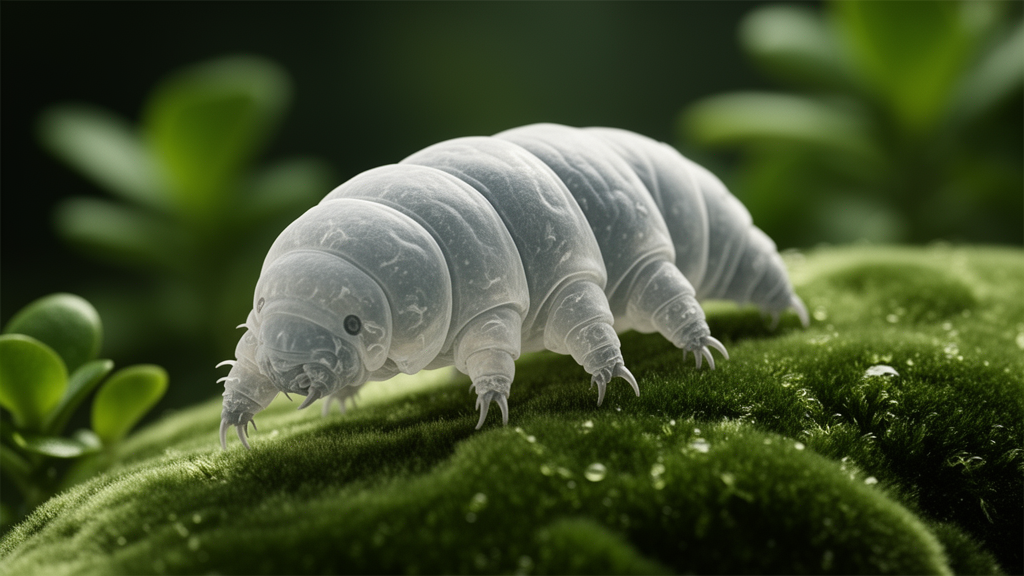
A developmental biology investigation published in EvoDevo has revealed that regionalized expression of distal limb patterning genes in the eutardigrade Hypsibius exemplaris indicates water bear legs are homologous to the distal tips of other panarthropod appendages. The research team, comprising Marc A. Mapalo, Mandy Game, Frank W. Smith, and Javier Ortega-Hernández, examined homologs of seven regulatory genes responsible for patterning outer leg segments in fruit flies to clarify how the unjointed, lobopodous walking legs of tardigrades relate to the complex paired limbs found across Panarthropoda. By tracking gene expression across three embryonic stages using hybridization chain reaction experiments, the researchers observed distinct spatial localization for five of these developmental regulators. Rather than displaying uniform activation across the entire limb, genes known to direct claw and tarsal development in insects demonstrated precise regional domains along the proximodistal axis of developing tardigrade legs. These molecular maps provide developmental evidence that the superficially simple legs of water bears possess hidden regional complexity while sharing an underlying genetic architecture with the specialized appendages of insects, myriapods, and velvet worms.
Panarthropoda represents a major ecdysozoan clade comprising three living lineages: arthropods, including arachnids, myriapods, and pancrustaceans; onychophorans, commonly known as velvet worms; and tardigrades, or water bears. Panarthropods stand out as the only limb-bearing moulting invertebrates, characterized by diverse paired segmental appendages that take either sclerotized, articulated forms in arthropods or fleshy, lobopodous structures in onychophorans and tardigrades. The Cambrian fossil record, coupled with molecular phylogenomic reconstructions placing tardigrades as a sister group to onychophorans and arthropods, indicates that lobopodous limbs represent the ancestral panarthropod state, whereas articulated limbs arose later as a derived innovation restricted to arthropods. Paired limbs are intricate anatomical novelties, prompting decades of developmental genetics research aimed at deciphering how panarthropod appendages first originated, diversified, and became patterned during early animal radiation. Yet while arthropod models such as Drosophila melanogaster have been exhaustively scrutinized and velvet worms have increasingly yielded comparative developmental data, tardigrades have historically remained neglected in limb evolution research, leaving a critical phylogenetic gap in understanding ancestral appendage development.
This historical model organism bias has constrained evolutionary comparisons, precluding robust reconstructions of the ancestral limb patterning networks that operated within the earliest panarthropod ancestors. Tardigrades possess four pairs of lobopodous walking limbs typically terminating in cuticular claws secreted by specialized cells. The phylum divides into two primary taxonomic classes: heterotardigrades, which feature considerable morphological variability, cuticular armoring, sensory organs such as proximal cirri, and occasionally telescopic or digitated leg segments; and eutardigrades, which exhibit a more conservative morphology lacking external sensory cuticular extensions. Despite their superficial simplicity, eutardigrade legs feature intricate internal musculature with distinct proximodistal attachment sites. A prior developmental study examining leg gap genes in Hypsibius exemplaris discovered that dachshund, which patterns medial leg domains in insects, is entirely absent from tardigrades, while Distal-less, homothorax, and extradenticle exhibited broad expression across limbs. That absence of canonical medial patterning suggested two alternative evolutionary scenarios: either hind limbs possess an altered regional identity relative to front legs, or all tardigrade legs share an entirely distal identity relative to other panarthropod appendages.
To rigorously evaluate whether distal limb regulators pattern tardigrade appendages, the researchers developed a computational gene mining strategy focused on seven conserved Drosophila melanogaster distal limb patterning genes: apterous, aristaless, BarH1, clawless, Lim1, rotund, and spineless. In Drosophila, Distal-less initiates epidermal growth factor receptor signaling to activate these downstream regulators, which progressively subdivide the distal podomeres into pretarsus, distal tarsus, and proximal tarsus. Using Drosophila protein isoforms retrieved from Flybase, the authors constructed profile hidden Markov models with HMMER version 3 to search predicted protein sequences of Hypsibius exemplaris. Candidate sequences were filtered through reciprocal BLASTp searches against the Drosophila proteome, retaining hits with expectation values below 10 to the power of negative six, maximum alignment scores exceeding 80, and sequence identities above 20 percent. The researchers then analyzed conserved protein domains using the NCBI Batch Conserved Domain tool and conducted Flybase BLAST searches. Applying the identical pipeline to translated transcriptome assemblies of the marine heterotardigrade Echiniscoides cf. sigismundi revealed that both major tardigrade classes harbor homologs of all seven distal limb patterning factors.
To establish orthology beyond sequence similarity matches, the authors performed rigorous maximum likelihood and Bayesian phylogenetic analyses comparing the tardigrade sequences to metazoan homologs gathered from OrthoDB and Flybase. Homeobox-containing genes including apterous, aristaless, BarH1, clawless, and Lim1 were evaluated in a combined dataset, while rotund and spineless were analyzed alongside outgroups glass and clock, respectively. Sequences aligned with MAFFT version 7 under the L-INS-i algorithm were processed in IQTree 1.6 using Akaike information criterion model selection, with bootstrap support evaluated over 500 replicates. Simultaneous Bayesian inference runs using MrBayes 3.2 operated for at least one million generations across four chains until average standard deviation of split frequencies dropped below 0.01 and effective sample sizes exceeded 200. Consensus phylogenies confirmed that each Hypsibius exemplaris gene robustly clustered within its expected bilaterian orthology group as a single-copy gene. Echiniscoides cf. sigismundi likewise possessed single copies for six genes, while two identified rotund transcripts represented non-overlapping protein domains of a single fractured transcript, verifying that the distal genetic toolkit was inherited from ancestral tardigrades.
Having validated gene identities, the authors characterized spatiotemporal expression dynamics during Hypsibius exemplaris embryogenesis using hybridization chain reaction in situ hybridization. Cultured embryos incubated at 23 degrees Celsius were harvested at three precisely documented developmental milestones: stage 14 at 35 hours post laying, corresponding to early limb bud formation; stage 16 at 45 hours post laying, when limbs elongate prior to claw emergence; and stage 17 at 55 hours post laying, when cuticular claws visibly differentiate. Custom multiplex fluorescent probe sets synthesized by Molecular Instruments were hybridized alongside Distal-less counterstains to unambiguously delineate limb territories. Nuclear counterstaining with DAPI enabled anatomical orientation under a Zeiss LSM 980 confocal microscope equipped with an Airyscan2 detector across multiple laser wavelengths. Optical z-stacks processed with maximum intensity projections in ImageJ 2.3 resolved fine-scale cellular localization across all four walking leg pairs. Although Echiniscoides cf. sigismundi confirmed genomic conservation, experimental expression assays were restricted to Hypsibius exemplaris due to the technical challenges of maintaining and culturing marine heterotardigrades under laboratory conditions.
At stage 14, transcripts of aristaless concentrated predominantly along the posterior margin of early limb buds, shifting by stage 16 to an interior position set back from the posterior edge before fading below detection thresholds by stage 17. In contrast, clawless transcripts appeared broadly dispersed across stage 14 limb buds as well as within a wide dorsal embryonic band. By stage 16, clawless expression condensed sharply toward the posterior limb boundary, partially overlapping aristaless, while also exhibiting focused accumulation in dorsal cephalic tissue. As claws differentiated at stage 17, clawless signal became virtually undetectable in the limbs. Lim1 demonstrated sustained, broad expression throughout all four limb pairs and the cephalic region across all three embryonic stages, though its intensity diminished noticeably by stage 17. The transient, localized bursts of aristaless and clawless prior to claw emergence directly parallel their pretarsal functions in insects, indicating that both genes regulate tardigrade claw gland specification or cuticle secretion.
Tarsal patterning homologs exhibited striking differences in spatial deployment within Hypsibius exemplaris embryos. In fruit flies, apterous and BarH1 collaborate to control distal tarsal segment identity. In water bears, however, apterous exhibited only sparse, weak transcript signals scattered indiscriminately across developing limb buds and embryonic tissues at every examined stage, suggesting it either remains dispensable for tardigrade limb development or acts outside the sampled developmental window. Conversely, BarH1 displayed a dynamic, highly structured expression profile. At stage 14, BarH1 localized distinctly to the proximal margin of budding limbs. By stage 16, this signal resolved into two separate, conspicuous patches within elongated legs: a proximal territory situated proximally relative to aristaless, and an independent distal patch localized to the postero-ventral leg tip. Notably, this distal tip domain appeared exclusively within the first three walking leg pairs, remaining absent from the fourth, rearward-facing hind limb pair. By stage 17, limb expression of BarH1 vanished entirely, although bilateral expression patches persisted in lateral cephalic regions and ventral nerve ganglia.
The proximal tarsal regulators rotund and spineless further underscored the extensive regionalization operating along the water bear proximodistal axis. At stage 14, rotund expression appeared strongly localized to one side of the limb bud, closely mirroring the posterior distribution of aristaless. By stage 16, rotund transcripts shifted to the distalmost leg territory, persisting robustly through stage 17 even after claws had fully formed, while also maintaining an independent dorsal trunk domain adjacent to the third leg pair. Conversely, spineless was expressed at stage 14 in limb regions largely complementary to rotund, exhibiting minimal spatial overlap. By stage 16 and stage 17, spineless transcripts localized prominently to the proximal postero-ventral leg base, alongside sustained expression within lateral cephalic tissues that mirrored BarH1 head domains. In heterotardigrades, the proximal limb base bears tactile sensory cirri, structures absent from smooth eutardigrade limbs. Because spineless and BarH1 govern sensory organ and bristle development in insects, their proximal presence in Hypsibius exemplaris suggests eutardigrades retain cryptic proximal sensory zones or associated leg ganglia inherited from an ancestor possessing leg sensory organs.
Synthesizing these expression profiles across Panarthropoda illuminates how limb patterning systems evolved over hundreds of millions of years. In insects such as Drosophila melanogaster, Tribolium castaneum, and Gryllus bimaculatus, aristaless marks distal leg tips and segment borders, but functional mutational analyses demonstrate its primary role is pretarsal patterning, a distal specialization shared with the myriapod Glomeris marginata and the velvet worm Euperipatoides kanangrensis. Conversely, the disparate, broad deployment of Lim1 in Glomeris and Hypsibius compared to discrete segmental bands in insects leaves its ancestral state unresolved. The proximal leg base expression of spineless in water bears reinforces its ancient, widespread association with sensory fields rather than ancestral podomere boundary formation.
Crucially, superimposing the expression territories of aristaless, clawless, and rotund onto panarthropod appendages provides compelling developmental support for the distal nature of water bear limbs. In Drosophila and Euperipatoides, transcripts of rotund, aristaless, and clawless occupy narrow zones confined to the outermost tips of walking legs. In Hypsibius exemplaris, however, the expression domain of rotund alone spans nearly half the entire length of the walking leg, while aristaless and clawless encompass extensive distal territories. When integrated with earlier findings demonstrating that the distal selector gene Distal-less is expressed along the entire length of all tardigrade legs while medial gap genes are lacking, the molecular topology suggests that the entire tardigrade limb is homologous exclusively to the distal tarsus and pretarsus of other panarthropods. This molecular regionalization shows that internal patterning predated external leg joints, demonstrating that water bears did not evolve simple legs de novo but instead maintained an ancient distal genetic program that continues to orchestrate claws, musculature, and sensory fields within microscopic lobopods.
Subject of Research: Expression of distal limb patterning genes in Hypsibius exemplaris indicate regionalization and suggest distal identity of tardigrade legs
Article Title: Expression of distal limb patterning genes in Hypsibius exemplaris indicate regionalization and suggest distal identity of tardigrade legs
Article References: Mapalo, M. A., Game, M., Smith, F. W., & Ortega-Hernández, J. (2024). Expression of distal limb patterning genes in Hypsibius exemplaris indicate regionalization and suggest distal identity of tardigrade legs. EvoDevo, 15(1), Article 15. https://doi.org/10.1186/s13227-024-00235-1
Image Credits: AI Generated
DOI: 10.1186/s13227-024-00235-1
Keywords: Expression, distal, limb, patterning, genes, Hypsibius, exemplaris, indicate, regionalization, suggest, identity, tardigrade, legs
News Source: Juliet Wilcox. (November 12, 2026). Tardigrade Leg Gene Patterns Suggest Water Bear Limbs Represent Distal Tips. Scienmag.