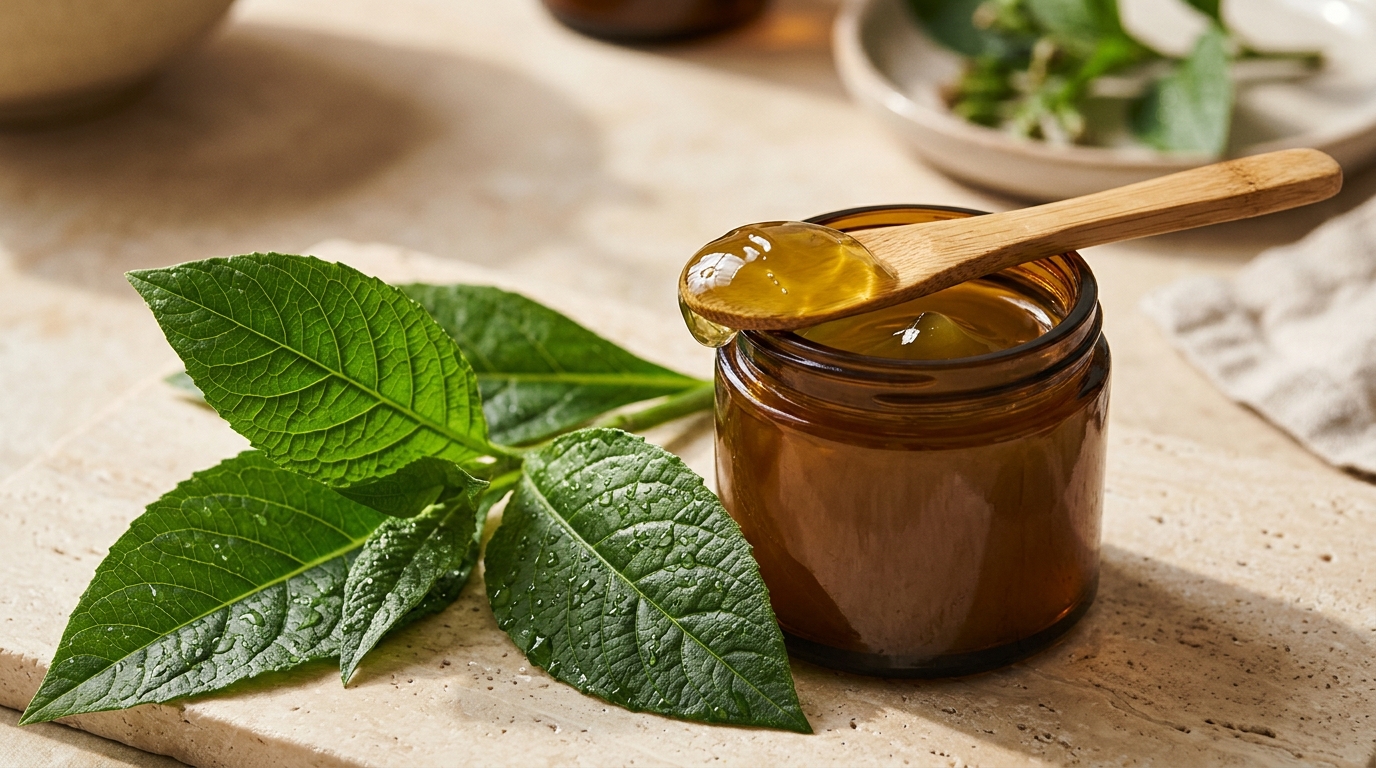
A jelly made from the leaves of a Tanzanian shrub called Phyllanthus englerii Pax has shown measurable antimicrobial activity against three skin-relevant microbes in laboratory tests, according to a study published in Clinical Phytoscience. Researchers ground dried leaves, extracted them with solvents of increasing polarity, screened the resulting extracts for phytochemicals, and then folded the most promising extract into ointments, creams, and jellies. The jelly containing 6.24 percent of the ethyl acetate leaf extract emerged as the leading prototype, producing inhibition zones between 8.00 and 17.00 millimeters across all tested pathogens while remaining stable over 28 days. The work was driven by a practical problem: atopic dermatitis, a condition often complicated by microbes such as Staphylococcus aureus and Candida albicans, affects an estimated 1.5 million people worldwide each year, and its management is increasingly complicated by antimicrobial resistance.
The team, led by Stephano Stanuel Matole and colleagues at institutions including the Muhimbili University of Health and Allied Sciences and the Dar es Salaam University College of Education, collected fresh leaves in February 2024 from Fundikila village in the Urambo district of Tanzania’s Tabora region. A botanist identified the plant in the field, and databases were used to confirm its scientific name; a voucher specimen labeled SM 001 was deposited at the Institute of Traditional Medicine herbarium. The leaves were air-dried in the shade for two weeks, pulverized, and extracted sequentially with n-hexane, ethyl acetate, ethanol, and distilled water at a plant-to-solvent ratio of 1:4. Yields varied with solvent polarity: n-hexane produced 8.07 grams (2.56 percent), ethyl acetate 10.11 grams (3.33 percent), ethanol 27.02 grams (9.34 percent), and distilled water 8.72 grams (3.39 percent). The relatively high ethanol yield followed by a lower water yield suggested the leaves contain a substantial proportion of polar compounds, while the low n-hexane yield indicated fewer non-polar constituents such as oils and fats.
Chemical screening with standard reagents revealed that the ethyl acetate extract contained alkaloids, phenols, cardiac glycosides, steroids, tannins, and terpenoids, whereas the n-hexane extract yielded only steroids and terpenoids. According to the authors, this is the first report of the possible presence of cardiac glycosides, flavonoids, phenols, steroids, tannins, and coumarins in P. englerii leaf extracts. Steroids and terpenoids appeared in every extract, a pattern the researchers linked to previous reports of sterols and terpenoids in this species contributing to anticancer and antiviral properties. The plant is no stranger to drug discovery: englerin A, a compound originally isolated from P. englerii growing in Tanzania, is currently used in drug development for cancer therapy, though it comes from the stem bark rather than the leaves studied here.
To characterize the ethyl acetate extract in more detail, the team turned to gas chromatography-mass spectrometry and liquid chromatography-mass spectrometry at the Government Chemist Laboratory Authority. Twelve compounds were detected by GC-MS and five by LC-MS, for a total of seventeen putatively identified phytochemicals. The most prominent were neophytadiene, squalene, phytol, astragalin, myricitrin, and phlorizin, spanning terpenoids, phenolic compounds, flavonoids, fatty acids, esters, lipids, and steroids. The authors were careful to flag a key limitation: compound assignments rested on spectral matching against reference libraries and literature comparisons, with no authentic reference standards or complementary techniques such as nuclear magnetic resonance employed, so the reported identities should be regarded as tentative. Several of the compounds have been reported from other Phyllanthus species and from plants in entirely different genera and families, meaning the chemical inventory is not novel so much as newly documented for this species.
The antimicrobial testing focused on three strains chosen for their known role in skin infections: S. aureus (ATCC 25923, Gram-positive), Escherichia coli (ATCC 25922, Gram-negative), and C. albicans (NR-29341, a yeast). Using a two-fold serial dilution method in 96-well microtiter plates, with extracts diluted from 10.00 down to 0.08 milligrams per milliliter and growth visualized with a tetrazolium dye, the researchers determined minimum inhibitory concentrations. The ethyl acetate extract inhibited S. aureus at 5.83 milligrams per milliliter, E. coli at 3.75 milligrams per milliliter, and C. albicans at 5.00 milligrams per milliliter. The n-hexane extract showed minimal activity with an MIC above 10 milligrams per milliliter, while the ethyl acetate, ethanol, and aqueous extracts ranged from 3.75 to 8.33 milligrams per milliliter. Notably, the extracts were somewhat more active against the Gram-negative E. coli than against the Gram-positive S. aureus, a difference the authors attribute to variations in bacterial cell wall structure.
The authors are explicit that these are modest numbers. All extract MICs were markedly higher than those of the standard drugs used as positive controls, gentamicin for bacteria and clotrimazole for fungi, tested at concentrations from 16 down to 0.125 micrograms per milliliter, and the difference was statistically significant. The observed activity, they write, suggests moderate potency rather than strong antimicrobial efficacy, and should not be interpreted as evidence of high clinical efficacy. Further purification, compound isolation, and mechanistic studies would be needed to determine whether activity can be enhanced.
Safety screening came next, using the brine shrimp lethality test, a common preliminary toxicity assay in which Artemia salina larvae are exposed to serial dilutions of a test substance. The ethyl acetate extract produced an LC50 of 125.50 micrograms per milliliter, which the authors classify as practically non-toxic at that level. By contrast, the positive control, sodium dichromate, killed 100 percent of larvae at 250 micrograms per milliliter with an LC50 of 1.126 micrograms per milliliter. The researchers also noted that several identified constituents, including two forms of vitamin E and two additional compounds previously shown to support skin health through antioxidant and anti-inflammatory properties, are considered non-toxic, while one compound could cause mild irritation but is generally regarded as safe. They caution that phytochemical screening and brine shrimp assays provide only indicative evidence and do not fully predict pharmacological efficacy or toxicological effects in living organisms.
With the extract selected, the team formulated it into nine products: three ointments (OPEA1, OPEA2, OPEA3), three creams (CPEA1, CPEA2, CPEA3), and three jellies (JPEA1, JPEA2, JPEA3), each at extract concentrations of 1.56, 6.24, and 24.96 percent. Antimicrobial activity was assessed by the agar well-diffusion method, in which 30 milligrams of each formulation were added to wells punched into inoculated agar plates, and inhibition zones were measured after incubation. The jelly products produced inhibition zones ranging from 8.00 plus-or-minus 0.25 to 17.00 plus-or-minus 1.25 millimeters across all tested microbes, with JPEA2 and JPEA3 showing the most promising activity, particularly against S. aureus and C. albicans. The ointments and creams performed worst, which the authors attribute to poor spreadability of their bases. Standard drugs still outperformed every formulation, with zones between 18.83 and 22.00 millimeters.
The authors acknowledge a methodological wrinkle: differences in viscosity among the ointments, creams, and jellies may have affected how well active compounds diffused through the agar, so the measured zones may partly reflect diffusion characteristics rather than intrinsic potency alone. Nevertheless, the concentration-dependent pattern, with higher extract loads producing larger zones, suggests the activity was not random variation but correlated with the bioactive extract content. JPEA2, the 6.24 percent jelly, showed activity similar to the 24.96 percent JPEA3, leading the team to designate it the key prototype. The authors suggest the active ingredients may exert bacteriostatic and fungistatic effects, though this remains an interpretation of the inhibition patterns rather than a demonstrated mechanism.
Physicochemical evaluation of JPEA2 over 28 days, with student volunteers assisting in color and odor tests after giving consent, found a deep green, homogeneous, washable, smooth-textured jelly with a characteristic aromatic scent, soluble in cold, warm, and hot water, stable at minus 22, 25, and 37 degrees Celsius, and with a pH of 5.9, close to that of healthy skin. The study’s conclusion is deliberately measured: the findings provide preliminary scientific support for the traditional use of P. englerii in managing skin-related conditions, but the results are limited to in-vitro evaluations and preliminary toxicity screening. Before any definitive claim of therapeutic efficacy, the authors call for isolation of active compounds, detailed toxicological assessment, formulation optimization, and well-designed in-vivo and clinical investigations.
Subject of Research: Phytochemical profiling and antimicrobial evaluation of Phyllanthus englerii leaf extracts for topical herbal formulation development
Article Title: Phytochemical constituents and antimicrobial evaluation towards development of bioactive herbal formulation from Phyllanthus englerii Pax leaf extracts for potential topical application against selected microbes
Article References: Matole, S. S., Amir, H. M., Mbukwa, E. A., Kacholi, D. S., Qwarse, M., Nondo, R. S. O., Mugaka, B. P., & Nyandoro, S. S. (2026). Phytochemical constituents and antimicrobial evaluation towards development of bioactive herbal formulation from Phyllanthus englerii Pax leaf extracts for potential topical application against selected microbes. Clinical Phytoscience, 12(1), Article 9. https://doi.org/10.1186/s40816-026-00423-7
Image Credits: AI Generated
DOI: 10.1186/s40816-026-00423-7
Keywords: Phyllanthus englerii, atopic dermatitis, antimicrobial resistance, ethyl acetate extract, GC-MS, LC-MS, minimum inhibitory concentration, brine shrimp lethality test, herbal jelly formulation, agar well diffusion, phytochemical screening, topical application
News Source: Ophelia Keating. (November 6, 2026). Tanzanian Bitter Leaf Extract Yields Herbal Jelly With Moderate Antimicrobial Activity. Scienmag.