


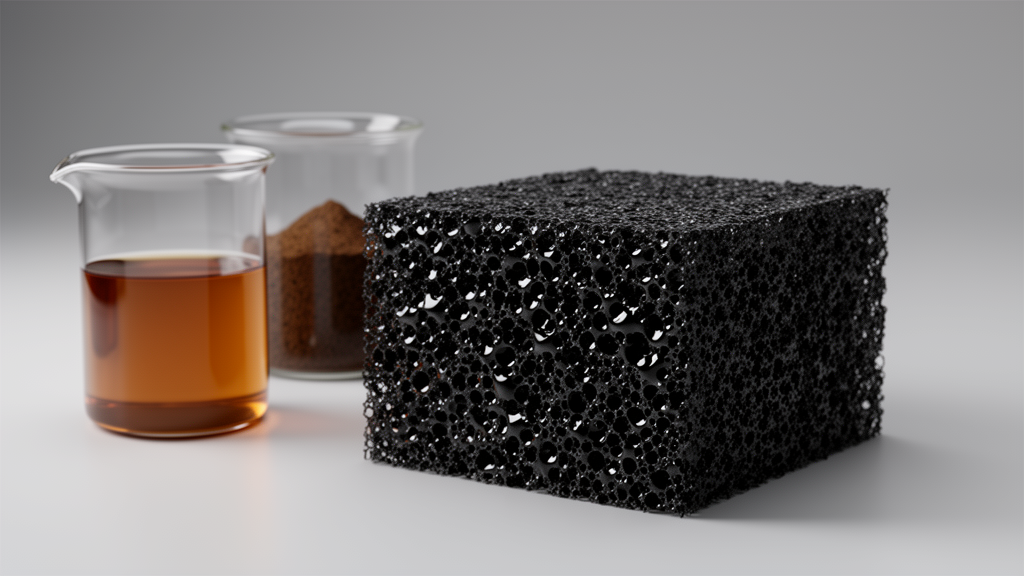
Carbon foams promise a rare combination of lightness, strength and fire resistance, but two stubborn flaws have kept them out of widespread use: brittle mechanical behavior after carbonization and, paradoxically for flame-retardant materials, the smoke they release when they burn. A new study published in the journal Collagen and Leather reports a way to tackle both problems at once, using two of the most abundant phenolic compounds in the plant world—lignin and tannin—as substitutes for petroleum-derived phenol in the foam’s precursor resin.
The research team, led by Qingmiao Jiang and Yongqian Shi, modified alkali lignin from Sinocalamus oldhami through an etherification reaction with epichlorohydrin, then used the modified lignin to replace 30 percent by weight of the phenol in a phenol-formaldehyde resin. Tannin was added afterward as a framework filler at loadings of 3, 5, 7 or 10 percent, in three chemically distinct forms: myrica extract (ME) and wattle extract (WE), both condensed tannins, and tannic acid (TA), a hydrolysable tannin. The cured foams were then carbonized in a nitrogen-flow tube furnace, ramped first to 200 degrees Celsius for stabilization and then to a final temperature of 600 degrees Celsius, a peak the authors selected from preliminary experiments showing no further improvement in smoke release up to 1200 degrees Celsius.
The headline result concerns smoke. In cone calorimeter tests at a heat flux of 35 kilowatts per square meter, following the ISO 5660 standard, the total smoke release of the optimized formulation, TLCF5−ME—containing 5 percent myrica extract—was just 0.39 square meters per square meter. That figure is 85.87 percent lower than a lignin-only carbon foam (2.76 square meters per square meter) and a striking 97.62 percent lower than the pure phenolic carbon foam control, which measured 16.40 square meters per square meter. At 7 percent ME loading the reduction was even deeper, with total smoke release falling to 0.13 square meters per square meter, a 99.21 percent drop relative to the control. The authors note that after the initial ignition stage, combustion of the ME-containing foams was nearly smokeless.
The mechanical story is equally consequential, because simply swapping in lignin made things worse before tannin made them better. After carbonization, the compressive strength of the pure phenolic foam was 0.24 megapascals, but the lignin-substituted foam without tannin dropped sharply to 0.08 megapascals, which the researchers attribute to a loose carbon skeleton caused by the large lignin fraction. Adding tannin reversed the decline in a dose-dependent way: compressive strength first rose and then fell as tannin content increased, a non-monotonic pattern the team links to crosslink density in the resin network, tracked by the intensity of the C-O-C infrared peak, which peaked at 5 percent tannin before molecular crowding reduced crosslinking efficiency.
At the optimum, 5 percent myrica extract lifted compressive strength to 0.32 megapascals—a 300 percent improvement over the lignin-only foam and 33.3 percent above the pure phenolic control. Flexural strength followed the same logic, reaching 0.38 megapascals for TLCF5−ME, which is 72.7 percent above the lignin-only foam and 11.8 percent above the control. Microscopy helped explain why: quantitative image analysis showed that TLCF5−ME had the smallest average pore size of all the samples, 103.46 micrometers, with the narrowest distribution, while the lignin-only foam had the largest average pore size and cell walls riddled with holes that compromised its strength.
Not every tannin worked. Tannic acid, the hydrolysable member of the trio, actually degraded performance. Its ester bonds cleave during pyrolysis, and the resulting carbon foams showed more defects, a higher ratio of disordered to graphitic carbon in Raman spectra, and—most damaging—more smoke than even the untreated control foam. The condensed tannins ME and WE, by contrast, acted as reactive co-monomers that integrated into the phenolic network, raising crosslink density and, after carbonization, producing a more robust carbon scaffold with thicker struts that distribute stress and resist cracking.
Spectroscopy tied these outcomes to carbon structure. Raman analysis of the foams showed that the ID/IG ratio, an inverse indicator of graphitization, fell from 2.566 for the pure phenolic foam and 2.493 for the lignin-only foam to 2.032 for TLCF5−ME and 2.057 for the 5 percent wattle extract sample, while the tannic acid formulation rose to 2.818. After cone calorimeter testing, the char residue of TLCF5−ME retained the lowest ID/IG value of the group at 1.277, and the team reports a negative correlation between the tannins’ Stiasny numbers—a measure of reactivity toward formaldehyde, determined as 88 for ME and 92 for WE—and the disorder in the resulting chars. In their interpretation, higher tannin reactivity promotes graphitization, and better-graphitized carbon forms a coherent, compact char barrier that physically suppresses smoke release during combustion.
The fire-safety picture has nuances worth noting. All tannin-containing foams kept high limiting oxygen index values of at least 38 percent, compared with 35.3 percent for the pure phenolic control, and peak heat release rates were only slightly higher than the lignin-only foam, with total heat release remaining low across the series. Carbon monoxide output told a mixed story: peak CO production rates of the tannin foams were higher than the lignin-only foam but 29.41 to 44.12 percent below the pure phenolic control, and CO yields of ME-containing samples fell by 4.64 to 46.27 percent relative to the control, depending on loading. The authors also observed increased CO2 yields in most tannin samples and argue, based on post-combustion infrared analysis, that this reflects more complete oxidation of a reinforcing char layer whose integrity simultaneously limits smoke and CO.
Dosage matters as much as tannin identity. Smoke suppression improved as ME content rose from 3 to 7 percent, but at 10 percent ME the total smoke release rebounded to 2.81 square meters per square meter, and excess wattle extract or tannic acid pushed smoke output sharply upward, with the tannic acid series exceeding even the untreated controls. The authors suggest that excessive tannin damages the compact structure of the foam, lowers graphitization and increases carbon content, all of which drive smoke production back up. There is an economic and environmental trade-off as well: the lignin modification relies on epichlorohydrin, a hazardous reagent requiring strict handling, yet the team judges the net benefit positive given the 30 percent reduction in petroleum-derived phenol—whose price they cite as roughly 2.5 times that of tannin—and the use of lignin obtainable from industrial waste.
The authors position TLCF5−ME as a candidate for lightweight, fire-safe insulation in construction and for components in transportation systems, while framing the work more broadly as a demonstration that tannin type governs char quality, which in turn determines both mechanical strength and fire performance. As with any laboratory-scale materials study, the results come from standardized cone calorimetry and small-scale mechanical testing rather than field deployment, and real-world durability, manufacturability at scale and long-term cost remain to be demonstrated. Still, the central finding stands on its own numbers: replacing nearly a third of the fossil phenol in a carbon foam precursor with biomass, then reinforcing it with a modest dose of condensed tannin, produced a foam that is stronger than the petrochemical original and emits almost none of its smoke.
Subject of Research: Biomass-derived tannin-lignin-phenolic carbon foam with smoke suppression and improved mechanical properties
Article Title: Controllable fabrication of a tannin-lignin-phenolic carbon foam with excellent smoke suppression and preferable mechanical properties
Article References: Jiang, Q., Zhou, Y., Liu, M., Lv, Y., Guo, H., Liu, Y., Ye, X., & Shi, Y. (2026). Controllable fabrication of a tannin-lignin-phenolic carbon foam with excellent smoke suppression and preferable mechanical properties. Collagen and Leather, 8(1), Article 25. https://doi.org/10.1186/s42825-026-00247-8
Image Credits: AI Generated
DOI: 10.1186/s42825-026-00247-8
Keywords: carbon foam, lignin, tannin, phenolic resin, smoke suppression, flame retardancy, compressive strength, graphitization, cone calorimetry, biomass materials, char formation, fire safety
News Source: Denise Maddox. (October 30, 2026). Tannin and Lignin Team Up to Make Carbon Foam That Barely Smokes. Scienmag.



