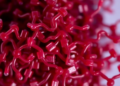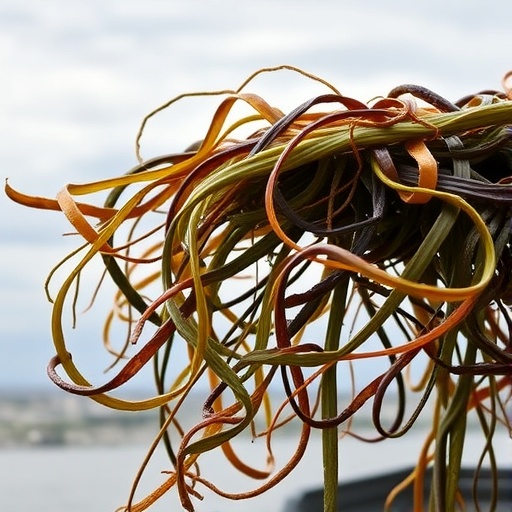
A fluffy, seaweed-inspired “net” could offer a new way to remove microplastics from water, capturing particles that range from visible fragments roughly a millimeter across to nanoparticles measured in tens of nanometers. Developed by researchers at North Carolina State University, the material combines a porous structural mesh with an exceptionally adhesive coating, allowing it to target a far broader size range than many existing filtration technologies.
Microplastics are generally defined as plastic particles smaller than five millimeters, but that category covers an enormous variety of materials and dimensions. Large fragments may be relatively easy to trap with screens or conventional filters, while smaller particles can pass through those barriers and remain suspended in water. Nanoplastics are even more difficult to remove because their tiny dimensions allow them to behave differently from larger particles, interacting with water and other substances at the molecular scale.
The new material was inspired by floating mats of seaweed and by naturally occurring “Neptune balls,” spherical masses formed when strands of seagrass and seaweed become tangled. Researchers have observed that these natural structures can collect plastic particles as they move through marine environments. Rather than copying their appearance alone, the NC State team sought to recreate the multiscale physical mechanisms that make tangled vegetation effective at trapping pollution.
The resulting cleaners are made from alginate and chitosan, biopolymers derived from seaweed and crustacean shells. These materials are widely available, renewable and generally considered more sustainable than petroleum-based filtration media. The main body of each cleaner consists of a porous network of fibers. That network creates openings large enough to intercept comparatively large plastic particles while allowing water to flow through the structure.
The surface of the mesh provides the key to capturing smaller contaminants. It is coated with extremely fine chitosan fibers that form soft dendritic colloids. These structures branch repeatedly, producing progressively finer filaments that end in tuft-like crowns of nanofibers. The branching architecture dramatically increases the available surface area and creates many points of contact where plastic particles can adhere.
In effect, the researchers created what they describe as a “fluffy net.” The underlying mesh acts as a physical sieve for larger microparticles, including pieces around a millimeter or more in size. The delicate coating performs a different function: instead of relying only on the size of the openings, it uses surface adhesion to capture much smaller particles. The chitosan-based dendritic structures can make direct contact with polymer particles and hold them to the fibers as water passes through.
That combination of size-based filtration and adhesion is important because plastic pollution in real water is not uniform. A single sample can contain fragments, fibers, irregular particles and nanoscale debris made from different polymers. Conventional systems designed for one size range may require several treatment stages, and filters capable of removing very small particles can become clogged or demand significant energy. A multiscale material could potentially simplify that process, although its performance outside the laboratory remains to be established.
In proof-of-concept experiments, the superadhesive meshes captured laboratory-produced model nanoparticles as well as real-world microplastics across a wide range of sizes. The tests worked in both freshwater and saltwater, an important result because dissolved salts and other substances can alter particle behavior and the interactions between contaminants and filter surfaces. The findings suggest that the mesh’s performance is not limited to a single aquatic environment, though larger-scale trials would be needed to determine how it performs in rivers, wastewater, coastal waters or heavily contaminated sites.
The researchers also envision a possible route for handling the material after it becomes loaded with plastic. Used meshes could be collected and reprocessed, while microbial digestion might eventually break down both the captured plastics and the biopolymer framework. In theory, biological processing could help convert the material into components for producing new biopolymer cleaners, reducing waste from the cleanup process. That idea remains prospective rather than demonstrated at industrial scale, and questions about durability, regeneration, contamination and cost will determine whether the technology can move beyond proof-of-concept testing.
The work, led by recent NC State Ph.D. graduate Haeleen Hong with Byeunggon Kim, Mesbah Ahmad and corresponding author Orlin Velev, is reported in the open-access journal Science Advances. The study presents the artificial Neptune balls as a biomimetic network designed for broad-spectrum microplastics capture. While the researchers emphasize that large-scale deployment would require substantial investment and engineering, the concept offers a striking example of how natural structures can inspire new pollution-control technologies: a soft, renewable and highly textured material that turns the tangled logic of seaweed into a potential tool for cleaning polluted water.
Subject of Research: Experimental development of sustainable biomimetic meshes for capturing microplastics and nanoplastics from freshwater and saltwater.
Article Title: Artificial Neptune balls: Superadhesive biomimetic networks for broad size microplastics capture and removal
News Publication Date: 5-Aug-2026
Web References: https://doi.org/10.1126/sciadv.aeg0819; https://www.eea.europa.eu/en/european-zero-pollution-dashboards/indicators/impacts-of-microplastics-on-health-signal; https://oceanservice.noaa.gov/education/tutorial-coastal/marine-debris/md04-sub-01.html; https://www.theguardian.com/environment/2021/jan/15/seagrass-neptune-balls-sieve-millions-of-plastic-particles-from-water-study-finds
References: Hong, H., Kim, B., Ahmad, M. et al. “Artificial Neptune balls: Superadhesive biomimetic networks for broad size microplastics capture and removal.” Science Advances. DOI: 10.1126/sciadv.aeg0819.
Image Credits: Byeunggon Kim, Haeleen Hong and Orlin Velev, NC State University
Keywords
Microplastics, nanoplastics, water purification, seaweed-inspired technology, biomimetic materials, chitosan, alginate, sustainable filtration, freshwater pollution, saltwater pollution, Science Advances