• HOME
  • NEWS
  • EXPLORE
    • CAREER
      • Companies
      • Jobs
    • EVENTS
    • iGEM
      • News
      • Team
    • PHOTOS
    • VIDEO
    • WIKI
  • BLOG
  • COMMUNITY
    • FACEBOOK
    • INSTAGRAM
    • TWITTER
Thursday, May 21, 2026
BIOENGINEER.ORG
No Result
View All Result
  • Login
  • HOME
  • NEWS
  • EXPLORE
    • CAREER
      • Companies
      • Jobs
        • Lecturer
        • PhD Studentship
        • Postdoc
        • Research Assistant
    • EVENTS
    • iGEM
      • News
      • Team
    • PHOTOS
    • VIDEO
    • WIKI
  • BLOG
  • COMMUNITY
    • FACEBOOK
    • INSTAGRAM
    • TWITTER
  • HOME
  • NEWS
  • EXPLORE
    • CAREER
      • Companies
      • Jobs
        • Lecturer
        • PhD Studentship
        • Postdoc
        • Research Assistant
    • EVENTS
    • iGEM
      • News
      • Team
    • PHOTOS
    • VIDEO
    • WIKI
  • BLOG
  • COMMUNITY
    • FACEBOOK
    • INSTAGRAM
    • TWITTER
No Result
View All Result
Bioengineer.org
No Result
View All Result
Home NEWS Science News Chemistry

Taking microelectronics to a new dimension

Bioengineer by Bioengineer
March 23, 2021
in Chemistry
Reading Time: 2 mins read
0
IMAGE
Share on FacebookShare on TwitterShare on LinkedinShare on RedditShare on Telegram

IMAGE

Credit: by Erik Hagen Waller, Julian Karst, and Georg von Freymann

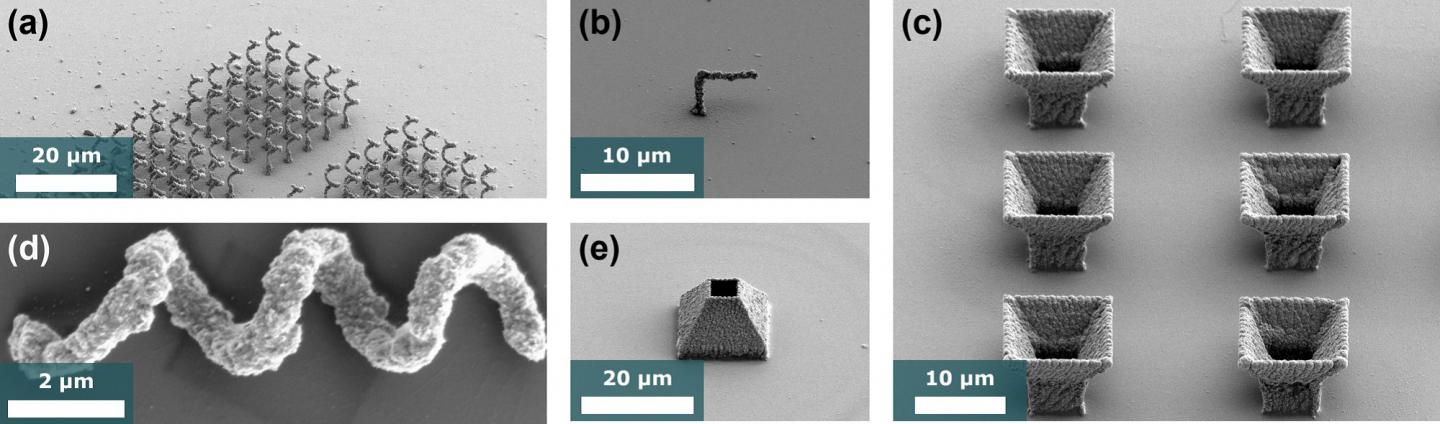
Metallic microstructures are the key components in almost every current or emerging technology. For example, with the next wireless communication standard (6G) being established, the need for advanced components and especially antennas is unbroken. The drive to yet higher frequencies and deeper integration goes hand in hand with miniaturization and fabrication technologies with on-chip capability. Via direct laser writing – an additive manufacturing technology that offers sub-micron precision and feature sizes – highly sophisticated and integrated components come into reach. One big advantage of direct laser writing is that it is not limited to the fabrication of planar structures but enables almost arbitrary 3D microstructures. This dramatically increases the options available to component or device designers and offers vast potential for, e.g., antenna performance improvement: gain, efficiency and bandwidth are higher at lower feeding losses for 3D antennas compared to their planar counterparts. These advantages become even more pronounced the higher the frequency gets.

In a recent paper published in Light: Advanced Manufacturing, a team of scientists from the Fraunhofer ITWM, the Technische Universität Kaiserslautern and the Stuttgart University have developed a novel photosensitive material that enables direct fabrication of highly conductive microcomponents via direct laser writing.

“Not only are the resulting structures made of almost 100 % silver, but they also have above 95% material density. Furthermore, almost arbitrary structure geometries are possible while onchip compatibility is maintained with this approach.”, says Erik Waller, the lead scientist of the project.

The feasibility and strength of the approach was demonstrated by the fabrication of a polarizer based on an array of helical antennas working in the infrared spectral region.

“This material and technology are well suited for the fabrication of conductive three dimensional micrometer-sized components. Next, we want to show the integration of thus fabricated components on conventionally fabricated chips. We then indeed take microelectronics to another dimension.”, says Georg von Freymann, head of department at the Fraunhofer ITWM and professor at the Technische Universität Kaiserslauten.

###

Media Contact
Erik Hagen Waller
[email protected]

Related Journal Article

http://dx.doi.org/10.37188/lam.2021.008

Tags: Chemistry/Physics/Materials SciencesOptics
Share12Tweet8Share2ShareShareShare2

Related Posts

Scientists Achieve Breakthrough in Molecular ‘Sandwich’ Assembly — Chemistry

Scientists Achieve Breakthrough in Molecular ‘Sandwich’ Assembly

May 21, 2026
Advancing In Vivo and In Situ Monitoring: Science Bulletin Highlights Host-Based Antifouling Gold Nanotube Sensor for Selective Detection of Mechanically Sensitive Serotonin Release in Intestinal Mucosa — Chemistry

Advancing In Vivo and In Situ Monitoring: Science Bulletin Highlights Host-Based Antifouling Gold Nanotube Sensor for Selective Detection of Mechanically Sensitive Serotonin Release in Intestinal Mucosa

May 20, 2026

How Magnetic Orientation Could Influence the Building Blocks of Life

May 20, 2026

Breaking a 200-Year-Old Belief: Novel Surface Design Achieves Two Distinct Wetting States on One Substrate

May 20, 2026
Please login to join discussion

POPULAR NEWS

  • blank

    New Study Reveals Plants Can Detect the Sound of Rain

    733 shares
    Share 292 Tweet 183
  • ESMO 2025: mRNA COVID Vaccines Enhance Efficacy of Cancer Immunotherapy

    304 shares
    Share 122 Tweet 76
  • Research Indicates Potential Connection Between Prenatal Medication Exposure and Elevated Autism Risk

    846 shares
    Share 338 Tweet 212
  • Breastmilk Balances E. coli and Beneficial Bacteria in Infant Gut Microbiomes

    58 shares
    Share 23 Tweet 15

About

We bring you the latest biotechnology news from best research centers and universities around the world. Check our website.

Follow us

Recent News

Innovative Reusable Brick Walls Revolutionize Construction Industry

Nonlinear Atomic Tunneling Enhanced by Bright Squeezed Vacuum

Label-Free Super-Resolution Imaging of Live Cells

Subscribe to Blog via Email

Enter your email address to subscribe to this blog and receive notifications of new posts by email.

Join 82 other subscribers
  • Contact Us

Bioengineer.org © Copyright 2023 All Rights Reserved.

Welcome Back!

Login to your account below

Forgotten Password?

Retrieve your password

Please enter your username or email address to reset your password.

Log In
No Result
View All Result
  • Homepages
    • Home Page 1
    • Home Page 2
  • News
  • National
  • Business
  • Health
  • Lifestyle
  • Science

Bioengineer.org © Copyright 2023 All Rights Reserved.