• HOME
  • NEWS
  • EXPLORE
    • CAREER
      • Companies
      • Jobs
    • EVENTS
    • iGEM
      • News
      • Team
    • PHOTOS
    • VIDEO
    • WIKI
  • BLOG
  • COMMUNITY
    • FACEBOOK
    • INSTAGRAM
    • TWITTER
Monday, May 11, 2026
BIOENGINEER.ORG
No Result
View All Result
  • Login
  • HOME
  • NEWS
  • EXPLORE
    • CAREER
      • Companies
      • Jobs
        • Lecturer
        • PhD Studentship
        • Postdoc
        • Research Assistant
    • EVENTS
    • iGEM
      • News
      • Team
    • PHOTOS
    • VIDEO
    • WIKI
  • BLOG
  • COMMUNITY
    • FACEBOOK
    • INSTAGRAM
    • TWITTER
  • HOME
  • NEWS
  • EXPLORE
    • CAREER
      • Companies
      • Jobs
        • Lecturer
        • PhD Studentship
        • Postdoc
        • Research Assistant
    • EVENTS
    • iGEM
      • News
      • Team
    • PHOTOS
    • VIDEO
    • WIKI
  • BLOG
  • COMMUNITY
    • FACEBOOK
    • INSTAGRAM
    • TWITTER
No Result
View All Result
Bioengineer.org
No Result
View All Result
Home NEWS Science News Chemistry

Taking a shine to polymers: Fluorescent molecule betrays the breakdown of polymer materials

Bioengineer by Bioengineer
November 24, 2020
in Chemistry
Reading Time: 3 mins read
0
IMAGE
Share on FacebookShare on TwitterShare on LinkedinShare on RedditShare on Telegram

IMAGE

Credit: Tokyo Tech

Nylon, rubber, silicone, Teflon, PVC – these are all examples of man-made polymers – long chains of repeated molecular units that we call monomers. While polymers also exist in nature (think wool, silk, or even hair), the invention of synthetic polymers, the most famous of which is plastic, revolutionized the industry. Light, stretchy, flexible, yet strong and resistant, synthetic polymers are one of the most versatile materials on the planet, used in everything from clothing to building, packaging and energy production. Since the very beginning of this new era in material engineering, understanding the influence of external forces on polymers’ strength and stability has been crucial to evaluate their performance.

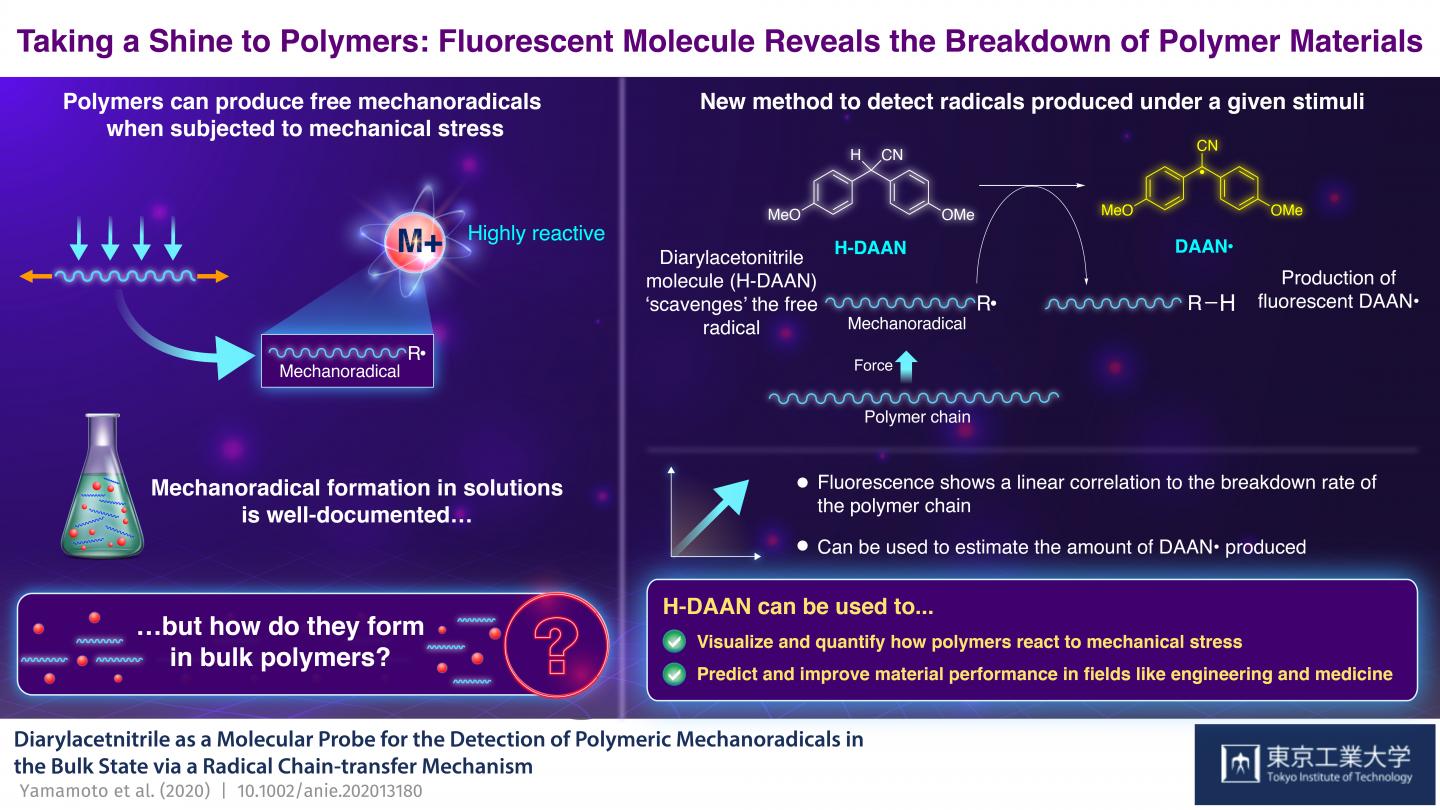
When subjected to mechanical stress, the weak bonds that keep some polymer chains together are overcome, and one inevitably breaks. When this happens, a free radical (a molecule with an unpaired electron, which is naturally unstable and very reactive, called a “mechanoradical” in this case) is generated. By estimating the amount of free mechanoradicals produced, we can infer the resistance of a material to the amount of stress. While this phenomenon is well documented, scientists struggled to observe it under ambient temperature in bulk state, because mechanoradicals produced for polymers in bulk are not stable due to their high reactivity toward oxygen and other agents.

Researchers from Tokyo Institute of Technology led by Professor Hideyuki Otsuka decided to take up the challenge. In their study published in Angewandte Chemie International Edition, they used a small molecule called diarylacetonitrile (H-DAAN) to capture the rogue free radicals. “Our theory was that H-DAAN would emit a distinctive fluorescent light when it reacts with the free radicals, which we could then measure to estimate the extent of polymer breakdown,” explains Prof Otsuka. “The theory is simple; the higher the force exerted on the polymer, the more mechanoradicals are produced, and the more they react with H-DAAN. This higher reaction rate results in more intense fluorescent light, changes in which can easily be measured.”

The researchers now wanted to see how this would work in practice. When polystyrene (in the presence of H-DAAN) was subjected to mechanical stress via grinding, the H-DAAN acted as a radical scavenger for polymeric mechanoradicals, and bound with them to produce “DAAN* ,” which has fluorescent properties. This caused a visible yellow fluorescence to appear.

“More important, probably, is the clear correlation that we found between fluorescence intensity and the amount of DAAN radicals generated by the ground-up polystyrene, as we had predicted,” reports Prof Otsuka. “This means that it is possible to estimate the amount of DAAN radicals generated in the bulk system just by measuring the fluorescence intensity.”

The implications of their findings are wide-ranging: by being able to visually quantify how materials respond to different external stimuli, they can test how suitable polymers are for various uses, depending on the mechanical stress they will be expected to undergo. This method could prove to be an invaluable tool for scientists and engineers as they strive to improve material performance and specificity.

This exciting research this shine light on the responses of polymers to mechanical stress and illuminate the way forward in the research of polymer mechanoradicals!

###

Media Contact
Kazuhide Hasegawa
[email protected]

Original Source

https://www.titech.ac.jp/english/news/2020/048368.html

Related Journal Article

http://dx.doi.org/10.1002/anie.202013180

Tags: Chemistry/Physics/Materials SciencesPolymer Chemistry
Share12Tweet8Share2ShareShareShare2

Related Posts

Miniature Sensor Uses Light to Detect Touch — Chemistry

Miniature Sensor Uses Light to Detect Touch

May 8, 2026
Iron Minerals Determine Whether Dissolved Organic Matter Fuels Microbes or Becomes Long-Term Carbon Storage — Chemistry

Iron Minerals Determine Whether Dissolved Organic Matter Fuels Microbes or Becomes Long-Term Carbon Storage

May 8, 2026

Kate Evans Appointed Associate Lab Director for Biological and Environmental Systems Science at ORNL

May 8, 2026

Advancing Multiscale Modeling and Overcoming Operational Challenges in Autothermal COâ‚‚-to-Methanol Reactors

May 8, 2026
Please login to join discussion

POPULAR NEWS

  • Research Indicates Potential Connection Between Prenatal Medication Exposure and Elevated Autism Risk

    840 shares
    Share 336 Tweet 210
  • New Study Reveals Plants Can Detect the Sound of Rain

    727 shares
    Share 290 Tweet 181
  • Salmonella Haem Blocks Macrophages, Boosts Infection

    61 shares
    Share 24 Tweet 15
  • Breastmilk Balances E. coli and Beneficial Bacteria in Infant Gut Microbiomes

    57 shares
    Share 23 Tweet 14

About

We bring you the latest biotechnology news from best research centers and universities around the world. Check our website.

Follow us

Recent News

New Post-Hoc Analysis Explores Daily Oral Orforglipron Use in Adults Over 65 with Obesity, Regardless of Diabetes Status

Evaluating Digoxin Use in Patients with Symptomatic Rheumatic Heart Disease

Evaluating the Effectiveness and Safety of Digitalis Glycosides in Treating Heart Failure

Subscribe to Blog via Email

Enter your email address to subscribe to this blog and receive notifications of new posts by email.

Join 82 other subscribers
  • Contact Us

Bioengineer.org © Copyright 2023 All Rights Reserved.

Welcome Back!

Login to your account below

Forgotten Password?

Retrieve your password

Please enter your username or email address to reset your password.

Log In
No Result
View All Result
  • Homepages
    • Home Page 1
    • Home Page 2
  • News
  • National
  • Business
  • Health
  • Lifestyle
  • Science

Bioengineer.org © Copyright 2023 All Rights Reserved.