New theory could help overcome a significant barrier to achieving fusion power
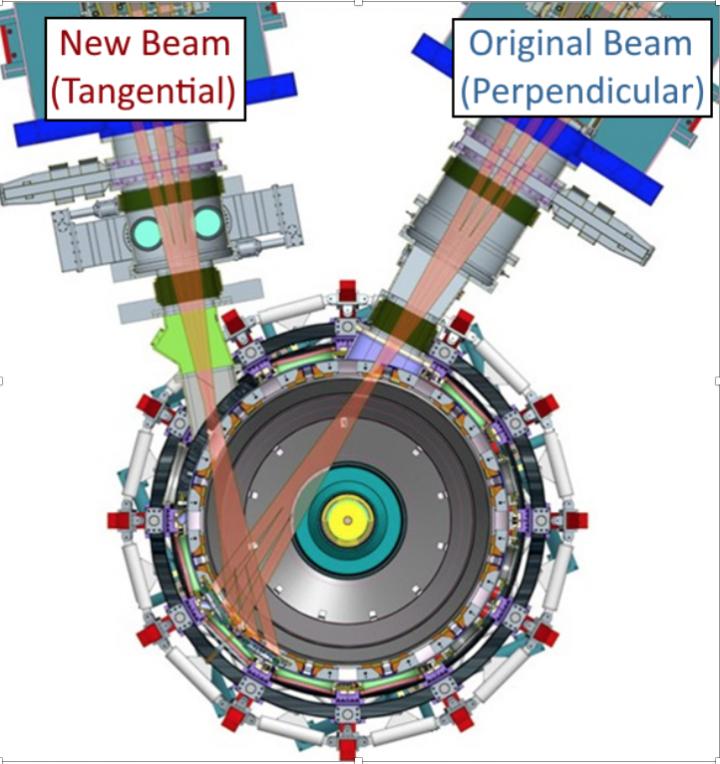
Credit: NSTX-U collaboration.
Fort Lauderdale, Fla.–Fusion combines light elements in the form of plasma–“the hot, charged state of matter composed of free electrons and atomic nuclei–“to generate massive amounts of energy. One of the ways that scientists help heat the plasma is by injecting beams of energetic particles into tokamaks to provide enough energy for plasma particles to overcome mutual repulsion and fuse together. The injected particles, however, can also produce waves that cause plasma energy to leak out of the magnetic fields that confine it, cooling the plasma and helping to quench the fusion reactions. It is therefore beneficial to the development of fusion energy to suppress these waves.
Researchers at the Princeton Plasma Physics Laboratory (PPPL) have developed new mathematical tools to forecast when the waves will be present and could cool the plasma. Importantly, the mathematical expressions predict that a second beam injected at a different angle from the original beam will suppress the undesired effect of the waves, providing new methods for maintaining the plasma’s confinement. Such a second beam (Figure 1) has been installed on the National Spherical Torus Experiment-Upgrade (NSTX-U) at PPPL.
The PPPL physicists ran detailed computer simulations to model the experiments in which the waves were observed. The results agreed with data from experiments on the predecessor of the NSTX-U.
“These results not only explain observations of the waves in past experiments, but also indicate how to avoid the negative impact of the waves using different mixtures of the two beams on NSTX-U that inject energetic particles at different angles,” says Jeff Lestz, a graduate student working on the project at PPPL.
PPPL scientists now plan to compare their predictions with other fusion experiments on tokamaks such as the DIII-D National Fusion Facility, on which beams are installed at different orientations and angles of injection. Without this detailed understanding, scientists cannot reliably predict how to effectively heat plasma, affecting the design of fusion facilities and potentially limiting fusion performance in tokamak fusion devices.
###
This research was supported by the U.S. Department of Energy via contracts DE-AC02-09CH11466 and DE-SC0011810.
Contacts: Jeff Lestz, Princeton University, [email protected]
Abstract:
Theory for control of sub-cyclotron Alfvén instabilities and implications for anomalous electron energy transport in tokamaks
9:30 AM – 12:30 PM, Thursday, October 24, 2019
Room: Floridian Ballroom AB
http://meetings.
About APS/DPP:
The 61st Annual Meeting of the American Physical Society’s Division of Plasma Physics will take place from October 21-25, 2019 in Fort Lauderdale, Florida. All technical sessions will be located at the Fort Lauderdale/Broward County Convention Center, where over 1,900 papers will be presented by scientists from over 20 countries around the world.
The American Physical Society (APS) is a nonprofit membership organization working to advance and diffuse the knowledge of physics through its outstanding research journals, scientific meetings, and education, outreach, advocacy, and international activities. APS represents over 55,000 members, including physicists in academia, national laboratories, and industry in the United States and throughout the world.
Media Contact
Saralyn Stewart
[email protected]
512-694-2320