A research team led by Guangwei He and Zhongyi Jiang has engineered polymer-filler interfaces to overcome longstanding loading constraints in mixed-matrix membranes, incorporating up to 75 volume percent of covalent organic frameworks for high-efficiency carbon dioxide separation. The collaborative investigation, conducted by researchers across institutions in China, Switzerland, and the United States, demonstrates that calibrating interfacial interaction strength allows porous crystalline frameworks to form continuous transport pathways within a polymeric matrix. By deliberately avoiding excessively strong polymer-filler bonding, the design maintains open transport channels while eliminating interfacial defects that typically degrade separation performance at high filler concentrations.
Industrial gas separation systems, encompassing carbon capture operations and hydrogen purification streams, continue to depend primarily on conventional thermal techniques such as distillation and chemical absorption. Membrane-based technologies offer a potentially more energy-efficient alternative to these thermal processes. Nevertheless, broader industrial adoption of membrane platforms has remained constrained by a well-documented trade-off between gas permeability and gas selectivity, alongside long-term mechanical stability considerations.
Polymeric membranes represent an attractive candidate for large-scale deployments due to their mechanical processability, flexibility, and scalability. However, purely polymeric films frequently fail to achieve the elevated transport rates and selectivity benchmarks demanded by energy-intensive gas separations. To bridge this performance deficit, mixed-matrix membranes were introduced to unify the processing characteristics of a continuous polymer matrix with the transport properties of porous dispersed fillers. In concept, introducing porous fillers into the polymeric phase establishes rapid, molecularly selective diffusion pathways, enhancing both overall throughput and selectivity beyond pure polymer limitations.
Despite this design promise, achieving practical synergy in mixed-matrix membranes has proven difficult due to interfacial incompatibility between organic polymers and dispersed filler particles. Traditional formulations that combine pre-synthesized porous particles, such as zeolites or metal-organic frameworks, with polymer solutions regularly experience particle aggregation, sedimentation, and interfacial microvoid defects. These physical anomalies compromise mechanical integrity and gas separation selectivity. Consequently, conventional mixed-matrix membranes are typically restricted to low filler contents of roughly 10 to 20 volume percent, leaving their overall separation properties predominantly constrained by the baseline polymer phase.
Covalent organic frameworks provide an alternative filler class because their entirely organic frameworks exhibit greater chemical affinity with polymer matrices than classical inorganic particles while providing rigid, ordered internal pore networks. Even so, loading high concentrations of covalent organic frameworks into polymer films without sacrificing mechanical robustness has persisted as an unresolved material hurdle. In the study reported in Nature Energy, He, Jiang, and their colleagues addressed this limitation by abandoning the conventional blending of preformed particles in favor of growing single-crystal covalent organic frameworks directly inside the polymer host.
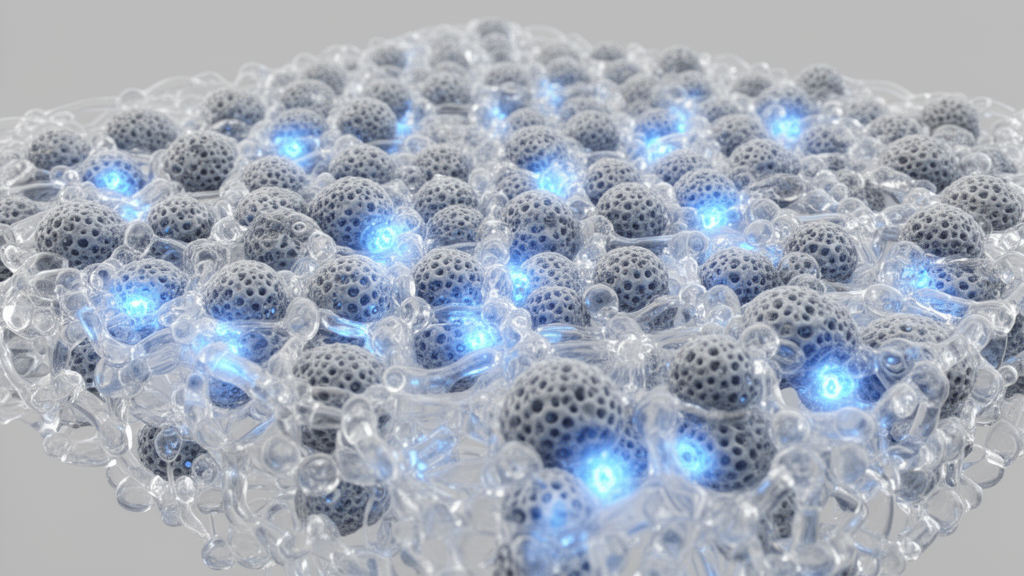
This in situ growth methodology establishes continuous contact between the polymer chains and the growing porous framework, preventing the sedimentation and severe agglomeration common to physical blending. Using this approach, the team successfully loaded between 50 and 75 volume percent of covalent organic frameworks into a benchmark polyimide, 6FDA-DAM, known for its high intrinsic selectivity but comparatively moderate permeability. Scanning electron microscopy and atomic force microscopy revealed that the single-crystal fillers dispersed uniformly throughout the matrix, forming a fully percolated, interconnected network across the entire thickness of the membrane once filler content surpassed 50 volume percent.
The study revealed unexpected behavior regarding polymer-filler interfacial thermodynamics. Conventional membrane fabrication paradigms generally assume that maximizing chemical interaction strength between polymer chains and filler surfaces produces optimal interfacial adhesion, minimizing defect formation. In contrast, the researchers demonstrated that excessively strong interactions restrict free volume, diminish gas transport, and promote filler sedimentation. Conversely, excessively weak interactions fail to couple the phases, creating non-selective interfacial voids that boost gas permeability while diminishing gas selectivity.
To evaluate this interaction spectrum systematically, the researchers synthesized a series of four structurally analogous covalent organic frameworks modified with distinct chemical functionalities: COF-H, COF-CH3, COF-F, and COF-OH. Molecular simulations alongside experimental characterization showed that strongly interacting COF-OH underwent substantial aggregation and sedimentation due to excessive affinity with the polymer matrix. Meanwhile, COF-H exhibited insufficient interfacial adhesion, generating voids. In contrast, the methyl-functionalized framework, COF-CH3, established an intermediate, weaker inlaying interaction regime that preserved unhindered access to the internal pore channels while maintaining compatibility with the 6FDA-DAM polyimide.
This intermediate interfacial balance transformed the transport mechanism of the resulting composite membranes. In conventional mixed-matrix architectures, gas transport remains dominated by diffusion through the polymer phase, but the interconnected framework networks achieved with COF-CH3 enabled the porous crystalline channels to govern overall molecular transport. Whereas neat 6FDA-DAM displays a baseline carbon dioxide permeability of roughly 1,000 Barrer, membranes incorporating 50 volume percent COF-CH3 achieved carbon dioxide permeabilities approaching 23,000 Barrer while sustaining a carbon dioxide over nitrogen selectivity near 30.
Across the complete series of synthesized membranes accommodating between 50 and 75 volume percent filler, the researchers recorded a maximum carbon dioxide permeability of 74,800 Barrer, approaching the highest values reported for polymer-based membranes, while maintaining a selectivity near 30. This combination of properties moves past the empirical inverse relationship historically defined by the Robeson upper bound. The observations also revealed that the highest separation performance did not align strictly with the highest filler loading, demonstrating that performance is dictated by an optimization of network connectivity, accessibility, and interfacial compatibility rather than filler volume alone.
Notwithstanding these laboratory metrics, the researchers and independent commentators highlight key technical constraints that must be resolved before this methodology can be deployed in practical gas separation systems. Physical aging phenomena characteristic of glassy polyimide matrices could alter separation performance over extended operational periods, and long-term membrane stability under realistic conditions involving humid gas streams, mixed-gas feeds, and plasticizing contaminants remains unverified. Furthermore, transitioning in situ single-crystal framework growth from controlled laboratory environments to large-scale, defect-free industrial roll-to-roll manufacturing represents an unproven engineering step.
Future module-scale testing and extended mixed-gas aging evaluations will determine whether interfacial interaction tuning becomes a universal design standard for mixed-matrix separation membranes or remains specific to the demonstrated model system.
Subject of Research: Interfacial engineering of covalent organic framework mixed-matrix membranes for carbon dioxide separation
Article Title: Improving compatibility in mixed-matrix membranes
Article References: Carta, M. (2026). Improving compatibility in mixed-matrix membranes. Nature Energy. https://doi.org/10.1038/s41560-026-02174-8
Image Credits: AI Generated
DOI: 10.1038/s41560-026-02174-8
Keywords: mixed-matrix membranes, carbon capture, covalent organic frameworks, polymer membranes, interfacial engineering, gas separation, carbon dioxide permeability, CO2 N2 selectivity, 6FDA-DAM, in situ growth, single-crystal COFs, membrane technology, Robeson upper bound, polyimide matrices, percolated networks, separation performance
News Source: Neil Sanderson. (November 20, 2026). Tailored Polymer Interfaces Enable High Filler Loadings for Carbon Capture. Scienmag.