• HOME
  • NEWS
  • EXPLORE
    • CAREER
      • Companies
      • Jobs
    • EVENTS
    • iGEM
      • News
      • Team
    • PHOTOS
    • VIDEO
    • WIKI
  • BLOG
  • COMMUNITY
    • FACEBOOK
    • INSTAGRAM
    • TWITTER
Friday, July 3, 2026
BIOENGINEER.ORG
No Result
View All Result
  • Login
  • HOME
  • NEWS
  • EXPLORE
    • CAREER
      • Companies
      • Jobs
        • Lecturer
        • PhD Studentship
        • Postdoc
        • Research Assistant
    • EVENTS
    • iGEM
      • News
      • Team
    • PHOTOS
    • VIDEO
    • WIKI
  • BLOG
  • COMMUNITY
    • FACEBOOK
    • INSTAGRAM
    • TWITTER
  • HOME
  • NEWS
  • EXPLORE
    • CAREER
      • Companies
      • Jobs
        • Lecturer
        • PhD Studentship
        • Postdoc
        • Research Assistant
    • EVENTS
    • iGEM
      • News
      • Team
    • PHOTOS
    • VIDEO
    • WIKI
  • BLOG
  • COMMUNITY
    • FACEBOOK
    • INSTAGRAM
    • TWITTER
No Result
View All Result
Bioengineer.org
No Result
View All Result
Home NEWS Science News Chemistry

Tailored hardening of ZrCuAl bulk metallic glass induced by 2D gradient rejuvenation

Bioengineer by Bioengineer
August 26, 2020
in Chemistry
Reading Time: 2 mins read
0
IMAGE
Share on FacebookShare on TwitterShare on LinkedinShare on RedditShare on Telegram

IMAGE

Credit: Tohoku University

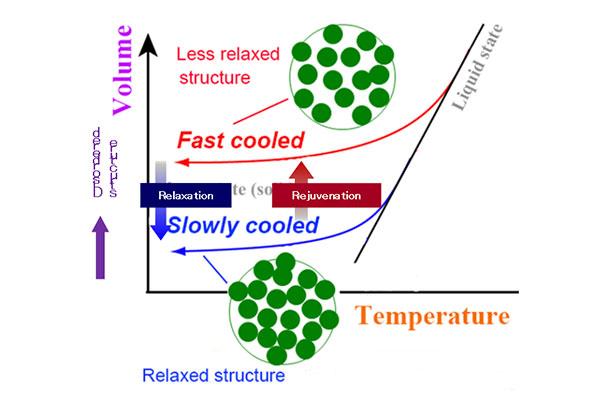
A team at Tohoku University have perfected a new heat treatment technique with rapid heating and asymmetrical cooling processes in metallic glass. This technique enabled the team to induce a gradient of local glassy structure, bringing an apparent work hardening behavior.

Work hardening is the process by which a material is strengthened via plastic deformation and is not generally observed in metallic glasses due to their intrinsic random structure.

Although bulk metallic glasses (BMGs) have attracted much attention owing to their high strength, wide elastic limit and excellent thermoplasticity, a major disadvantage in terms of their mechanical properties has been a lack of ductility due to an intrinsic work softening at room temperature.

Dr Wookha Ryu, Assistant Professor Rui Yamada and Professor Junji Saida of the Frontier Research Institute for Interdisciplinary Sciences (FRIS) have now successfully produced unique Zr60Cu30Al10 bulk metallic glass with a 2D gradient rejuvenation state, which leads to an excellent ductility and tailored hardening of a monolithic BMG at room temperature.

“We have developed a novel structure controlling technique with asymmetric cryogenic heat treatment and produced a unique glassy structure with the 2D gradient rejuvenation state. The BMG exhibits a tailored hardening behavior throughout the overall plastic deformation stage as well as an excellent ductility at room temperature,” said Professor Saida.

The local free volume concentration related to the rejuvenation state controls the shear band angle and the maximum effective shear stress. Hence, shear band propagation is prohibited and the formation of a complete shear plane transecting the whole specimen is blocked. The generation of plastic strain is accompanied by an increase in the critical shear stress, which results in a sustainable apparent hardening.

The team investigated a tailored hardening mechanism and established an experimental link between the gradient of the rejuvenation state and mechanical properties in Zr-based metallic glass.

###

The work was published online in NPG Asia Materials on 31 July 2020.

Media Contact
Junji Saida
[email protected]

Original Source

https://www.tohoku.ac.jp/en/press/tailored_hardening_zrcual.html

Related Journal Article

http://dx.doi.org/10.1038/s41427-020-0233-8

Tags: Chemistry/Physics/Materials Sciences
Share12Tweet8Share2ShareShareShare2

Related Posts

Graz University of Technology Deciphers the Structural Secrets of MOF Thin Films — Chemistry

Graz University of Technology Deciphers the Structural Secrets of MOF Thin Films

July 2, 2026
Breaking Thermodynamic Limits: Wavelength-Driven Catalysis Advances Ammonia Synthesis — Chemistry

Breaking Thermodynamic Limits: Wavelength-Driven Catalysis Advances Ammonia Synthesis

July 2, 2026

From Quantum Mechanics to AI-Powered Materials Discovery: MARVEL Marks 12 Years of Transforming Computational Science

July 2, 2026

Djire Recognized with National Award for Outstanding Contributions in Research and Teaching

July 2, 2026
Please login to join discussion

POPULAR NEWS

  • Detection of EDCs in Breast Milk and Infant Urine Up to Six Months Highlights Early Exposure Risks

    77 shares
    Share 31 Tweet 19
  • Saying Goodbye to PGY-6: Pediatric Fellowship Realities

    103 shares
    Share 41 Tweet 26
  • New Drug Candidate Developed at McMaster Shows Potential for Treating Brain Cancer

    58 shares
    Share 23 Tweet 15
  • KTU Researchers Explore Ultrasound’s Role in Enhancing Blood Flow Beyond Diagnostics

    53 shares
    Share 21 Tweet 13

About

BIOENGINEER.ORG

We bring you the latest biotechnology news from best research centers and universities around the world. Check our website.

Follow us

Recent News

Steatosis Drives Liver Metastasis Diversity in CRC

Unlocking the Mysteries of Alzheimer’s Disease

Pensoft Introduces New Peer-Reviewed Journal of Regeneration to Advance Restorative Biology Across Species

Subscribe to Blog via Email

Enter your email address to subscribe to this blog and receive notifications of new posts by email.

Join 83 other subscribers
  • Contact Us

Bioengineer.org © Copyright 2023 All Rights Reserved.

Welcome Back!

Login to your account below

Forgotten Password?

Retrieve your password

Please enter your username or email address to reset your password.

Log In
No Result
View All Result
  • Homepages
    • Home Page 1
    • Home Page 2
  • News
  • National
  • Business
  • Health
  • Lifestyle
  • Science

Bioengineer.org © Copyright 2023 All Rights Reserved.