


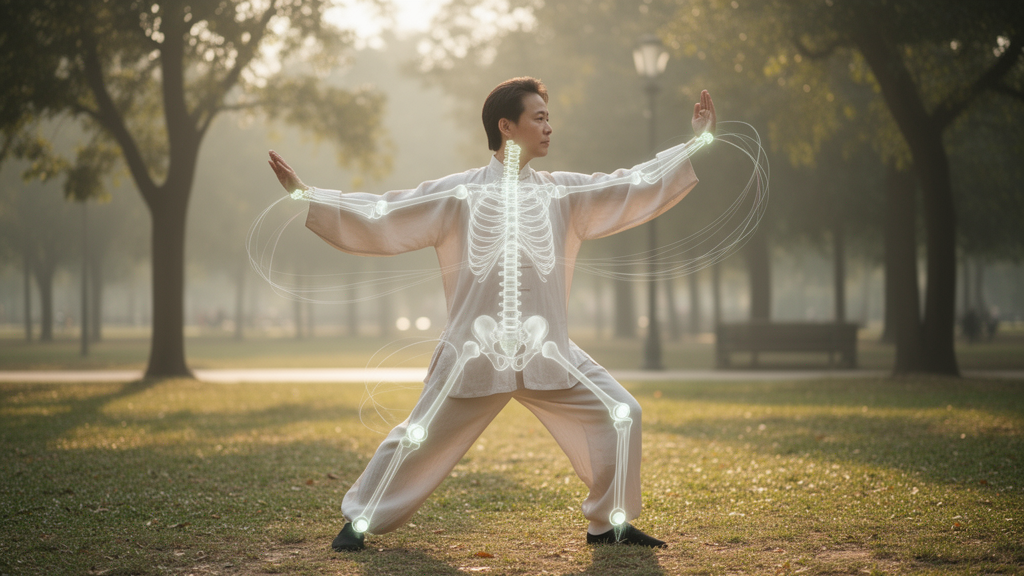
Recognizing Tai Chi movements from skeletal motion data is challenging. The Chinese martial art involves continuous transitions between postures, subtle differences between classes that can look nearly identical, and coordinated whole-body motion in which every limb contributes to the meaning of a movement. A new open-access study in Complex & Intelligent Systems, published on 29 October 2026, tackles this challenge with a skeleton-based framework called TaichiNet, which integrates local spatio-temporal modeling with global temporal dependency learning in a single architecture.
The framework’s core building block is a Time-Space Graph Unit, or TS-GU, described by the authors as a residual recurrent graph block. Within this unit, graph convolution extracts frame-level spatial dependencies across the body’s joints, capturing how the skeleton is structured at each moment. The resulting node features are then reweighted through a feature-sensor attention mechanism, allowing the model to emphasize the joints that matter most for distinguishing a given movement.
The distinguishing design choice, according to the paper, is that TaichiNet explicitly forms a graph-conditioned, node-wise recurrent state across adjacent frames before the sequence ever reaches the Transformer. In other words, local motion information is carried forward from one frame to the next at the node level, so each joint retains a running memory of how it has been moving before global processing begins.
Only after this local recurrent stage does the TS-GU output sequence enter a Transformer encoder, which captures dependencies over the whole movement segment. This local-before-global interface is the architectural idea the authors set out to test: can a model that first builds per-joint temporal states through graph convolutions, then hands those states to a global attention mechanism, better resolve the fine-grained distinctions that make Tai Chi recognition difficult?
To answer that question, the researchers evaluated TaichiNet extensively on UMONS-TAICHI, a benchmark dedicated to Taijiquan movements. The evaluation covered both random-split settings, where data from the same participants can appear in training and test sets, and participant-disjoint settings, where the model must generalize to people it has never seen. Across the reported classification criteria, TaichiNet consistently outperformed the comparison methods in both settings.
The team also examined whether the underlying design generalizes beyond martial arts. They adapted a segment-level evaluation on NTU RGB+D 120, a larger and more diverse action recognition benchmark, to test whether the recurrent local-state-before-global-attention interface remains effective on broader action data.
Beyond headline accuracy numbers, the evaluation package includes controlled architectural comparisons, component ablations, motion-pattern analysis, and reproducibility checks. The reproducibility checks are intended to let other researchers verify and build on the reported results.
The work is an Original Article published open access, and the version shared early is citable and carries a permanent DOI, though it remains subject to further edits before the final Version of Record replaces it.
Subject of Research: A skeleton-based deep learning framework for recognizing Tai Chi movements from motion capture data.
Article Title: A Tai Chi movement recognition framework integrating local–global temporal dynamics and spatial structure features
Article References: Guo, Z., Liu, D., Guo, Z., Zhu, B., Nie, L., Shao, X., Dong, Y., & Wu, J. (2026). A Tai Chi movement recognition framework integrating local–global temporal dynamics and spatial structure features. Complex & Intelligent Systems. https://doi.org/10.1007/s40747-026-02513-y
Image Credits: AI Generated
DOI: 10.1007/s40747-026-02513-y
Keywords: Tai Chi, skeleton-based action recognition, graph convolution, Transformer, TaichiNet, UMONS-TAICHI, NTU RGB+D 120, spatio-temporal modeling, deep learning, computer vision, movement, recognition
News Source: Blake Davidson. (October 29, 2026). TaichiNet reads whole-body Tai Chi motion from skeletons to sort subtle moves. Scienmag.



