Researchers from Hokkaido University, Ebetsu City Hospital, and DENSEI COMTEC Inc. have engineered an unsupervised generative framework overcoming data scarcity in automated respiratory sound analysis. By pairing a rectangular StyleGAN2 model with an asymmetric variational autoencoder pretrained on 100,000 unlabeled synthetic Mel-spectrograms, the pipeline enables robust acoustic anomaly detection on minimal clinical datasets. When transferred to patient recordings from a prototype wearable sensor, the lightweight classifier rivals the diagnostic precision of massive audio networks while using just 0.5 percent of their convolutional parameter footprint. This pre-training methodology avoids training classifiers on synthetic disease labels, eliminating the risk that models learn generative artifacts rather than true lung pathologies. The results demonstrate that scaling domain-specific synthetic pre-training provides a scalable pathway for medical domains constrained by critically scarce clinical annotations.
Automated auscultation using wearable sensors offers an objective foundation for standardized, operator-independent home monitoring of respiratory health. However, deep learning models frequently struggle to generalize because diverse abnormal lung sounds are logistically and ethically difficult to collect from patients. While generative adversarial networks can synthesize artificial training examples, supervised models trained directly on synthetic labels tend to memorize generator-specific patterns instead of authentic pathological features. To overcome these obstacles, the research team designed a three-phase pipeline decoupling data generation from disease classification. Public audio from the ICBHI 2017 repository, comprising 5.5 hours of recordings from 126 participants, provided the foundational training distribution. From this data, researchers extracted balanced subsets to train a generative model producing vast numbers of high-fidelity Mel-spectrograms without assigning artificial clinical labels.
Modern audio classifiers rely on Mel-spectrograms, transforming raw acoustic signals into two-dimensional time-frequency images mapped to human perceptual auditory sensitivity. Conventional generative architectures like StyleGAN2 are configured for square images because natural visual scenes exhibit isotropic spatial relationships. Respiratory Mel-spectrograms, however, represent frequency on the vertical axis and time on the horizontal axis, where fine crackles manifest as brief vertical impulses and wheezes register as continuous horizontal ridges. Forcing these asymmetric signals into square dimensions causes severe temporal resolution loss or structural distortion. The researchers modified StyleGAN2 to natively synthesize rectangular 64 by 512 Mel-spectrograms, preserving a constant one-to-eight aspect ratio across all resolution steps. This adaptation preserves millisecond-scale temporal resolution across 5.12-second audio clips sampled at 16,000 hertz across 64 Mel bins spanning 50 to 8000 hertz.
The rectangular StyleGAN2 architecture was optimized for 1500 kilo-images using R1 and path length regularizations to ensure stable convergence and prevent mode collapse. Standard generative evaluation metrics like Fréchet Inception Distance and Fréchet Audio Distance assume that underlying features follow a multivariate Gaussian distribution, a condition routinely violated by complex acoustic textures. To establish rigorous domain-specific evaluation, the team adopted Kernel Audio Distance calculated through feature representations from the CNN14 backbone of Pretrained Audio Neural Networks. Kernel Audio Distance applies maximum mean discrepancy to provide an unbiased, distribution-free metric with rapid sample convergence. Both distance metrics converged synchronously throughout training, and evaluation by a respiratory specialist confirmed that synthesized spectrograms faithfully captured authentic low-frequency energy peaks and fine crackle patterns without evidence of generative failure.
Following optimization, the generator produced an unlabeled corpus of 100,000 synthetic Mel-spectrograms. To eliminate data leakage between training and validation splits without subjective filtering, researchers partitioned the generator’s latent space using an orthogonal hyperplane derived from an average reference vector. This synthetic corpus was utilized for unsupervised pre-training of a variational autoencoder incorporating a novel parallel asymmetric convolutional block. Standard square kernels entangle independent time and frequency properties. In contrast, the proposed parallel block branches feature maps into dual paths: a frequency branch using vertical five-by-three rectangular kernels and a temporal branch using horizontal three-by-five kernels. After independently capturing orthogonal directional semantics, the extracted feature streams recombine through channel-wise concatenation and a one-by-one convolution, allowing the network to isolate temporal transients and continuous harmonic tones.
The variational autoencoder compresses input spectrograms into a 512-dimensional probabilistic latent space governed by mean and logarithmic variance vectors. To ensure the encoder retains crisp acoustic textures rather than blurred approximations, the objective function jointly optimizes mean squared error and structural similarity index measure loss. Dynamic range variations in decibel-scale spectrograms were controlled by internally normalizing target and reconstructed images between zero and one during the forward pass. To prevent posterior collapse—where the decoder ignores latent representations early in training—the authors applied cyclical annealing to the Kullback-Leibler divergence term across epochs 25 to 80. By periodically restarting and raising regularization weight from zero to one, the network established a smooth Gaussian latent distribution with latent mean near zero, variance near one, and divergence of approximately 0.08 per dimension.
In the pipeline’s third phase, the pretrained encoder was repurposed as a frozen feature extractor for clinical anomaly classification. Because clinical datasets are small, freezing encoder weights prevents destructive overfitting on limited patient samples. The decoder and variance projection branches were discarded, retaining solely the 512-dimensional mean representation. This vector was routed into an attached lightweight classification head built around a gated linear unit. The classification head projects latent vectors through two parallel linear transformations: one producing the primary feature representation and the other functioning as a sigmoid-activated gate dynamically weighting features by clinical relevance. The resulting gated representation passes into a final two-class softmax layer, confining trainable parameters entirely to the compact head while keeping the underlying acoustic representation completely fixed.
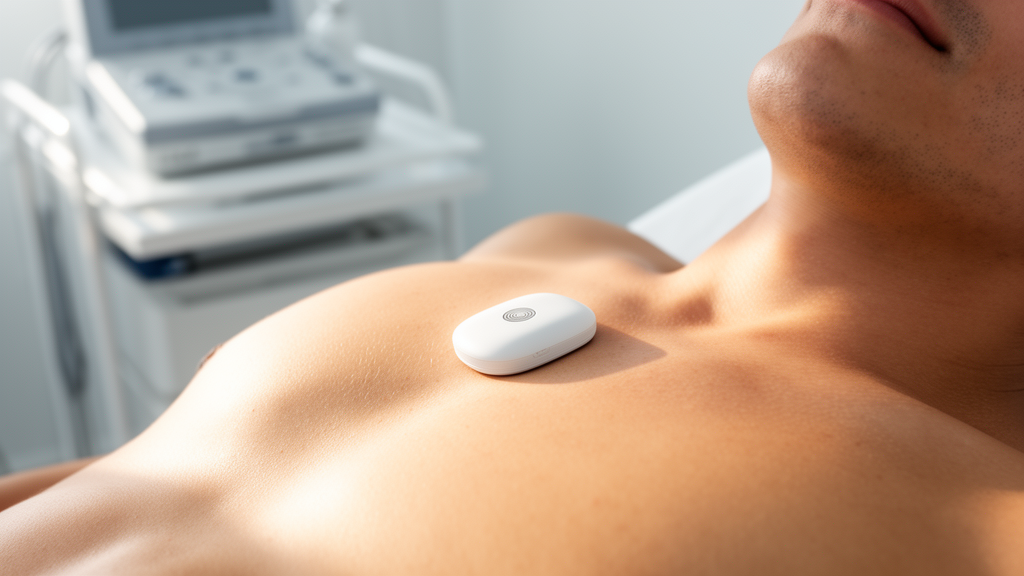
Clinical evaluation used audio captured at 16,000 hertz via the built-in microphone of a prototype wearable auscultation device developed by DENSEI COMTEC Inc., conducted under Hokkaido University Hospital ethical approval. The clinical dataset comprised 56 healthy individuals providing 56.4 minutes of normal lung sounds and 10 patients with interstitial lung disease contributing 10.0 minutes of fine crackles. Audio preprocessing extracted 10,000 balanced training samples and 1000 validation samples using 5.12-second random crops. Participant-wise partitioning ensured recordings from any individual never appeared across both training and validation sets. Model evaluation was conducted across ten independent trials with distinct random seeds, calculating performance as the average over each trial’s final ten training epochs. Seed-paired Wilcoxon signed-rank tests assessed statistical significance for differences in area under the receiver operating characteristic curve and recall.
At the 100,000-image pre-training scale, the Serial five-by-three asymmetric architecture achieved the highest classification performance, recording an AUROC of 0.942 ± 0.030 and recall of 0.718 ± 0.139. The proposed Parallel dual-branch architecture attained a competitive AUROC of 0.929 ± 0.033 and recall of 0.684 ± 0.143, showing no statistically significant AUROC difference compared to the Serial Square baseline at 0.927 ± 0.035. Crucially, the compact Parallel model matched the discrimination of the massive CNN14 audio network, which achieved an AUROC of 0.937 ± 0.049 and recall of 0.710 ± 0.069. Empirical comparisons across 0, 100, 1000, 10,000, and 100,000 pre-training samples confirmed a performance frontier governed primarily by data volume. While a bottleneck in the 100-sample condition yielded misleadingly elevated mean metrics with extreme variance, genuine generalization scaled consistently from 10,000 to 100,000 images, where expanded data continuously refined diagnostic recall.
Probing frozen encoders with identical triplets of normal, fine crackle, and wheeze audio confirmed that directional kernels exhibit differential acoustic selectivity. The Serial three-by-five time-oriented kernel showed a statistically significant relative displacement bias toward wheezes compared to the frequency-oriented five-by-three kernel, which naturally aligned with the vertical spectral bursts of fine crackles. Furthermore, noise testing across seven additive white Gaussian noise levels ranging from clean audio to 1 decibel demonstrated that variational autoencoder pre-training significantly outperformed deterministic autoencoders in AUROC across all four architectures. Its dual-branch architecture allowed the temporal branch to contextualize frequency noise, surpassing even CNN14 by 0.24 to 0.28 AUROC at 10 decibels before heavy acoustic degradation elevated false-positive rates below that threshold.
A direct pooled comparison over forty paired observations demonstrated that pre-training on 10,000 synthetic Mel-spectrograms achieved significantly higher AUROC and recall than pre-training on 10,000 real ICBHI recordings, an advantage widening further at 100,000 synthetic images. Real-data pre-training exhibited severe seed-to-seed instability, including an isolated trial failure of 0.69 AUROC at seed 42 caused by single-setup recording constraints. Synthetic sampling avoided this vulnerability by exposing encoders to broader distributional support. Computational profiling on CPU hardware confirmed the Parallel architecture’s operational efficiency, requiring only 0.51 giga multiply-accumulate operations—a 20.2-fold reduction compared to CNN14’s 10.32 GMACs. The Parallel model achieved inference latency of 6.46 milliseconds, operating nearly nine times faster than CNN14’s 57.95 milliseconds while maintaining a memory footprint under 70 megabytes, making it highly suitable for real-time edge deployment on wearable monitors.
Despite these encouraging technical outcomes, the authors identified several methodological constraints requiring further investigation. The clinical evaluation served as a proof-of-concept pilot study restricted to binary classification between normal breathing and fine crackles, drawing from ten interstitial lung disease patients with only four available for validation. Expanding the framework to multi-class detection—incorporating wheezes, coarse crackles, and rhonchi across diverse clinical sites—represents an essential requirement for real-world medical deployment. Nevertheless, the study demonstrates a vital engineering principle: for medical artificial intelligence constrained by scarce clinical labels, scaling domain-specific unsupervised pre-training and enforcing regularized latent spaces should take precedence over raw model capacity. By uniting rectangular generative synthesis with asymmetric feature extraction, wearable medical devices can achieve robust diagnostic accuracy within tightly constrained computational budgets.
Subject of Research: Unsupervised synthetic pre-training for wearable respiratory acoustic classification
Article Title: Domain-specific unsupervised pre-training for robust respiratory sound classification
Article References: Hirasawa, T., Tamura, Y., Shimizu, K., Konno, S., & Yamamoto, M. (2026). Domain-specific unsupervised pre-training for robust respiratory sound classification. Artificial Life and Robotics. https://doi.org/10.1007/s10015-026-01151-4
Image Credits: AI Generated
DOI: 10.1007/s10015-026-01151-4
Keywords: respiratory sound classification, StyleGAN2, variational autoencoder, Mel-spectrograms, wearable auscultation, interstitial lung disease, fine crackles, kernel audio distance, PANNs CNN14, asymmetric convolutional kernels, unsupervised pre-training, transfer learning, gated linear unit, ICBHI 2017 dataset, noise robustness, structural similarity index, additive white Gaussian noise
News Source: Denise Maddox. (November 23, 2026). Synthetic Spectrogram Pre-Training Delivers Accurate Lung Sound Classification for Wearables. Scienmag.