In the realm of physics, synthetic dimensions (SDs) have emerged as one of the frontiers of active research, offering a pathway to explore phenomena in higher-dimensional spaces, beyond our conventional 3D geometrical space. The concept has garnered significant attention, especially in topological photonics, due to its potential to unlock rich physics inaccessible in traditional dimensions. Researchers have proposed various theoretical frameworks to study and implement SDs, aiming at harnessing phenomena like synthetic gauge fields, quantum Hall physics, discrete solitons, and topological phase transitions in four dimensions or higher. Those proposals could lead to new fundamental understandings in physics.
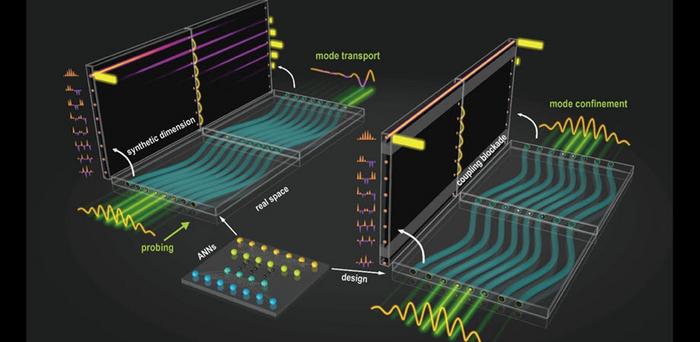
Credit: Xia, Lei, et al., doi 10.1117/1.AP.6.2.026005.
In the realm of physics, synthetic dimensions (SDs) have emerged as one of the frontiers of active research, offering a pathway to explore phenomena in higher-dimensional spaces, beyond our conventional 3D geometrical space. The concept has garnered significant attention, especially in topological photonics, due to its potential to unlock rich physics inaccessible in traditional dimensions. Researchers have proposed various theoretical frameworks to study and implement SDs, aiming at harnessing phenomena like synthetic gauge fields, quantum Hall physics, discrete solitons, and topological phase transitions in four dimensions or higher. Those proposals could lead to new fundamental understandings in physics.
One of the primary challenges in conventional 3D space is the experimental realization of complex lattice structures with specific couplings. SDs offer a solution, by providing a more accessible platform for creating intricate networks of resonators with anisotropic, long-range, or dissipative couplings. This capability has already led to groundbreaking demonstrations of non-Hermitian topological winding, parity-time symmetry, and other phenomena. A variety of parameters or degrees of freedom within a system, such as frequency modes, spatial modes, and orbital angular momenta, can be used to construct SDs, promising for applications in diverse fields ranging from optical communications to topological insulator lasers.
A key goal in this field is the construction of a “utopian” network of resonators where any pair of modes can be coupled in a controlled manner. Achieving this goal necessitates precise mode manipulation within photonic systems, offering avenues for enhancing data transmission, energy harvesting efficiency, and laser array radiance.
Now, as reported in Advanced Photonics, an international team of researchers has created customizable arrays of waveguides to establish synthetic modal dimensions. This advance allows for effective control of light in a photonic system, without the need for complicated extra features like nonlinearity or non-Hermiticity. Professor Zhigang Chen of Nankai University notes, “The ability to adjust different modes of light within the system brings us a step closer to achieving ‘utopian’ networks, where all parameters of an experiment are perfectly controllable.”
In their work, the researchers modulate perturbations (“wiggling frequencies”) for propagations that match the differences between different modes of light. To do so, they employ artificial neural networks (ANNs) to design waveguide arrays in real space. The ANNs are trained to create waveguide setups that have exactly the desired mode patterns. These tests help reveal how light propagates and gets confined within the arrays. Finally, the researchers demonstrate the use of ANNs to design a special type of photonic lattice structure called a Su-Schrieffer-Heeger (SSH) lattice. This lattice has a specific feature enabling topological control of light throughout the system. This allows them to change the bulk mode in which light travels, showcasing the unique properties of their synthetic dimensions.
The implication of this work is substantial. By fine-tuning waveguide distances and frequencies, the researchers aim to optimize the design and fabrication of integrated photonic devices. Professor Hrvoje Buljan of University of Zagreb remarks, “Beyond photonics, this work offers a glimpse into geometrically inaccessible physics. It holds promise for applications ranging from mode lasing to quantum optics and data transmission.” Both Chen and Buljan note that the interplay of topological photonics and synthetic dimension photonics empowered by ANNs opens new possibilities for discoveries that may lead to unprecedented materials and device applications.
For details, see the Gold Open Access article by Xia, Lei, et al., “Deep-learning-empowered synthetic dimension dynamics: morphing of light into topological modes,” Adv. Photon. 6(2), 026005 (2024), doi 10.1117/1.AP.6.2.026005.
Journal
Advanced Photonics
DOI
10.1117/1.AP.6.2.026005
Article Title
Deep-learning-empowered synthetic dimension dynamics: morphing of light into topological modes
Article Publication Date
18-Mar-2024