• HOME
  • NEWS
  • EXPLORE
    • CAREER
      • Companies
      • Jobs
    • EVENTS
    • iGEM
      • News
      • Team
    • PHOTOS
    • VIDEO
    • WIKI
  • BLOG
  • COMMUNITY
    • FACEBOOK
    • INSTAGRAM
    • TWITTER
Saturday, July 11, 2026
BIOENGINEER.ORG
No Result
View All Result
  • Login
  • HOME
  • NEWS
  • EXPLORE
    • CAREER
      • Companies
      • Jobs
        • Lecturer
        • PhD Studentship
        • Postdoc
        • Research Assistant
    • EVENTS
    • iGEM
      • News
      • Team
    • PHOTOS
    • VIDEO
    • WIKI
  • BLOG
  • COMMUNITY
    • FACEBOOK
    • INSTAGRAM
    • TWITTER
  • HOME
  • NEWS
  • EXPLORE
    • CAREER
      • Companies
      • Jobs
        • Lecturer
        • PhD Studentship
        • Postdoc
        • Research Assistant
    • EVENTS
    • iGEM
      • News
      • Team
    • PHOTOS
    • VIDEO
    • WIKI
  • BLOG
  • COMMUNITY
    • FACEBOOK
    • INSTAGRAM
    • TWITTER
No Result
View All Result
Bioengineer.org
No Result
View All Result
Home NEWS Science News Chemistry

Synthesizing a superatom: Opening doors to their use as substitutes for elemental atoms

Bioengineer by Bioengineer
February 25, 2020
in Chemistry
Reading Time: 2 mins read
0
IMAGE
Share on FacebookShare on TwitterShare on LinkedinShare on RedditShare on Telegram

IMAGE

Credit: Tokyo Tech

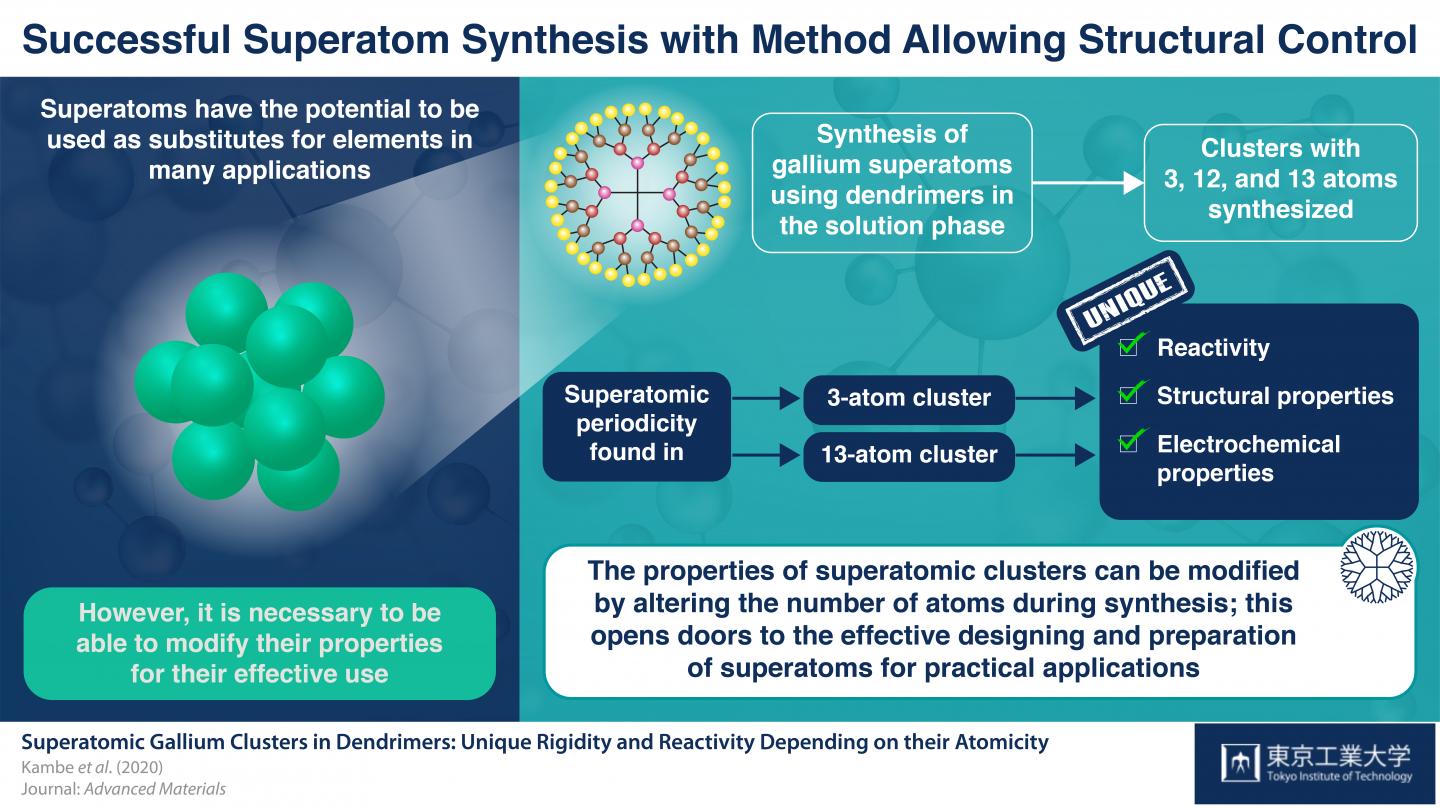
Superatom is a name given to a cluster of atoms that seem to exhibit properties similar to elemental atoms. Scientists have shown particular interest in superatomic structures, since they can be linked with atoms to produce molecules, and potentially be used to substitute certain elements in many applications.

But for superatoms to be effectively utilized, they must be specially tailored to resemble the characteristics of the corresponding elements. This transformation depends on the specific combination of electrons used. For example, when an aluminum atom with 3 valence electrons (outer shell electrons that can contribute to the formation of chemical bonds) is added to the superatom of aluminium-13, the properties change to those of a superatom of aluminium-14. Due to this modifiability of superatoms, investigating them and understanding them further is important. But previous research has been mainly theoretical, and largely focused on single clusters. Research has also not been able to synthesize superatomic clusters with sufficient volume and stability for practical application.

In a recent study, scientists from Tokyo Tech and ERATO Japan Science and Technology, led by Dr Tetsuya Kambe and Prof Kimihisa Yamamoto, fabricated clusters of the element gallium (Ga) in solution to demonstrate the effects of changing the number of atoms in a cluster on the properties of the cluster. The team synthesized Ga clusters of 3, 12, 13 and other numbers of atoms using a specialized superatom synthesizer. To characterize and analyze the structural differences among the synthesized clusters, transmission electron microscopic images were captured and calculations were performed using computation tools.

The mass spectrometry revealed that the 13- and 3-atom clusters had superatomic periodicity. The 13-atom cluster differed from the other clusters structurally and electrochemically. But the 3-atom cluster with hydrogen (Ga3H2) was reduced to Ga3H2- and was not detected, suggesting a low stability of this cluster when synthesized in the solution medium.

The ability to alter the clusters reinforces the concept that structural change can be induced in superatoms. Describing the implications of their findings, the scientists explain: “These series of results demonstrate that it is possible to change the valence electrons in superatomic clusters in solution by controlling the number of constituent atoms. This in turn enables the designing and preparation of superatoms.”

This study paves the way for future research to investigate the use of superatoms as substitutes for elements. As Dr Kambe, Prof Yamamoto and team reiterate, “the superatom reveals an attractive strategy for creating new building blocks through the use of cluster structures.”

###

Media Contact
Kazuhide Hasegawa
[email protected]
81-357-342-975

Original Source

https://www.titech.ac.jp/english/news/2020/046288.html

Related Journal Article

http://dx.doi.org/10.1002/adma.201907167

Tags: Atomic/Molecular/Particle PhysicsChemistry/Physics/Materials Sciences
Share12Tweet8Share2ShareShareShare2

Related Posts

Blue Light and Chemistry Simplify Complex Drug Production Steps

Blue Light and Chemistry Simplify Complex Drug Production Steps

July 10, 2026
New Discovery Promises Brighter, More Energy-Efficient Digital Displays

New Discovery Promises Brighter, More Energy-Efficient Digital Displays

July 10, 2026

New Crystalline 3D Frameworks Linked by Spiroborates Developed

July 10, 2026

IBEC Joins Major European Grant on Living Matter Physics

July 10, 2026
Please login to join discussion

POPULAR NEWS

  • Detection of EDCs in Breast Milk and Infant Urine Up to Six Months Highlights Early Exposure Risks

    77 shares
    Share 31 Tweet 19
  • New Drug Candidate Developed at McMaster Shows Potential for Treating Brain Cancer

    58 shares
    Share 23 Tweet 15
  • KTU Researchers Explore Ultrasound’s Role in Enhancing Blood Flow Beyond Diagnostics

    53 shares
    Share 21 Tweet 13
  • 高齢者の骨粗鬆症治療の持続性比較

    51 shares
    Share 20 Tweet 13

About

We bring you the latest biotechnology news from best research centers and universities around the world. Check our website.

Follow us

Recent News

Ultra-fine bubbles revolutionize future of inkjet printing technology

Polyunsaturated Fatty Acid Synthesis Influences Ferroptosis Sensitivity with Low Arachidonic Acid

Real-Time Pain and Activity Patterns in Older Adults with Chronic Pain

Subscribe to Blog via Email

Success! An email was just sent to confirm your subscription. Please find the email now and click 'Confirm' to start subscribing.

Join 84 other subscribers
  • Contact Us

Bioengineer.org © Copyright 2023 All Rights Reserved.

Welcome Back!

Login to your account below

Forgotten Password?

Retrieve your password

Please enter your username or email address to reset your password.

Log In
No Result
View All Result
  • Homepages
    • Home Page 1
    • Home Page 2
  • News
  • National
  • Business
  • Health
  • Lifestyle
  • Science

Bioengineer.org © Copyright 2023 All Rights Reserved.