1. An international research team, led by NIMS, including Institute for Molecular Science (IMS) and Aalto University in Finland, has succeeded in synthesizing a two-dimensional silicon-integrated covalent organic framework (COF) film on a metal surface. This nanostructure was obtained by linking molecules and silicon atoms using a novel on-surface chemical reaction. This synthesis technique may potentially be applicable to the development of new materials in a bottom-up manner.
Credit: Shigeki Kawai
National Institute for Materials Science
1. An international research team, led by NIMS, including Institute for Molecular Science (IMS) and Aalto University in Finland, has succeeded in synthesizing a two-dimensional silicon-integrated covalent organic framework (COF) film on a metal surface. This nanostructure was obtained by linking molecules and silicon atoms using a novel on-surface chemical reaction. This synthesis technique may potentially be applicable to the development of new materials in a bottom-up manner.
2. COF films with nanosized pores have a wide range of potential applications, from battery materials to catalysts and materials capable of separating small molecules. Imparting these capabilities to COF films requires the substitution of specific carbon atoms within molecular thin films with other chemical elements, such as nitrogen, boron and silicon. Silicon has some advantageous characteristics for these substitutions: it is the second most abundant chemical element by weight in Earth’s crust with a Clarke number of 25.8%, it is a group 14 element on the periodic table—as is carbon—and its chemical and physical properties are more similar to those of carbon than any other chemical element. Attempts to develop a method for substituting carbon with silicon in COF films had been unsuccessful, partly because silicon is an inorganic material and is therefore rarely used in the synthesis of organic materials, including COF films.
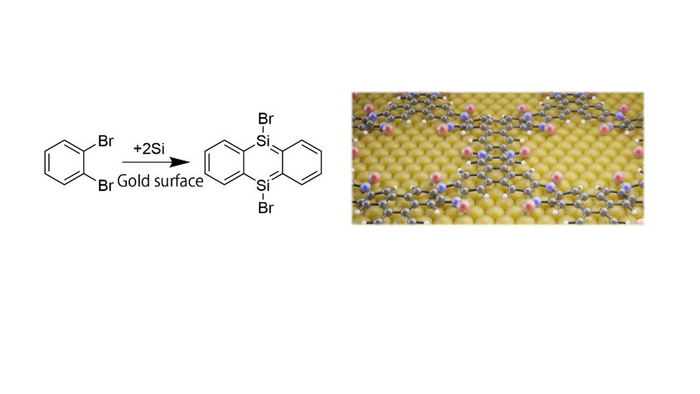
3. Major efforts have been made in recent years to develop on-surface synthesis techniques for forming carbon thin films and COF films on the surfaces of metallic solids by causing small organic molecules to undergo chemical reactions on these surfaces. This research team developed a new molecular synthesis technique for integrating silicon atoms into small organic molecules by allowing the molecules to react with the silicon deposited on the (111) surface of a gold substrate (figure (a)), rather than introducing them into the molecules using a conventional organic synthesis method. Using this technique, the team succeeded for the first time in synthesizing a silicon-integrated COF film (i.e., carbon nanofilm, figure (b)).
4. This technique may be used to synthesize various types of carbon thin films with different physical properties, including those containing heavier group 14 elements (i.e., germanium and tin). The team plans to further improve the on-surface synthesis technique so that it can be used to synthesize carbon nanofilms with characteristics suitable for the development of next-generation electronics.
***
5. This project was carried out by an international research team consisting of Shigeki Kawai (Leader of the Nanoprobe Group, Research Center for Advanced Measurement and Characterization, NIMS), Kewei Sun (JSPS Postdoctoral Research Fellow, International Center for Young Scientists, NIMS), Michio Matsumoto (Independent Scientist, International Center for Materials Nanoarchitectonics, NIMS), Satoshi Kera (Professor, Institute for Molecular Science, National Institutes of Natural Sciences) and Adam S. Foster (Professor, Department of Applied Physics, Aalto University, Finland).
6. This research was published in the online version of the November 7, 2022 issue of Nature Chemistry.
Journal
Nature Chemistry
DOI
10.1038/s41557-022-01071-3
Method of Research
Experimental study
Subject of Research
Not applicable
Article Title
On-surface synthesis of disilabenzene-bridged covalent organic frameworks
Article Publication Date
7-Nov-2022