Researchers report that aluminium oxide nanoparticles dispersed in HFE-7000 with Tween-80 raise the coefficient of performance of a domestic refrigerator by 18.4 percent at 0.1 percent nanoparticle loading.
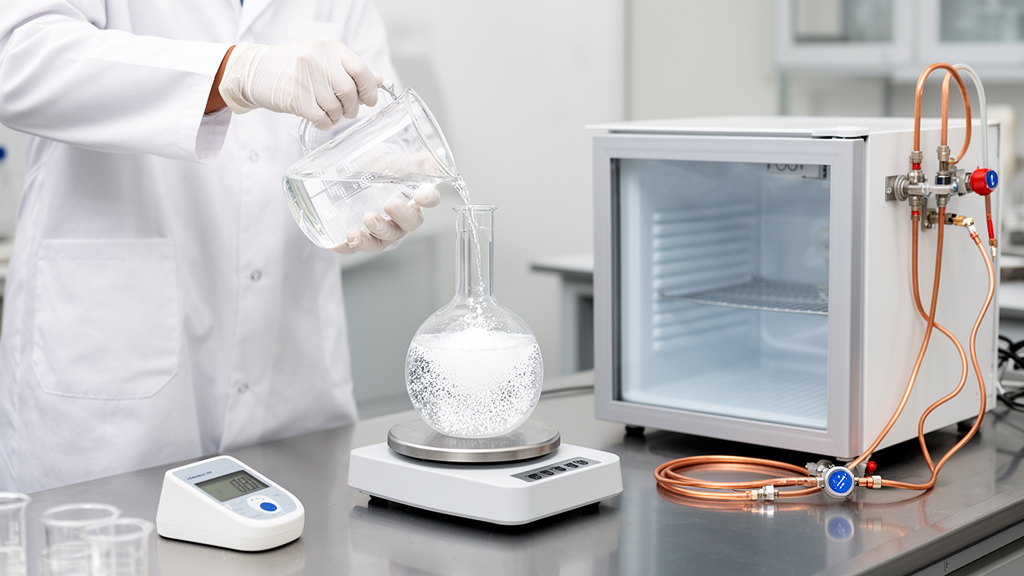
The team prepared the nanorefrigerant by first dispersing aluminium oxide nanoparticles in HFE-7000 through mechanical stirring and ultrasonication, then adding Tween-80 as a surfactant to stabilize the suspension. The two-step approach produced a nanorefrigerant that remained stable for 72 hours without visible sedimentation, a critical benchmark for practical refrigerant applications.
Testing followed American Society of Heating, Refrigerating and Air-Conditioning Engineers standards for refrigerator performance measurement, covering evaporator and condenser temperatures, compressor power consumption, and cooling capacity. The researchers varied nanoparticle loading from 0.01 to 0.1 percent by volume and measured performance across a range of operating conditions.
At 0.1 percent loading, the coefficient of performance rose by 18.4 percent compared with pure HFE-7000, while compressor energy consumption fell by 15.2 percent. Evaporator air temperature dropped by 6.8 percent, and cooling capacity increased by 12.4 percent, confirming that the nanoparticle suspension enhanced heat transfer on both the evaporator and condenser sides of the system.
The improvements stem from the higher thermal conductivity of the nanorefrigerant, which rose by 21.4 percent at 0.1 percent loading, and from changes in boiling behavior inside the evaporator. The nanoparticles promote nucleate boiling, increasing bubble frequency and improving the heat transfer coefficient during phase change.
Performance gains peaked at 0.1 percent loading and declined at higher concentrations. At 0.2 percent, the coefficient of performance fell below the peak as particle agglomeration increased fluid viscosity and raised pumping losses inside the compressor. The researchers identified this concentration as the optimal balance between heat transfer enhancement and flow resistance.
Tween-80 proved essential to the nanorefrigerant’s stability. Without the surfactant, nanoparticles settled within hours, degrading heat transfer performance. With it, the suspension remained uniformly dispersed, allowing the nanoparticles to circulate continuously through the refrigeration loop and maintain consistent performance across the test duration.
The study also examined compressor discharge temperature, which decreased by 4.2 percent with the nanorefrigerant, reducing thermal stress on the compressor and potentially extending its service life. Lower discharge temperatures also suggest reduced refrigerant decomposition risk inside the compressor.
The researchers conclude that aluminium oxide nanoparticles in HFE-7000 with Tween-80 offer a practical route to more energy-efficient domestic refrigeration, provided nanoparticle loading remains near the 0.1 percent optimum and surfactant stabilization is maintained throughout the system’s service life.
The nanoparticles at the heart of this study were produced through a citrate sol-gel route, a wet-chemistry technique favored for producing oxide powders with tight control over particle size and purity. Aluminium nitrate nonahydrate and citric acid, each at 0.6 molar concentration, were dissolved in distilled water and combined drop by drop while stirring at 80 degrees Celsius for eight hours. Raising the temperature to 200 degrees Celsius for three hours drove off the solvent and produced a fluffy polymeric citrate precursor, which was then ground and calcined in a muffle furnace at 800 degrees Celsius for three hours. The calcination step is what converts the organic-metallic precursor into the final crystalline oxide, and the furnace temperature strongly influences the resulting crystal structure and particle size.
Characterization confirmed the quality of the resulting powder. Powder X-ray diffraction verified high crystallinity, while field emission scanning electron microscopy and high-resolution transmission electron microscopy revealed a spherical morphology with an average particle diameter of roughly 22.5 nanometers. Energy-dispersive X-ray spectroscopy confirmed the elemental composition, and Brunauer-Emmett-Teller analysis measured a specific surface area of 26.2 square meters per gram with a mesoporous structure. That combination of small particle size and high surface area matters for refrigeration applications because heat transfer between the particles and the surrounding fluid scales with exposed surface, so finer particles with porous structures can exchange thermal energy more effectively per unit mass than coarser powders.
The choice of HFE-7000 as the base fluid reflects both safety and environmental considerations. Hydrofluoroethers of this class are odorless, non-flammable, and non-explosive, and they carry low global warming potential together with zero ozone depletion potential, positioning them as alternatives to conventional hydrofluorocarbon refrigerants that face tightening regulation. HFE-7000 also has a low boiling point and a low latent heat of phase change, which the researchers note reduces the heat input needed to induce boiling and limits heat losses in the test apparatus. These properties make the fluid well suited to bench-scale vapor compression rigs, though its thermodynamic characteristics differ from the refrigerants used in most commercial household units.
Dispersion stability is the central practical challenge for any nanorefrigerant. Nanoparticles suspended in a liquid experience strong van der Waals attractions that drive them to clump and settle, and refrigerant fluids, being notably low-polarity, offer little natural resistance to this agglomeration. The two-stage sonication protocol used here addresses the problem directly: an initial 60-minute ultrasonic bath breaks apart pre-existing agglomerates, and a second 30-minute sonication after Tween-80 addition distributes the surfactant evenly so it can coat the particle surfaces and provide steric stabilization. Surfactants of this type adsorb on oxide surfaces and create a protective barrier that keeps particles separated, which is why the treated suspensions resisted sedimentation over the observation period while untreated mixtures degraded quickly.
The concentration range explored in the work spans five formulations, and the behavior across that range illustrates a well-known trade-off in nanofluid engineering. At low loadings, added particles increase the effective thermal conductivity of the working fluid and provide additional nucleation sites for boiling, both of which improve heat exchange in the evaporator and condenser. As loading rises, however, particle-particle interactions increase the fluid’s viscosity, which raises the work the compressor must do to circulate the refrigerant and can promote agglomeration that negates the thermal benefits. The study identified an optimal window between 1.2 and 1.4 percent by weight, beyond which these penalties begin to outweigh the gains. The precise optimum in any given system depends on the balance between conductivity enhancement, boiling dynamics, and viscous losses, which vary with compressor design and operating temperatures.
The performance metrics reported in the study connect directly to the physics of the vapor compression cycle. An improved coefficient of performance means the system delivers more cooling per unit of electrical input, which translates into lower household energy consumption for the same refrigeration duty. Reduced discharge pressure and a lower compression ratio ease the mechanical load on the compressor, the component that typically dominates both the energy budget and the failure statistics of domestic refrigerators. Enhanced subcooling of the liquid refrigerant before it enters the expansion device increases the fraction of the evaporator length available for useful phase-change heat absorption, squeezing more cooling capacity from the same hardware.
Environmental context strengthens the case for this line of research. Domestic refrigerators run continuously, and their cumulative electricity demand is substantial on national grids, so even single-digit percentage efficiency improvements aggregate into meaningful energy and emissions savings when multiplied across hundreds of millions of appliances. Pairing a low-global-warming-potential base fluid with efficiency-boosting nanoparticles addresses both sides of the environmental ledger: the refrigerant itself contributes less to climate forcing if released, and the improved efficiency reduces the indirect emissions associated with electricity generation.
Several questions remain before such nanorefrigerants can move from laboratory rigs to commercial products. Long-term stability must be demonstrated over months and years of continuous circulation, not merely the hours observed in bench testing, since surfactants can degrade or desorb over time and particles can slowly deposit on heat exchanger surfaces or inside compressor components. The interaction between nanoparticles and compressor lubricants, the potential for particle abrasion of moving parts, and the manufacturability of consistently dosed nanorefrigerant charges all require further study. Cost considerations also matter, since the synthesis route described here is laboratory-scale and scaling citrate sol-gel production to industrial volumes would need its own economic analysis. Nevertheless, the demonstration that a carefully characterized, surfactant-stabilized alumina suspension can improve coefficient of performance while reducing compressor stress marks a concrete step toward refrigeration systems that cool more effectively while consuming less energy.
Subject of Research: Nanorefrigerant research
Article Title: Synthesis, characterization, and performance evaluation of Al2O3 nanoparticles in HFE7000 refrigerant for domestic refrigeration
Article References: Digra, M., & Singh, J. (2025). Synthesis, characterization, and performance evaluation of Al2O3 nanoparticles in HFE7000 refrigerant for domestic refrigeration. Frontiers in Thermal Engineering, 5, Article 1682295. https://doi.org/10.3389/fther.2025.1682295
Image Credits: AI Generated
DOI: 10.3389/fther.2025.1682295
Keywords: nanorefrigerant, HFE-7000, aluminium oxide nanoparticles, domestic refrigeration, coefficient of performance, Tween-80, thermal conductivity, energy efficiency, vapour compression system, nanofluid stability, sustainable cooling, heat transfer enhancement
News Source: Denise Maddox. (October 17, 2026). Synthesis, characterization, and performance evaluation of Al2O3 nanoparticles in HFE7000 refrigerant for domestic refrigeration. Scienmag.